Which pays back faster for your project—Buy, EPC or ESCO?
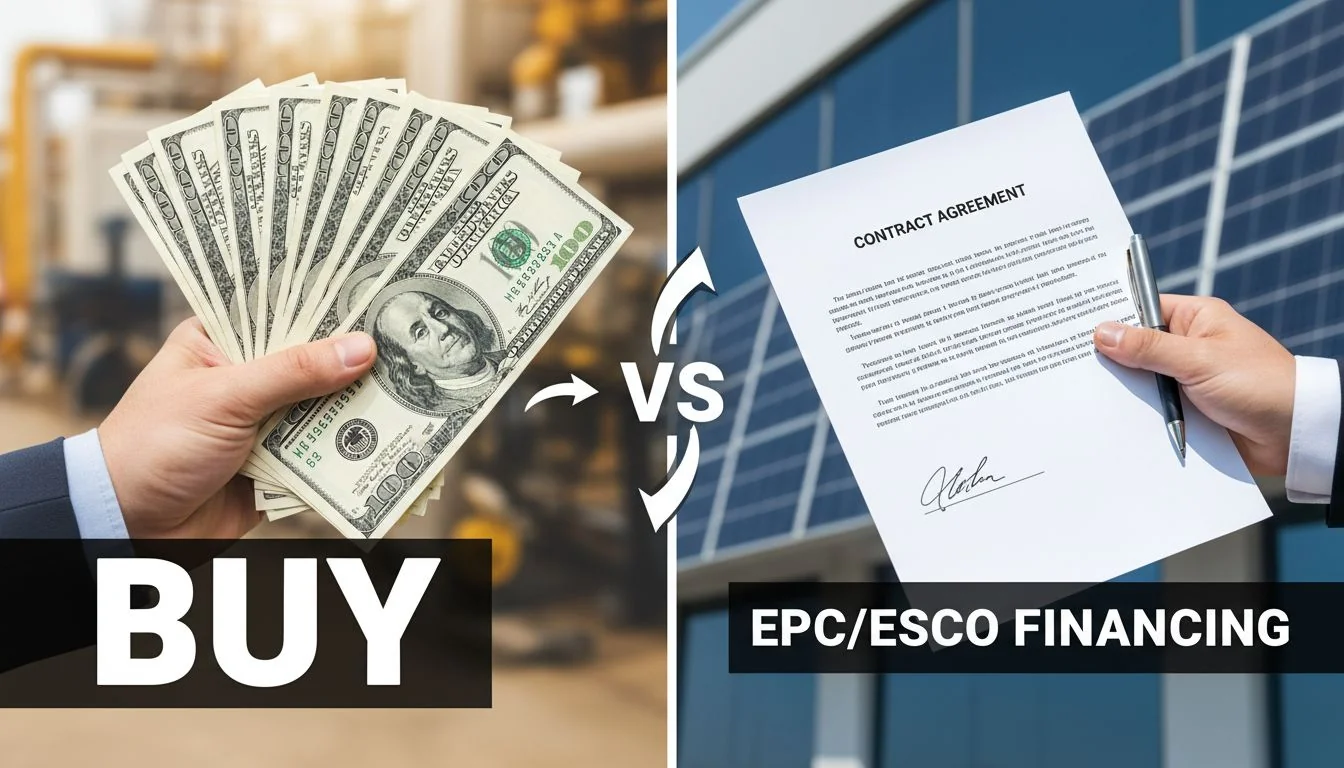
Choosing how to fund a major lighting upgrade is tough. You worry about high upfront costs and whether the promised savings will actually happen, leaving you with a bad investment.
It depends on your goals. An EPC/ESCO1 model often achieves positive cash flow faster because you have no upfront cost. A direct 'Buy' has a shorter nominal payback but requires a large initial investment, tying up your cash for years before you break even.
It’s not just about the simple payback number you see on a proposal. It’s about when your project stops costing you money and starts putting cash back into your budget. Over my 13 years in the LED lighting business, I've helped hundreds of clients like you navigate this choice. The best decision always comes from understanding how money flows in each scenario. Let's break down how each model works so you can see the real financial picture for your project.
An ESCO project always has a longer simple payback period than a direct purchase.False
Not always. While the total cost might be higher due to financing, the project can be cash-flow positive from day one, whereas a direct purchase starts with a large negative cash flow, making the 'real' payback longer in terms of cash availability.
Performance guarantees in EPC/ESCO contracts shift the risk of underperformance from the client to the service provider.True
This is the core value proposition of an ESCO. If the promised energy savings aren't realized, the ESCO is contractually obligated to cover the shortfall.
Buy vs EPC/ESCO: who pays, who guarantees, and when does cash turn positive?
You see three options: pay with your own cash, get a guaranteed project, or have someone else pay for it all. But it's easy to get confused about who is responsible for what.
The lines can get blurry. You could end up paying for underperforming equipment or facing unexpected maintenance costs that destroy your return on investment. Let's clarify who pays, who guarantees performance, and how that affects your cash flow from day one.
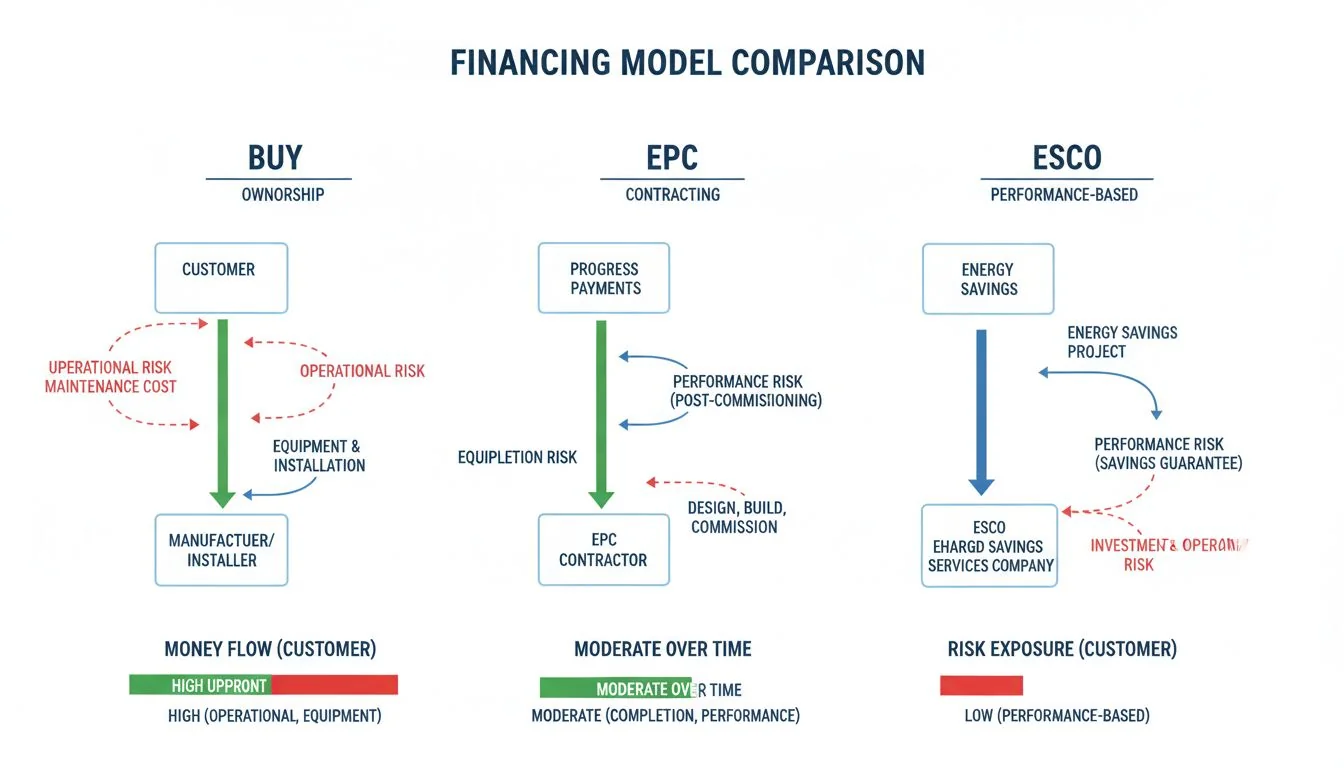
In a 'Buy' model, you pay for everything upfront and you own all the risk. With an Energy Performance Contract (EPC) or Energy Service Company (ESCO) model, the service company often finances the project and guarantees the energy savings2. This means your project can be cash-flow positive immediately, since the savings are designed to cover the financing payments.
Breaking Down the Models
The best way to understand the difference is to see it side-by-side. I always walk my clients through a simple table like this to make it clear.
| Feature | Direct Buy | EPC / ESCO |
|---|---|---|
| Who Pays Upfront? | You (100%) | The ESCO or a third-party financier. |
| Who Guarantees Savings? | The equipment manufacturer (warranty only). | The ESCO (guarantees performance). |
| Who Owns the Risk? | You. If savings are low, it's your problem. | The ESCO. They pay you if savings fall short. |
| initial cash flow3 | Large negative (full project cost). | Zero or positive. |
With a 'Buy', your cash flow starts deeply in the red. You might spend $1 million on a project, and it could take 3-5 years just to get back to zero. With an ESCO, they handle the investment. Your cash flow from day one is the savings minus their service fee. I've seen many projects where this is a positive number from the very first month. The performance guarantee is the most important part. It gives lenders confidence and protects you from risk.
LED streetlights can reduce energy consumption by up to 80%.True
Combined with smart controls like dimming and scheduling, energy savings of 50-80% are commonly achieved compared to legacy high-pressure sodium (HPS) or metal halide lamps.
The initial cost of the LED fixture is the most important factor for payback.False
While important, factors like energy rates, maintenance savings, and guaranteed performance through M&V often have a much larger impact on the total lifecycle cost and payback period.
What street-lighting numbers drive payback: savings, rates, term, and M&V?
You're planning a street lighting upgrade and need to build a business case. But which numbers actually matter for your payback calculation?
Focusing on the wrong things, like only the price per light, can lead to a project that looks good on paper but fails in the real world. I'll show you the four key drivers that determine your actual payback and how to use them to your advantage.
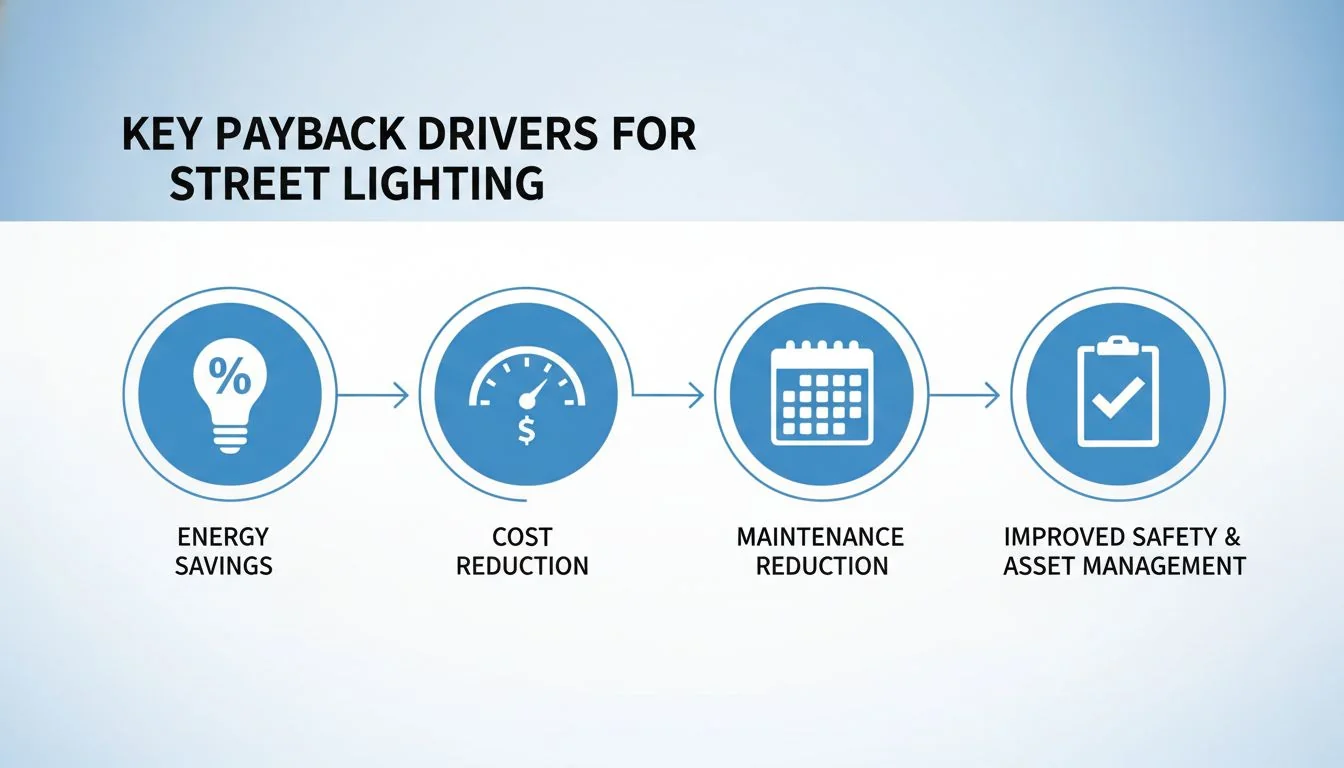
The fastest payback comes from maximizing energy savings (50-80% with LEDs), knowing your electricity rates, choosing the right contract term4 (often 7-10 years), and using rigorous Measurement & Verification (M&V) to prove the savings. These four factors are much more important than the initial hardware cost.
Energy & Maintenance Savings
This is the biggest driver. Modern LEDs, like the ones we make at Besenled, are highly efficient at 120-140 lumens per watt, easily cutting energy use by 50-60%. But the real gains come from bundling smart controls. A client of mine in South America added our DALI-controlled pole lights to their project. The dimming schedule alone added another 15% to their savings, which paid for the entire control system in under two years. You also save on maintenance because our lights have a 50,000-hour lifespan.
Electricity Rates
This is simple: the higher your electricity cost, the faster your payback. A project in a region with high rates will show a much quicker return than the exact same project in a low-cost area.
Contract Term
For an EPC/ESCO, the contract length is key. A longer term (e.g., 12 years) means lower annual payments, but you'll pay more in total financing costs. A shorter term (e.g., 7 years) has higher payments but a lower total cost. The sweet spot is usually 7-10 years, where the annual payments are comfortably covered by the guaranteed savings.
Measurement & Verification (M&V)
This is your insurance policy. M&V isn't just paperwork; it's the process an ESCO uses to prove the savings are real. Without rigorous M&V, a guarantee is meaningless. Insist on standardized protocols like the International Performance Measurement and Verification Protocol (IPMVP). This protects your project's financial outcome and is essential for securing financing.
Cash flow modeling is too complex for anyone but a financial analyst.False
Simple cash flow models can be built in a basic spreadsheet. Tools like the ENERGY STAR CFO Calculator are also designed for non-financial managers to easily compare project financing options.
A project's simple payback period is the same as its cash-flow breakeven point.True
Yes, these terms refer to the same thing: the point in time when the cumulative savings from a project equal the initial investment, and the cumulative cash flow crosses from negative to positive.
How can you use cash-flow modeling to compare scenarios?
You have quotes for a Buy, an EPC, and an ESCO. They all look different, and comparing them feels like comparing apples to oranges.
If you can't model the cash flow accurately, you might choose a deal that drains your budget, even if it has a low "sticker price." I'll show you a simple way to model the cash flow for each scenario, so you can see the real financial impact over time.

Use a simple spreadsheet or a free tool like ENERGY STAR’s Cash Flow Opportunity (CFO) Calculator. For the 'Buy' model, input the total project cost as a negative number in Year 0. For the 'EPC/ESCO' model, input the annual payments. Then, plot the cumulative cash flow year by year. The point where the line crosses from negative to positive is your true payback.
Step-by-Step Cash Flow Comparison
I once worked with a city manager who was fixated on a 5-year simple payback for a 'Buy' deal. When we modeled the cash flow, he saw his city would be $2 million in the red for four of those years. The ESCO option we presented kept them cash-flow positive from month one. He changed his mind immediately. Here’s how we did it:
-
Gather Your Inputs: You need three numbers: the total project cost (for the 'Buy' option), the annual service payments (for the EPC/ESCO option), and the estimated annual savings from energy and maintenance.
-
Model the 'Buy' Scenario: In your spreadsheet, Year 0 is a large negative number (e.g., -$1,000,000). For Year 1, the cumulative cash flow is
(-$1,000,000) + (Annual Savings). Each following year, you just add the annual savings to the previous year's total. -
Model the 'EPC/ESCO' Scenario: Here, Year 0 is $0. For Year 1, the cash flow is
(Annual Savings) - (Annual Payment). This number should be positive. You add this amount to your cumulative total each year.
When you plot these two cumulative cash flow lines on a graph, you will visually see which option gets you back to positive cash flow faster.
EPC/ESCO models are only for large, multi-million dollar projects.False
While common for large projects, aggregation allows smaller entities (like small towns or school districts) to bundle their projects together to achieve the scale needed to attract an ESCO and reduce transaction costs.
A direct 'Buy' is always cheaper in the long run.False
Not if you factor in risk. If a 'Buy' project underperforms or has unexpected maintenance costs, its total lifecycle cost can easily exceed that of a guaranteed EPC/ESCO project.
When does an EPC/ESCO beat Buy—and when does it not?
You understand the models, but you're still not sure which is right for your specific situation. Is your project better for one over the other?
Choosing the wrong model can mean missing out on a great project because you think you lack the capital, or overpaying for a simple one you could have handled yourself. Let's get straight to the point. Here is a clear guide on when to choose an EPC/ESCO model and when a direct Buy is better.
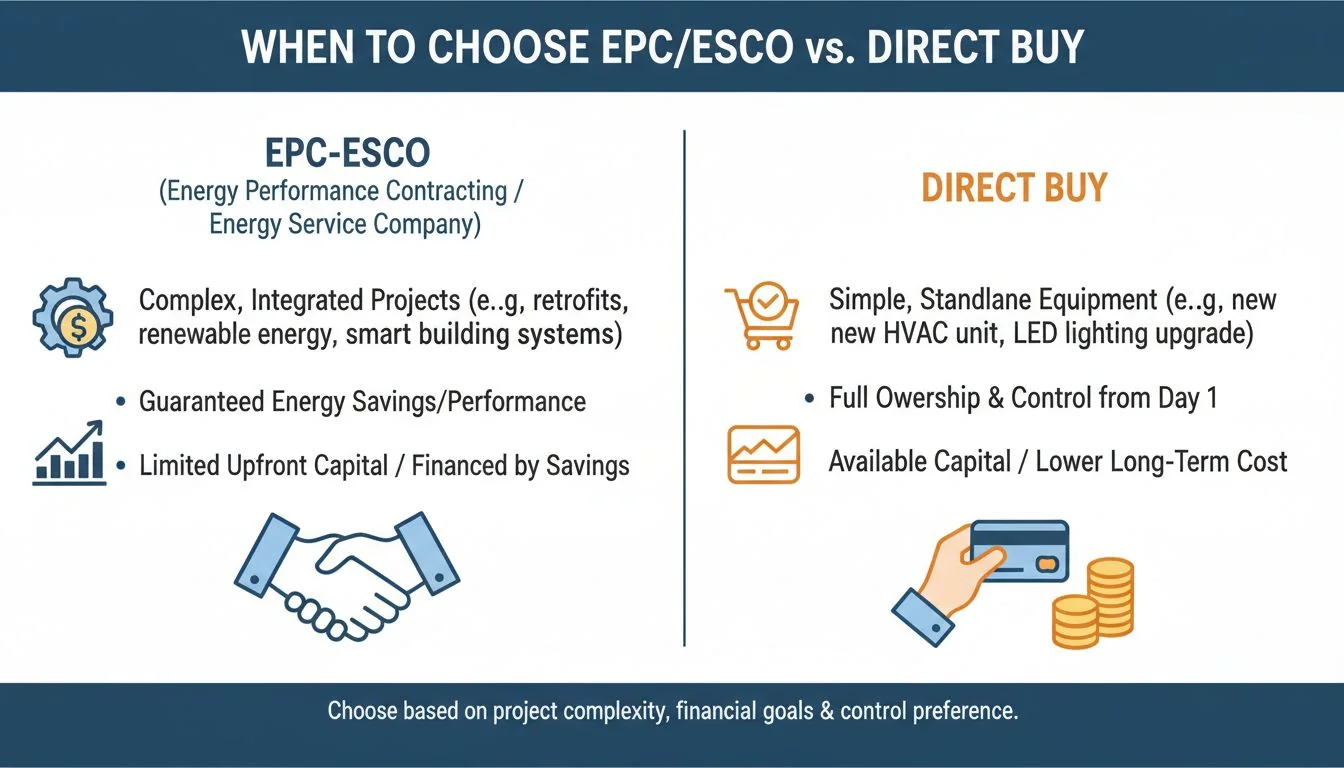
An EPC/ESCO model is better when you lack upfront capital, want to transfer performance risk, or have a complex project with bundled services like smart controls and ongoing maintenance. A direct 'Buy' is better when you have available cash, a simple project, and a strong in-house technical team to manage the risk.
Making the Right Choice for Your Situation
I use this simple checklist with my clients, like procurement directors and developers, to help them decide. It clarifies the decision based on their resources and risk tolerance.
| If Your Situation Is... | Then Your Best Choice Is... | Because... |
|---|---|---|
| Limited Upfront Capital | EPC/ESCO | It requires little to no initial cash outlay from you. |
| High Risk Aversion | EPC/ESCO | The performance guarantee transfers the risk of under-saving to the ESCO. |
| Complex Project | EPC/ESCO | It bundles expertise, smart controls, and long-term maintenance into one contract. |
| Sufficient Capital Available | Direct Buy | You can avoid financing costs and keep all the savings for yourself. |
| Strong In-house Technical Team | Direct Buy | Your team can manage the project, verify performance, and handle maintenance. |
| Small, Simple Project | Direct Buy | The transaction costs of setting up an EPC might be too high for a small project. |
For smaller cities or businesses, the legal and administrative costs of an EPC can seem too high. That's why I always recommend they look into aggregating their projects. By joining with other nearby towns or companies and using standardized contracts, they can create a larger project that attracts ESCOs and dramatically cuts down on those transaction costs. This makes the benefits of an EPC accessible to everyone.
A 15-year contract term is standard for LED lighting projects.False
While possible, 15 years is quite long for lighting technology that evolves quickly. A term of 7-10 years is more common as it aligns better with the primary warranty and technology cycle of the equipment.
Aggregating projects can reduce the transaction costs associated with an EPC.True
By sharing legal, administrative, and project development costs across multiple entities, aggregation makes the EPC model more accessible and cost-effective for smaller organizations.
Still have questions? Here are the answers.
You've learned a lot, but a few key questions might still be on your mind before you can make a decision.
Lingering doubts can stall a project indefinitely. You need clear, direct answers to move forward with confidence. I've gathered the most common questions I hear from clients and answered them for you right here.

The fastest payback depends on your cash flow needs; EPC/ESCO is often faster to positive cash flow. Expect 50-80% savings from LED street lighting. Calculate EPC cash flow by subtracting the annual payment from the guaranteed savings. Choose a contract length that keeps payments below savings. And yes, EPCs work for small cities, especially through aggregation.
Which pays back faster—Buy or EPC/ESCO?
It depends on how you define "payback." A direct Buy has a shorter nominal payback (Total Cost ÷ Annual Savings). But an EPC/ESCO often achieves positive cash flow faster because there's no large upfront cost. For organizations that need to preserve capital, an EPC/ESCO "pays back" from day one by not costing you anything.
What savings should I expect from LED street lighting?
You can confidently expect 50-60% energy savings just from replacing old lamps with high-efficiency LEDs (120-140 lm/W). If you add smart controls for dimming and remote monitoring, those savings can reach 80%. Don't forget maintenance savings from longer-lasting fixtures, which can be substantial.
How do I calculate cash flow for an EPC?
It's simple: Annual Cash Flow = Guaranteed Annual Savings - Annual EPC Payment. The ESCO must provide both of these numbers in their proposal. A well-structured EPC project should have a positive cash flow from the very first year.
What contract length should I choose?
The ideal length is a balance. A 7-10 year term is very common for LED lighting projects. This is long enough to keep annual payments low and comfortably below the savings, but not so long that you're locked into old technology. The goal is to align the financing term with the useful life and warranty of the equipment.
Do EPCs work for small cities?
Absolutely. The key is aggregation. A single small city might not have a large enough project to attract an ESCO on its own. But by joining with other nearby towns, school districts, or public agencies, they can create a larger, more attractive project portfolio. Using standardized legal documents also helps cut costs and makes the model feasible for them.
Conclusion
Choosing between Buy, EPC, and ESCO depends on your capital, risk tolerance, and project complexity. Model the cash flow to see the real winner for your organization's financial health.
References
-
Explore how EPC/ESCO models can provide funding solutions with lower upfront costs and guaranteed savings. ↩
-
Discover the potential energy savings from LED street lighting and how it impacts overall project costs. ↩
-
Learn about the cash flow implications of different funding models and their impact on project viability. ↩
-
Find out the best contract lengths for EPC/ESCO projects to balance payments and savings effectively. ↩