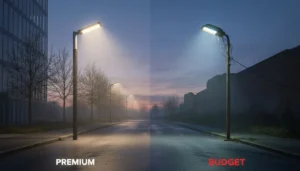
What Truly Separates Premium from Budget Street Lights?

Tired of street lights failing years before their promised lifespan? The constant replacement costs and safety risks are frustrating. It’s time to understand what really matters for long-term performance.
The key differences are not just cosmetic. They lie in three core areas: the quality of materials used, the effectiveness of the thermal design1, and the reliability of the internal driver. Premium fixtures use superior components in these areas to ensure a longer, more stable life.
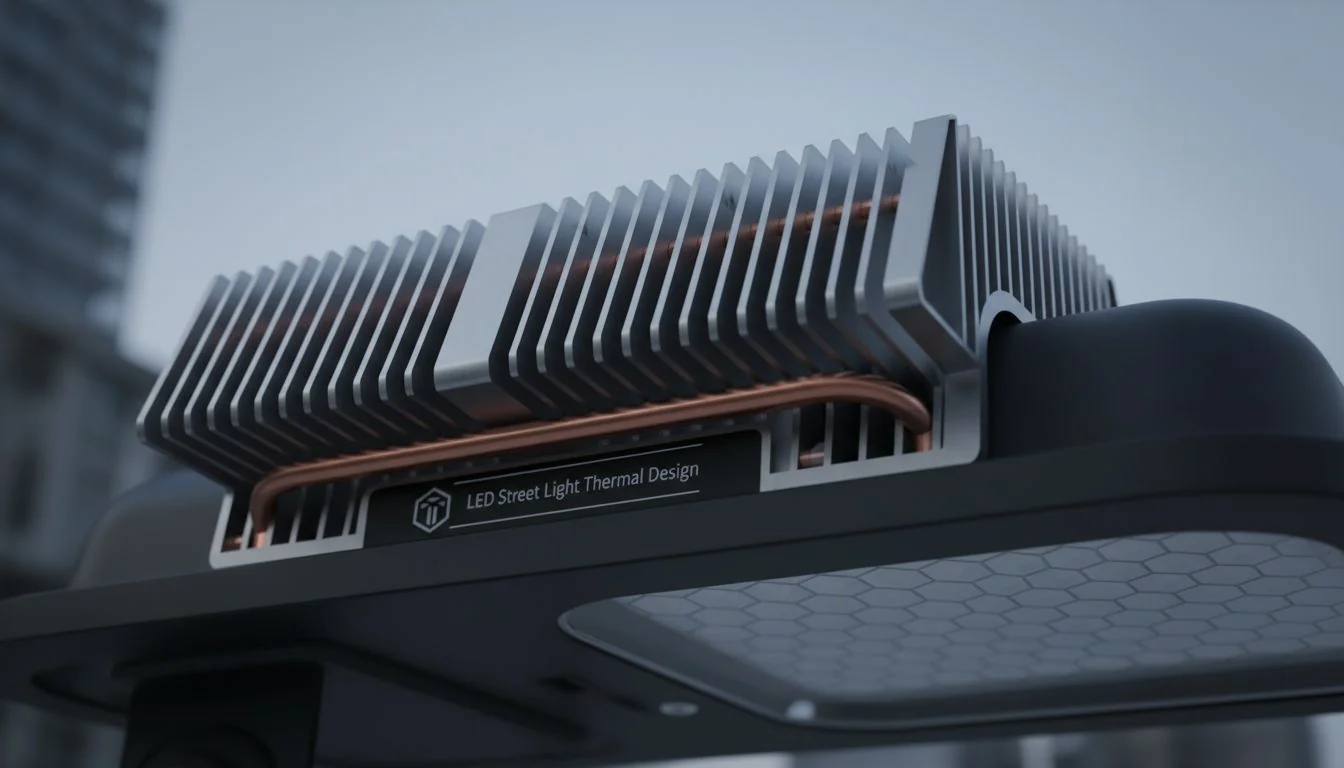
When you're sourcing for a large-scale project, whether it's a commercial parking lot in North America or a new highway in the Middle East, the spec sheet can be overwhelming. It's easy to get lost in lumens and watts. But after 13 years in this business, I've seen firsthand what makes a light last. It's not about the brightest promises, but about the robust engineering that you can't always see. Let's break down the technical details that translate into real-world reliability and a lower total cost of ownership2.
Most LED street lights fail due to the driver, not the LED chips themselves.True
The driver contains sensitive electronic components like capacitors that are highly susceptible to heat and electrical surges, making it the most common point of failure in an outdoor lighting system.
A budget street light can lose up to 30% of its brightness in the first 10,000 hours.True
This rapid lumen depreciation is often due to poor thermal management causing the LED junction temperature to exceed its optimal range, which accelerates the aging of the LED chips.
Choosing between two fixtures that look similar can be confusing. The price difference is obvious, but the reasons for it are hidden in the technical specifications. Let's make it simple.
The numbers tell the story. Premium fixtures use stronger, corrosion-resistant materials like ADC12 aluminum, have lower thermal resistance to dissipate heat effectively, and feature drivers with much higher surge protection3 (10kV+) and longer rated lifetimes (L70 > 100,000 hours). These metrics directly predict reliability.
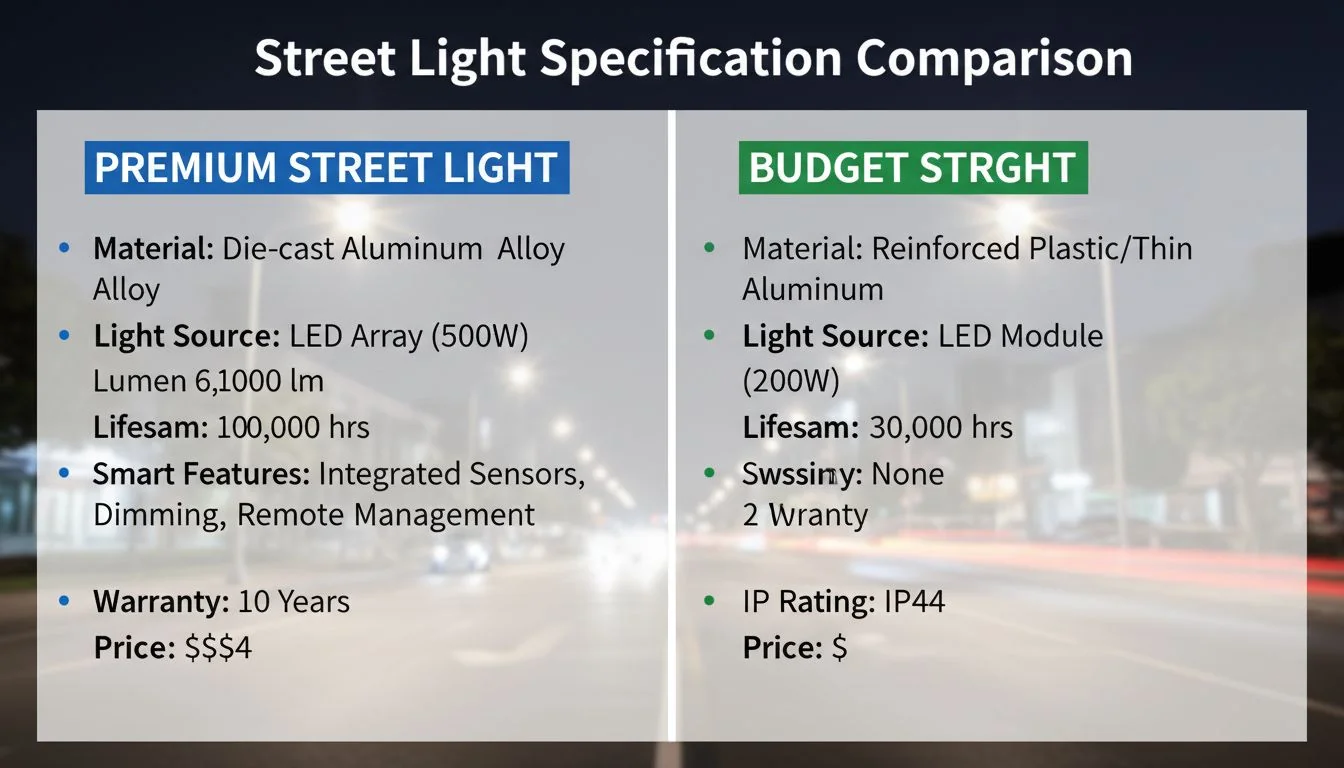
When I work with developers like Somchai in Thailand, we don't just talk about price. We talk about value over the project's lifetime. A light that costs 20% more but lasts twice as long and requires zero maintenance is the smarter investment. The proof is in the data. A cheap fixture might use standard aluminum and a basic driver, but a premium one is built for harsh reality. Let's look at a typical comparison.
Housing, Heat, and Power: A Clear Breakdown
The difference isn't just one thing; it's a combination of better choices in every critical component. A strong housing resists environmental stress, good thermal design protects the electronics, and a robust driver handles unstable power grids.
| Specification | Budget Fixture (Typical) | Premium Fixture (Besenled Standard) | Why It Matters |
|---|---|---|---|
| Housing Material | A360/A380 Aluminum | ADC12 Aluminum Alloy | ADC12 offers superior corrosion resistance4, crucial for coastal or industrial areas. |
| thermal resistance5 | > 1.5 °C/W | < 0.8 °C/W | Lower value means heat escapes faster, keeping LEDs and driver cool and extending life. |
| Driver Surge Protection | 4-6 kV | 10-20 kV | Higher kV rating protects against lightning and grid surges, the #1 killer of drivers. |
| Driver Lifetime (L70) | ~50,000 hours | >100,000 hours | A longer rated life means fewer replacements and lower maintenance costs over time. |
ADC12 aluminum has a copper content of 1.5-3.5%, which significantly improves its strength and corrosion resistance compared to standard alloys.True
This specific composition makes it a 'marine-grade' alloy, ideal for durable outdoor enclosures that must withstand salt spray, pollution, and humidity.
All street lights are waterproof.False
Only fixtures with an IP65 rating or higher are considered protected against water jets. Lower ratings may only protect against splashes, making them unsuitable for most outdoor environments.
Reliability in the Real World: How Do Heat and Surges Actually Kill Street Lights?
You've seen it happen. A row of street lights is installed, and within two years, some are flickering or completely dead. This isn't bad luck; it's predictable failure.
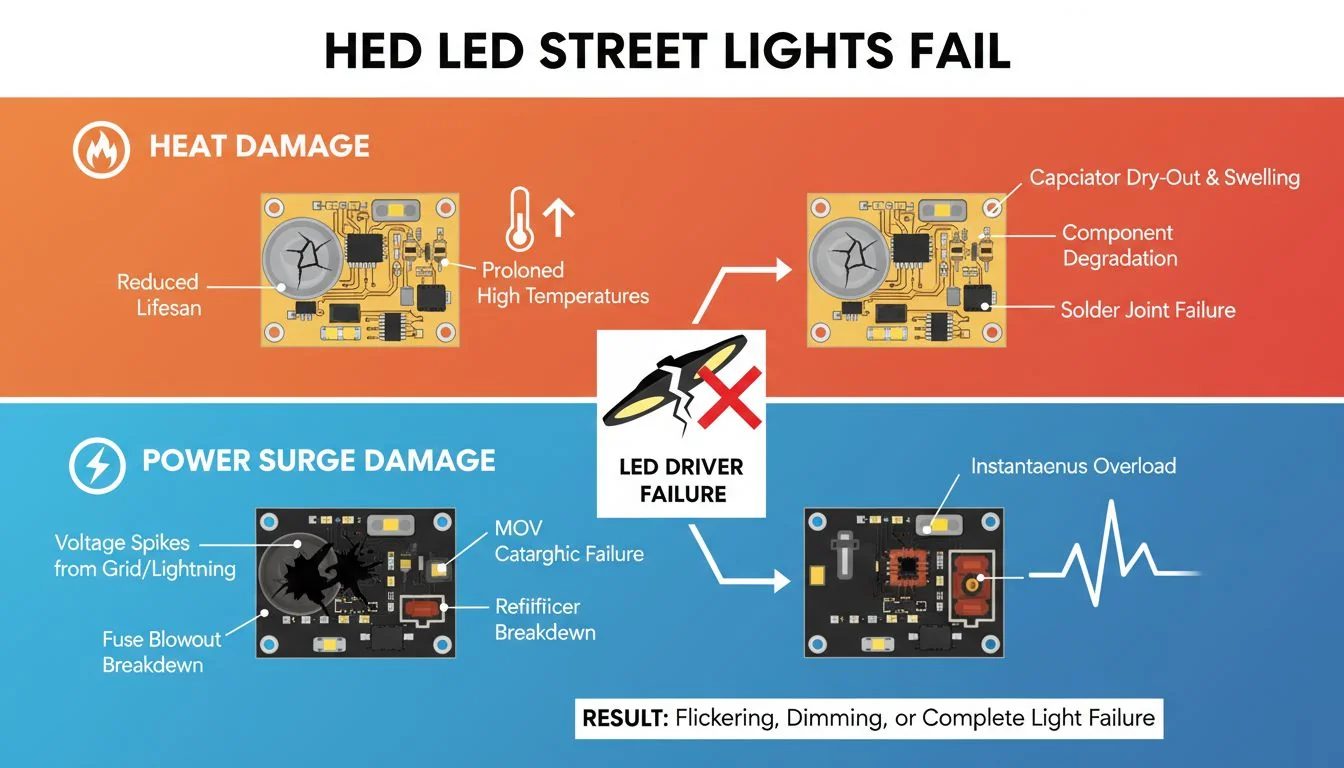
Heat and power surges are the two silent assassins of outdoor LED fixtures. Heat degrades the LED chips and, more importantly, cooks the sensitive components in the driver. Power surges from the grid or lightning strikes can instantly destroy the driver, killing the light for good.
I once consulted on a project where a contractor chose budget lights for a large parking garage to save on upfront costs. A year later, after a regional power outage, nearly 30% of the fixtures were dead. The low-rated drivers couldn't handle the surge when the power returned. The cost to replace them, including labor and lifts, erased all the initial savings. This is why we focus so heavily on thermal management and surge immunity. They aren't bonus features; they are essential for survival.
The Chain Reaction of Failure
It starts with heat. An LED isn't a simple light bulb; it's a semiconductor. And like all electronics, it generates heat.
1. The Heat Problem
A poor thermal design traps this heat. The fixture's housing acts like an oven. This raises the "junction temperature" of the LED chip, causing it to dim faster and fail sooner. But the real victim is the driver. Its capacitors and integrated circuits are even more sensitive to heat. For every 10°C increase in temperature, the life of a capacitor is cut in half.
2. The Surge Problem
The driver is also the gatekeeper for electricity. A cheap driver has minimal protection. When a power surge occurs, this high voltage bypasses the weak defenses and fries the internal circuitry. A premium driver has robust components (like Metal Oxide Varistors) that absorb this excess energy, protecting the rest of the system.
A 10kV surge protection rating means the fixture can withstand a 10,000-volt spike without failing.True
This is a standard test (ANSI/IEEE C62.41.2) that simulates indirect lightning strikes and utility switching surges, common events in any power grid.
LEDs themselves don't 'burn out' like old bulbs.True
Instead, they experience 'lumen depreciation,' where they gradually lose brightness over time. The rate of this decay is heavily influenced by heat.
Procurement Checklist: Which Spec Lines Guarantee Long Life and Lower TCO?
You need to write a tender or a purchase order that ensures you get reliable fixtures. How do you specify quality without just naming a brand?
Focus your specification on the metrics that matter for longevity. Don't just ask for a "5-year warranty"; demand the performance data that backs it up. This protects your investment.
The key is to move beyond basic requirements like wattage and specify the underlying quality components. Ask for the material grade, the driver's surge rating, the thermal resistance, and the L70/B50 lifetime data. These are the lines that separate a true industrial-grade fixture from a cheap alternative.

When I help contractors and developers build their procurement documents, I tell them to think like an engineer. Imagine the worst-case scenario for your project location—is it coastal with salt spray? Is the power grid unstable? Then, write the spec to defend against that. A well-written spec sheet is your best insurance policy against premature failure and budget overruns. It forces all bidders to compete on quality, not just price.
Your Must-Have Specification Lines
Here is a simple checklist to add to your next procurement document. This ensures you are comparing apples to apples and investing in fixtures built to last.
| Category | Specification Line | Recommended Value | Why It's Critical |
|---|---|---|---|
| Materials | Housing Construction | Die-cast ADC12 aluminum6, >2.5mm thick | Ensures structural integrity and maximum corrosion resistance. |
| Coating/Finish | AkzoNobel (or similar) powder coat, >80μm | Provides a durable barrier against UV rays, salt, and chemicals. | |
| Fasteners | 304 or 316 Stainless Steel | Prevents rust streaks and structural failure from corroded screws. | |
| Thermal | Thermal Management | Segregated driver and LED compartments | Isolates heat sources, preventing the driver from being cooked by the LEDs. |
| heat sink design7 | Efficacy > 95% (Low thermal resistance) | Guarantees efficient heat transfer away from critical components. | |
| Driver | Surge Protection | Minimum 10kV (Common/Differential Mode) | Protects against common power grid events and extends driver life. |
| Lifetime Rating | L70 > 100,000 hours @ Ta 25°C | Provides a standardized measure of long-term reliability. | |
| Certifications | UL/CE/CB and region-specific (e.g., TISI) | Confirms safety and performance have been third-party verified. |
316 stainless steel contains molybdenum, which makes it significantly more resistant to chlorides (like salt) than 304 stainless steel.True
For coastal or de-icing zone installations, specifying 316 stainless steel for all external hardware is a critical detail for preventing corrosion.
A higher wattage light is always brighter.False
Efficacy (lumens per watt) is the true measure of efficiency. A 100W fixture with 150 lm/W is brighter than a 120W fixture with 100 lm/W.
Field Performance and Warranty: What Data and Terms Separate True “Municipal Grade”?
A long warranty looks great on paper, but what does it really mean? A warranty is only as good as the company and the data behind it.
A true "municipal-grade" warranty is backed by extensive reliability data (like LM-80, TM-21) and has clear, simple terms. It should cover not just the fixture, but also lumen depreciation8. A 10-year warranty from a new company is a gamble; a 5-year warranty from an established manufacturer with proven field data is a safe bet.
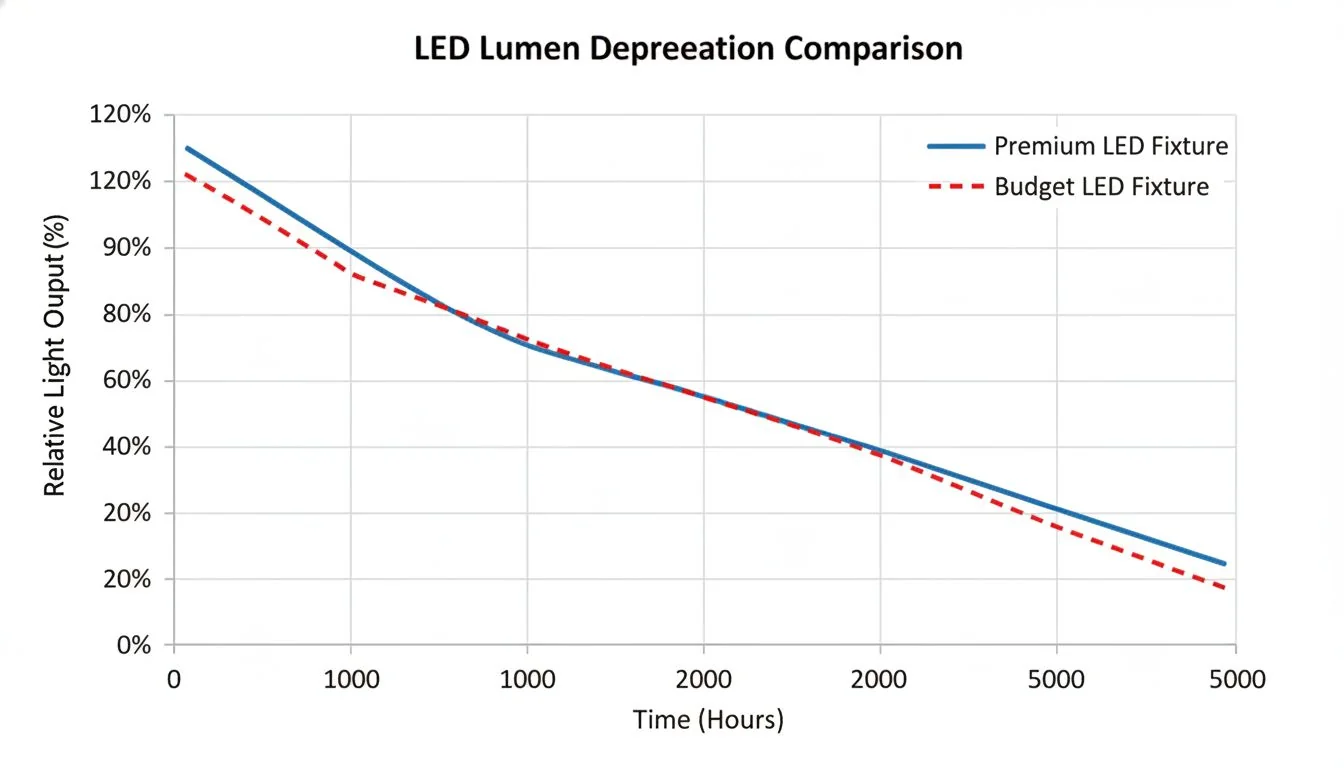
I've seen warranties with so many exclusions they are practically useless. They won't cover failures from power surges or installations in "harsh" environments—the very places you need protection! At Besenled, our warranty is straightforward because we build our products based on performance data. We use LM-80 reports for our LEDs to project long-term lumen maintenance (TM-21). This allows us to confidently guarantee that a fixture will not only work but will also remain bright for its entire rated life.
Decoding Warranty and Performance Data
When you evaluate a supplier, ask for more than just the warranty document. Ask for the test reports that support their claims.
Key Data Points to Request:
- LM-80 Report: This is a third-party test that measures the lumen depreciation of the LED chips over 6,000-10,000 hours at different temperatures. Without this, any lifetime claim is just a guess.
- TM-21 Projection: This is a mathematical method that uses LM-80 data to project the long-term lumen maintenance (e.g., L70). This tells you how long the light will stay useful.
- ISTMT (In-Situ Temperature Measurement Test): This test measures the actual operating temperature of the LEDs inside the fixture. It proves the thermal design is effective.
A supplier who can provide this data is confident in their product's engineering. A supplier who can't is asking you to trust them blindly. In my experience, trust is good, but data is better.
The L70 rating indicates the number of hours until the light output drops to 70% of its initial level.True
This is considered the end of 'useful life' for most commercial and industrial lighting applications, as further dimming becomes noticeable.
A 5-year warranty is standard for all commercial LED lights.False
While common, warranty length and terms vary widely. Many budget options offer only 1-3 years, and premium 'municipal-grade' fixtures may offer 7-10 year warranties with specific performance guarantees.
FAQ: Your Quick Guide to Street Light Reliability
Still have questions? Here are quick answers to the most common things I get asked by clients when they're trying to choose the right street light for their projects.
What fails first in LED street lights?
The driver is almost always the first component to fail. It's the most complex part of the system and is highly sensitive to both heat and electrical surges. While the LEDs themselves can last for over 100,000 hours, a poorly made driver can fail in less than 20,000 hours.
How does thermal design affect lifespan?
It's the single most important factor after driver quality9. A good thermal design uses a large, efficient heat sink to pull heat away from the LED chips and the driver. This keeps them cool, which dramatically slows down the aging process and prevents premature failure.
Are premium fixtures worth the higher upfront cost?
Absolutely, if you consider the Total Cost of Ownership (TCO). The upfront cost is only part of the story. A premium fixture saves you money over its life through lower energy consumption, zero maintenance, and no replacement costs. The initial savings from a budget light are often lost the first time you have to rent a lift to replace a failed unit.
What surge rating should I specify?
For most commercial and municipal projects, a 10kV surge protection rating should be your minimum standard. This provides solid protection against common grid surges. For areas with high lightning activity or notoriously unstable power, specifying a 20kV rating is a wise investment for maximum reliability.
Which materials resist corrosion best outdoors?
For the housing, die-cast marine-grade aluminum alloys like ADC12 are the best choice. For all external screws, gaskets, and fasteners, insist on 304 or, even better, 316 stainless steel. This combination will prevent rust and structural degradation, even in coastal or polluted industrial environments.
Conclusion
Choosing the right street light comes down to specifying quality materials, effective thermal design, and a robust driver. These factors, not the initial price, determine long-term reliability and lower your total cost.
References
-
Understanding thermal design is crucial for ensuring the longevity and efficiency of LED street lights. ↩
-
Total cost of ownership helps evaluate the long-term value of street lights beyond initial purchase price. ↩
-
Surge protection is essential to prevent damage from electrical surges, ensuring the longevity of street lights. ↩
-
Corrosion resistance is vital for outdoor fixtures to withstand harsh environments and ensure durability. ↩
-
Thermal resistance affects heat dissipation, which is critical for maintaining LED performance and lifespan. ↩
-
ADC12 aluminum offers superior strength and corrosion resistance, making it ideal for outdoor lighting applications. ↩
-
Effective heat sink design is crucial for managing heat, which directly impacts the performance and lifespan of LED fixtures. ↩
-
Lumen depreciation is a key factor in understanding how LED lights lose brightness over time, affecting their usability. ↩
-
Driver quality is a key factor in the reliability of LED street lights, impacting their lifespan and maintenance needs. ↩