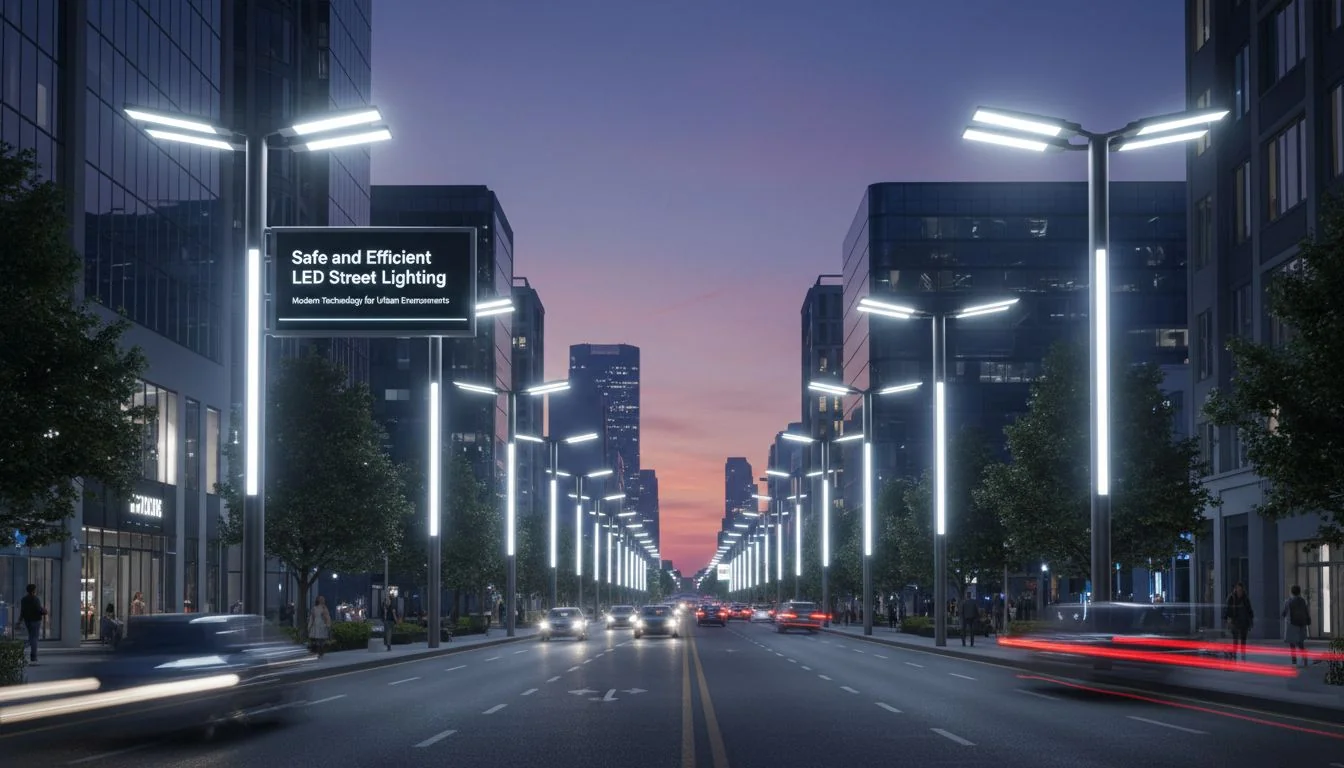
Struggling to write a spec that balances performance and cost? You're not alone. Chasing the highest numbers often leads to expensive, unreliable fixtures. The solution is a balanced, practical specification.
To specify street lights effectively, focus on realistic ranges that deliver long-term value. Target 130–170 lm/W1 for efficacy, use a 10 kA/20 kV SPD for standard surge protection, and select IK08 and IP65 for durable, serviceable enclosures. This approach avoids unnecessary costs and ensures reliability.
Over the last 13 years, I've seen countless procurement documents. The ones that lead to successful, long-lasting projects don't just list the highest possible numbers. They specify for the real world. They balance the desire for high efficacy with the need for visual comfort2, and they match durability ratings to the actual risks on the street. Pushing for extreme specs often means you pay a premium for features you don't need, or worse, you compromise on what really matters, like serviceability. Let's break down how to get this right and create a specification that wins bids and stands the test of time.
LED street lights can achieve efficacies over 200 lm/W.True
While technically possible in lab conditions or with extreme CCT and low CRI, commercially viable and visually comfortable street lights typically operate in the 130-170 lm/W range to balance performance, cost, and lifespan.
The highest IP rating (IP68) is always best for outdoor lighting.False
IP68 is for continuous submersion in water, which is unnecessary for a street light. IP65 or IP66 is sufficient for rain and jet washing, and over-specifying can increase cost and complicate maintenance.
How can you specify 130–170 lm/W without sacrificing glare control?
High lm/W numbers look impressive on a datasheet. But they often lead to harsh, uncomfortable glare that communities complain about. The secret is to focus on system efficacy3, not just the LED chip's potential.
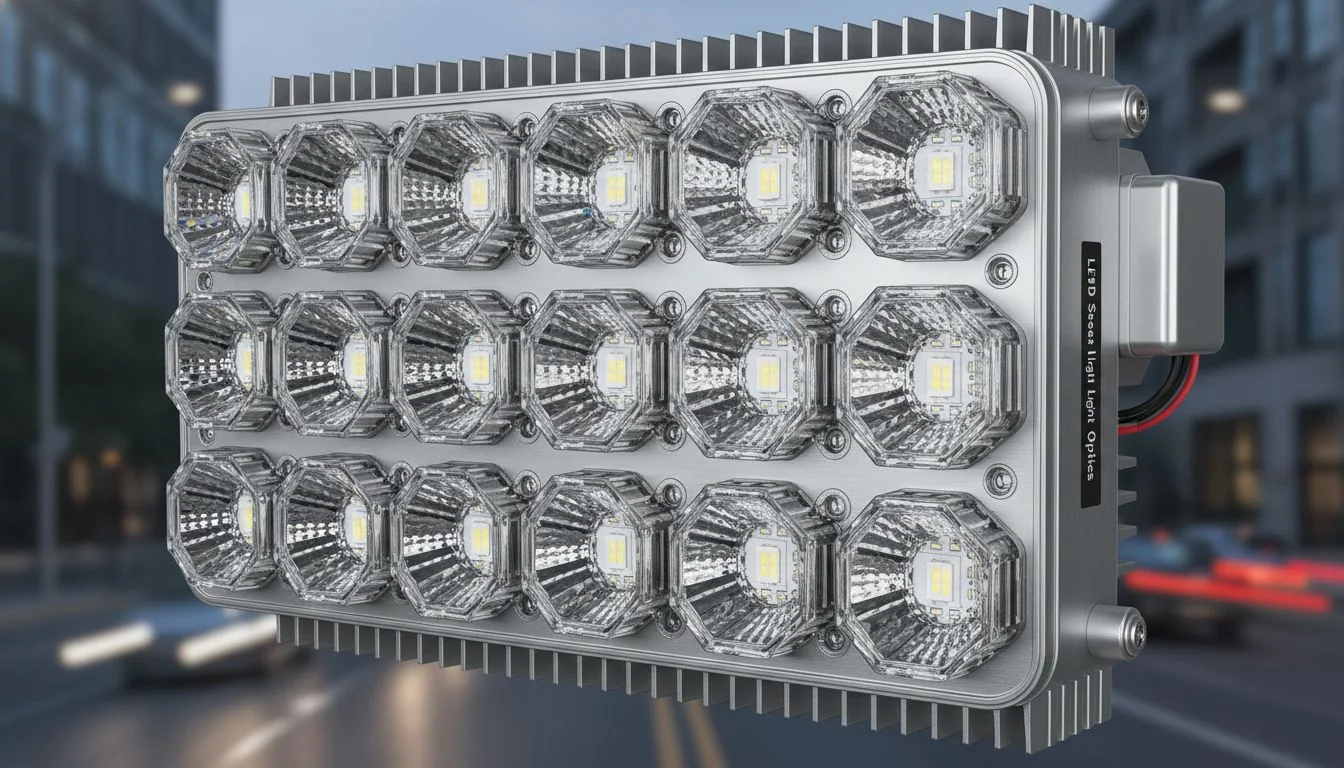
To achieve a realistic 130–170 lm/W, you must pair efficient LEDs with a quality optic package and a reliable driver running at a modest current. This approach delivers the target illuminance without pushing the color temperature too high or creating disabling glare.
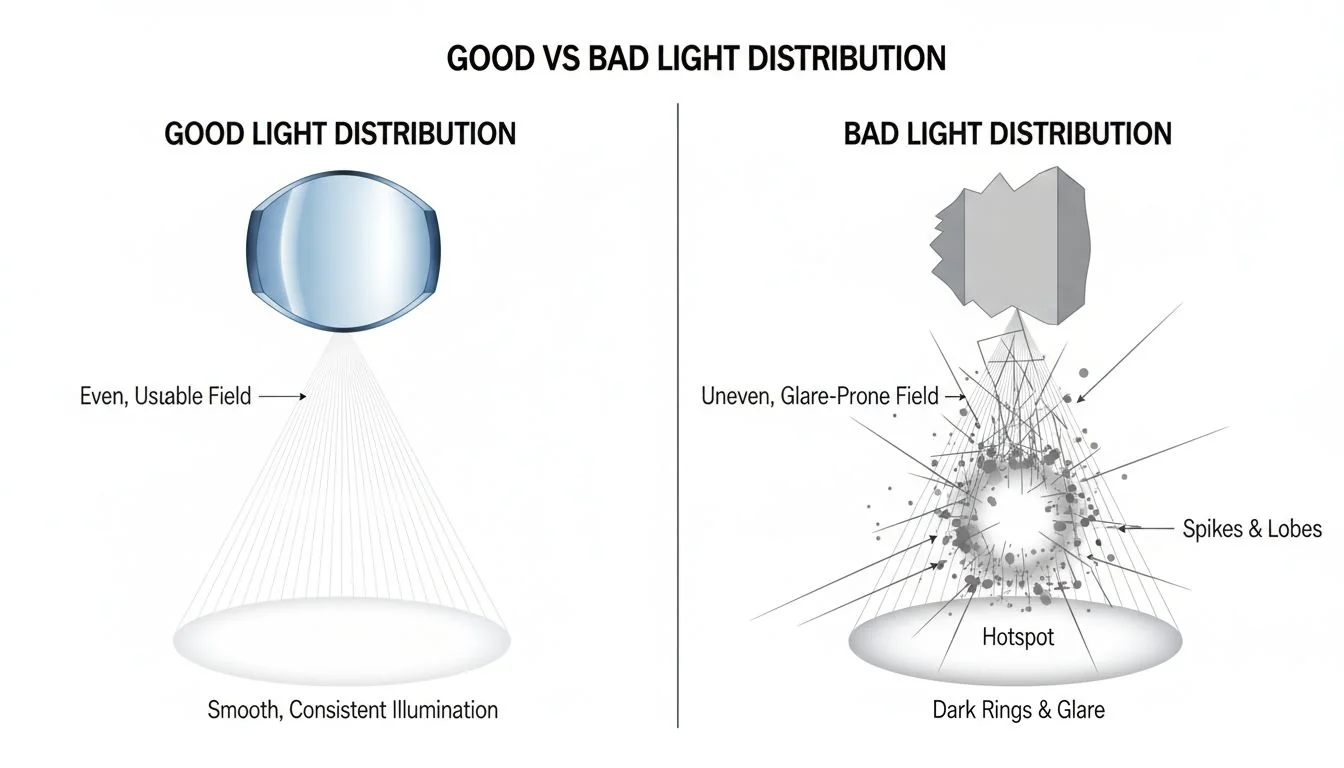
In my experience, the biggest mistake I see is specifiers chasing a high lumen-per-watt (lm/W) figure at all costs. This often fails because the manufacturer has to push the components beyond their optimal state. They might use a very high Correlated Color Temperature (CCT), like 6500K, which appears brighter but feels harsh and unnatural. Or they might overdrive the LEDs, which boosts initial output but accelerates lumen depreciation4 and shortens the fixture's life. A truly efficient luminaire is about the entire system working together.
The Difference Between Chip and System Efficacy
First, it's important to understand that the lm/W printed on an LED chip's spec sheet is not what the final luminaire delivers. That number is a lab value. System efficacy accounts for all the losses in the real world. This includes:
- Optical Losses: Light gets absorbed or scattered by the lens. A good optic package might be 90-95% efficient, but a poor one can be much lower.
- Thermal Losses: As LEDs heat up, their efficiency drops. Good thermal management5 is crucial.
- Driver Losses: The driver that powers the LEDs consumes energy itself. An efficient driver might be 90-95% efficient.
Finding the Sweet Spot for Performance
The key is to specify a luminaire that achieves your target illuminance and uniformity levels while running at a modest drive current. This is the "sweet spot" where you get great performance, long life, and visual comfort.
| Drive Current | Efficacy (lm/W) | Lifespan (L70) | Glare Risk |
|---|---|---|---|
| Low | High | Very Long | Low |
| Moderate | Good (130-170) | Long | Low |
| High | Lower | Shorter | High |
| Overdriven | Lowest | Very Short | Very High |
As you can see, pushing for the absolute maximum output is a losing game. A well-designed fixture from a supplier like us at Besenled will be optimized to run in that moderate, balanced zone.
A 5000K CCT LED is always more efficient than a 3000K CCT LED.True
Cooler CCT LEDs are inherently more efficient at converting electricity to light due to the physics of the phosphors used. However, the choice of CCT should be based on visual comfort and application, not just raw efficacy.
Luminaire efficacy is calculated by simply multiplying the LED chip efficacy by the driver efficiency.False
This calculation is too simple. It ignores critical factors like thermal losses (as the fixture heats up) and optical losses from the lens or diffuser, which can significantly reduce the final system efficacy.
How do you choose the right surge protection for different environments?
A single lightning strike or power grid surge can wipe out an entire circuit of street lights. But over-specifying the surge protection device (SPD) is a waste of money. The key is to match the protection level to the real-world risk.
For most urban and suburban roads, a 10 kA / 20 kV SPD is the industry standard and offers robust protection. Only specify higher-rated SPDs (e.g., 20 kA) for locations with high lightning activity, such as coastal areas or mountain passes.
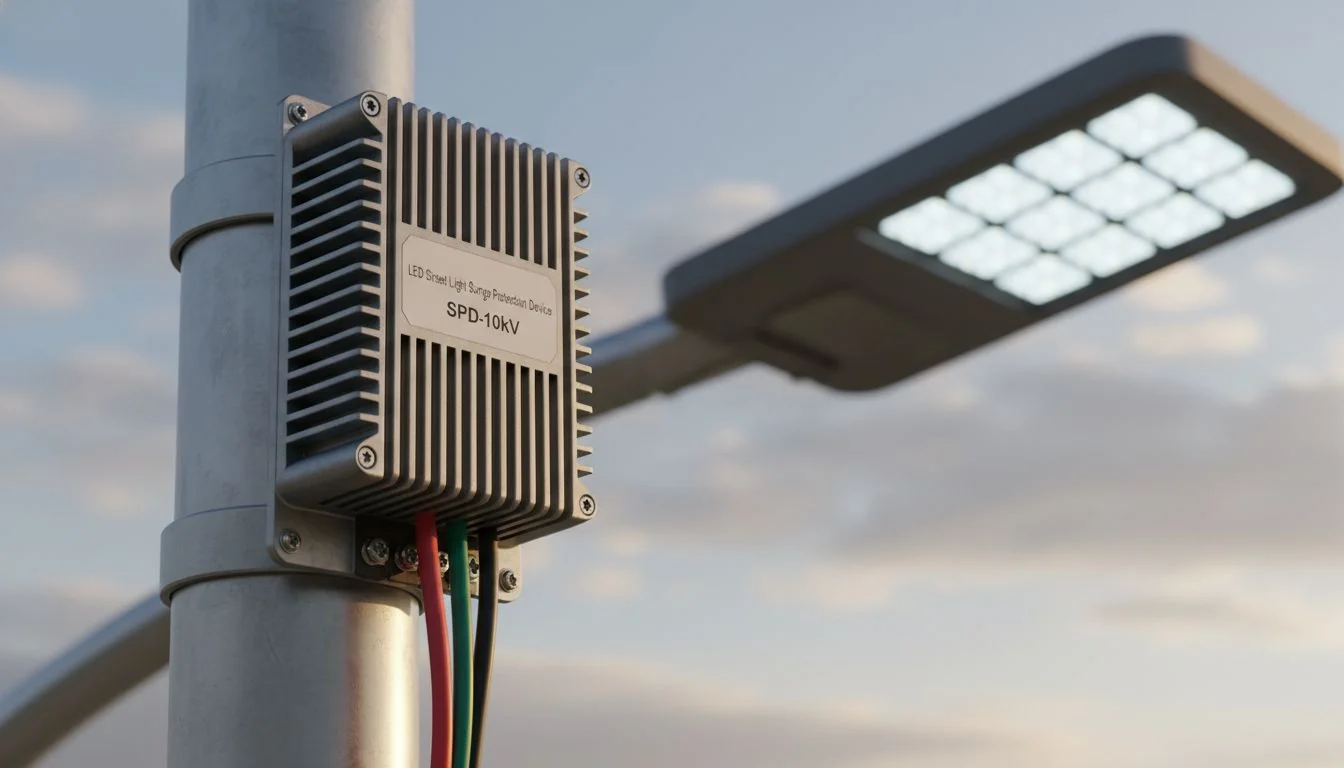
I've seen projects where every single fixture was specified with a massive 20 kA SPD, even in a dense urban area with very low lightning risk. This added significant cost to the project for protection that was never going to be needed. On the other hand, skimping on an SPD is one of the fastest ways to a maintenance nightmare. A balanced approach is always best. The mainstream 10 kA / 20 kV SPD is a workhorse. It handles the vast majority of transient voltage events you'll see on the grid and provides a great level of protection against nearby lightning.
Understanding SPD Ratings
An SPD rating has two key numbers:
- kA (Kiloampere) Rating: This is the maximum amount of surge current the device can shunt to ground one time without failing. A 10 kA rating is very robust for induced surges from distant lightning.
- kV (Kilovolt) Rating: This is the maximum amount of surge voltage the device can withstand. This is often referred to as the Basic Insulation Level (BIL).
Where to Place the SPD: Fixture vs. Cabinet
You can have protection at the fixture level (inside or attached to the luminaire) or at the cabinet level (protecting a whole circuit). For modern LED systems, I almost always recommend a fixture-level SPD. This protects the most sensitive component—the driver—directly. Cabinet-level protection is good, but long wire runs to the fixtures can still allow damaging energy to reach the luminaire.
| Environment | Lightning Risk | Recommended SPD (Fixture Level) | Justification |
|---|---|---|---|
| Dense Urban | Low | 10 kA / 10 kV | Grid is stable; buildings provide shielding. |
| Suburban / Main Roads | Medium | 10 kA / 20 kV | The industry standard, balances cost and protection. |
| Rural / Coastal / Mountain | High | 20 kA / 20 kV | Areas with frequent, direct lightning strikes. |
Choosing the standard 10 kA / 20 kV SPD covers you for most applications. It's a proven, cost-effective solution6 that avoids the service burdens of failed drivers without inflating your initial project cost.
A 20 kA SPD provides twice the protection of a 10 kA SPD.False
It can handle twice the peak surge current once, but it doesn't mean it's 'twice as good' for all situations. Most surges are far below 10 kA. The 10 kA rating is already well above what's needed for typical induced surges.
All LED street lights come with built-in 10 kV surge protection.False
Many standard drivers have some level of built-in protection (e.g., 4-6 kV), but a separate, dedicated 10 kV or 20 kV SPD module is required for true roadway-level protection and is often specified as an add-on.
Which IK and IP ratings actually survive on the street?
Your fixtures need to be tough enough for rain, dust, and the occasional impact. But chasing the highest IP and IK ratings can add unnecessary cost and even make maintenance harder. The smart move is to choose ratings based on risk, not hype.
For most street and area lighting, an IP65 rating for dust and water protection and an IK087 rating for impact resistance are the perfect balance. This combination ensures durability against common hazards without the cost or service complexity of higher ratings.
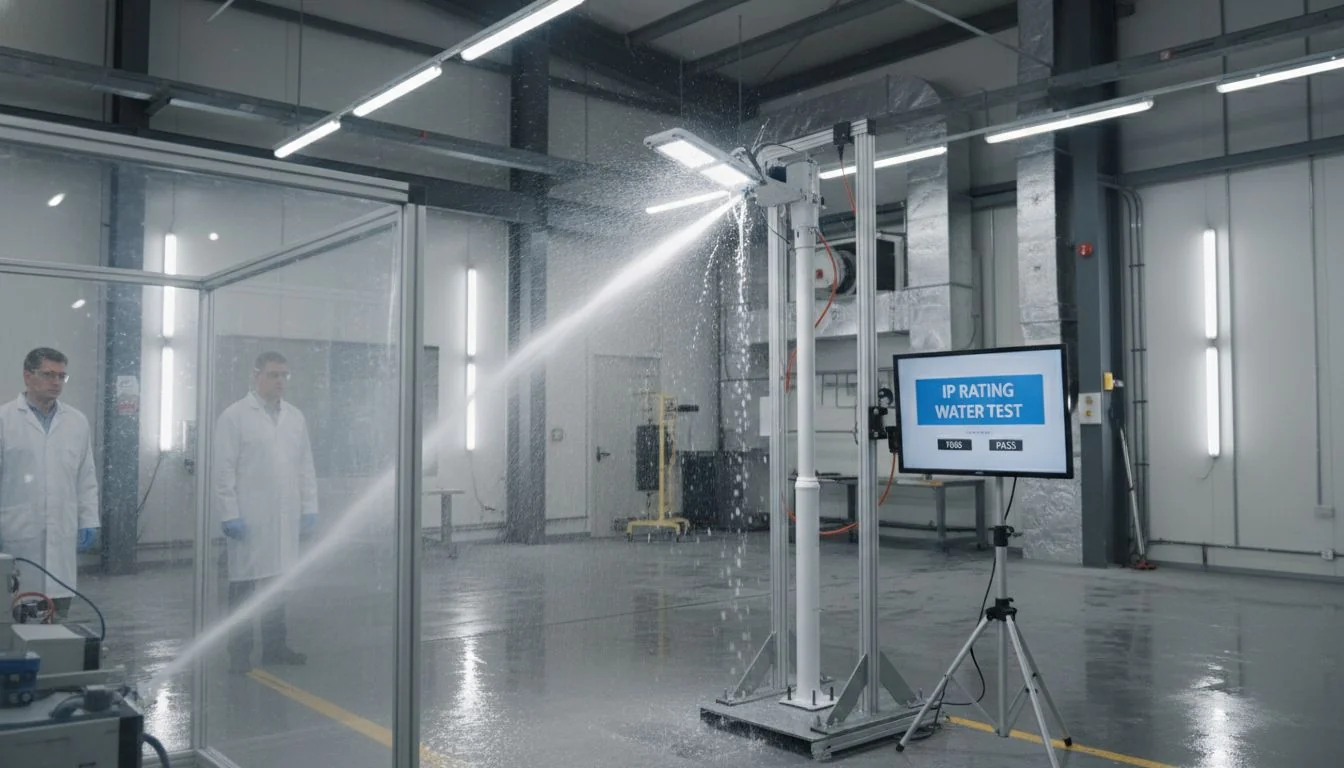
I often talk to maintenance crews, and one thing I hear consistently is their preference for IP658 enclosures over IP66, unless absolutely necessary. Why? An IP65 fixture is sealed against dust and low-pressure water jets (like rain), but it's often easier to open for a quick driver swap. An IP66 fixture, sealed against high-pressure jets, can have more complex gasketing that makes field service a little more difficult. You should only specify IP66 if you know the fixtures will be cleaned with pressure washers.
Decoding IP and IK Ratings
Let's quickly break down what these numbers mean:
- IP (Ingress Protection): This is a two-digit number.
- The first digit is for solids (dust). A '6' is the highest, meaning "dust-tight."
- The second digit is for liquids. A '5' means protected against water jets from any direction. A '6' means protected against powerful water jets.
- IK (impact protection9): This rating, from IK00 to IK10, measures how much impact energy the enclosure can withstand. IK08 is equivalent to an impact from a 1.7 kg mass dropped from 300 mm.
Matching the Rating to the Risk
You don't need an IK10 (the highest rating) fixture on a 40-foot pole over a highway. The risk of vandalism is near zero. But for a pedestrian walkway or in an underpass, IK09 or IK10 might be a wise investment.
| Location | Vandalism Risk | Water Exposure | Recommended IP | Recommended IK |
|---|---|---|---|---|
| Highway / Main Road | Low | Rain | IP65 | IK08 |
| Pedestrian / Park | Medium | Rain / Sprinklers | IP65 | IK09 |
| Underpass / Tunnel | High | Rain / Washing | IP66 | IK10 |
| Coastal / Marine | Low | Salt Spray / Rain | IP66 | IK08 |
By choosing IK08 and IP65 for the majority of your projects, you get fixtures that will easily survive the street without paying for over-engineered protection. It's the reliable, cost-effective choice that maintenance teams prefer.
IP66 is always better than IP65 for street lights.False
Not necessarily. IP66 protects against powerful water jets, which is often overkill. IP65 is sufficient for rain and can make maintenance easier. The 'better' rating depends on the specific application and maintenance plan.
An IK10 rating makes a fixture indestructible.False
IK10 is the highest standard rating (20 joules of impact), making it very robust against vandalism. However, it is not 'indestructible' and can be damaged by extreme force or specialized tools.
What's the quick spec guide for winning bids and ensuring long-term reliability?
You need to create a spec sheet that is competitive and reliable, fast. A weak spec can lose the bid or, worse, lead to years of maintenance headaches. Use this quick guide to build a specification that works.
A winning spec focuses on a balanced range: 130–170 lm/W efficacy, a 10 kA/20 kV SPD10, IK08 impact resistance, and IP65 ingress protection. This combination is the sweet spot for performance, durability, and total cost of ownership.
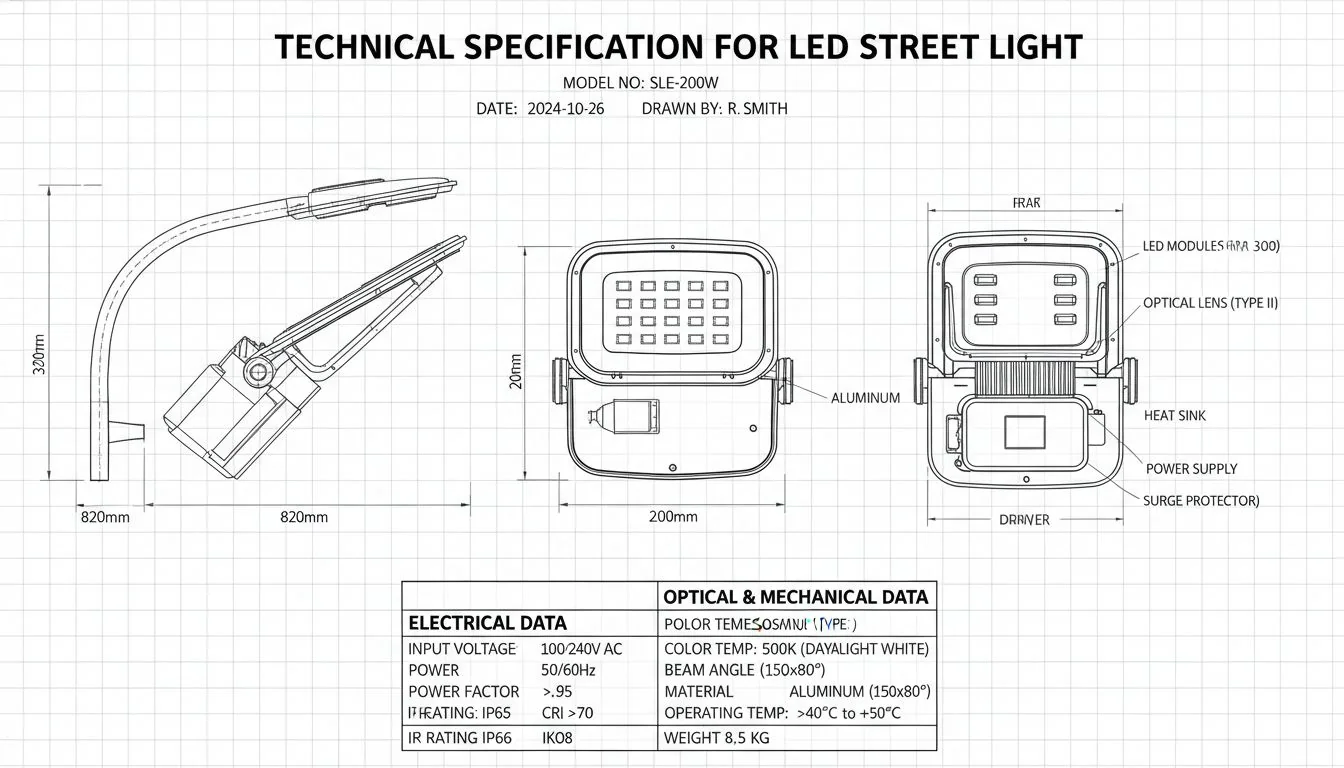
When I help clients like Somchai in Thailand develop specifications for their large-scale commercial projects, we don't start with the highest numbers. We start with the application and build a practical, reliable spec from there. A developer needs lighting that enhances their property, meets local codes like TISI, and won't cause problems for their maintenance team. This table below is the foundation for that kind of winning specification. It's based on my 13+ years of experience seeing what works in the field, from North America to Southeast Asia. This is the spec that wins bids because it shows you understand value, not just numbers.
The Quick Spec Table for Reliable Street Lighting
| Parameter | Recommended Range | Test Standard | Compliance Markers | Why It Matters |
|---|---|---|---|---|
| System Efficacy | 130–170 lm/W | IES LM-79 | DLC, ENEC | Balances energy savings with visual comfort and long life. Avoids glare. |
| Surge Protection | 10 kA / 20 kV | ANSI/IEEE C62.41 | UL 1449 | Protects the driver from common power surges and lightning, preventing premature failure. |
| Impact Protection | IK08 | IEC 62262 | CE, UL | Withstands common, accidental impacts and light vandalism without damage. |
| Ingress Protection | IP65 | IEC 60529 | CE, UL | Dust-tight and protected from rain and water jets, ensuring internal components stay dry. |
| CCT | 3000K – 5000K | IES LM-79 | DLC | Warmer CCTs (3000K) are better for residential areas; cooler CCTs (4000K-5000K) for main roads. |
| Lifespan | L70 > 100,000 hrs | IES LM-80, TM-21 | DLC | Ensures long-term performance and reduces the frequency of costly replacements. |
This table is your starting point. For any project, you can confidently build your specification around these ranges. It demonstrates to suppliers that you are a knowledgeable buyer focused on total cost of ownership, not just the initial price tag. It's how you procure fixtures that last.
DLC Premium listing requires a luminaire efficacy of at least 150 lm/W.True
As of DLC V5.1, the efficacy requirement for a 'Premium' listing for most outdoor categories is indeed 150 lm/W or higher, encouraging manufacturers to push for higher efficiency.
A fixture with a 100,000-hour L70 rating will work for 100,000 hours.False
L70 at 100,000 hours means that after 100,000 hours of operation, the fixture is projected to produce at least 70% of its initial light output. It does not guarantee the driver or other components will last that long.
Got questions about street light specs?
You still have some specific questions about getting the details right. Getting a clear answer is critical, as a small mistake can be costly. Here are the quick, straightforward answers to the questions I hear most often.
This FAQ tackles the most common questions about lm/W, IP ratings, IK ratings, and surge protection. It cuts through the confusion to help you specify with confidence and avoid common mistakes on your next lighting project.
These are the questions that come up in nearly every project meeting. My goal here is to give you the same direct advice I give my long-term partners. No hype, just practical answers based on what works in the real world.
What lm/W is “good” for LED street lights?
A "good" system efficacy for modern LED street lights is between 130–170 lm/W. This range provides excellent energy savings without the compromises of higher-efficacy fixtures, such as harsh glare, poor color rendering, or reduced lifespan from overdriving the components.
Is IP66 better than IP65 for street lights?
Not always. IP66 protects against powerful water jets, while IP65 protects against standard jets. For 95% of applications where fixtures are only exposed to rain, IP65 is perfectly sufficient. It provides excellent water protection and often allows for easier field maintenance. Only specify IP66 if you know the fixtures will be pressure washed.
What IK rating do I need?
For most applications, IK08 is the right choice. It protects against significant impacts (5 joules) and is suitable for fixtures mounted on poles where accidental impacts are the main concern. Reserve higher ratings like IK09 or IK10 for areas with a high risk of vandalism, such as pedestrian tunnels or low-mounted fixtures in public squares.
How big should my surge protector be?
The industry standard and the best choice for most locations is a 10 kA / 20 kV SPD. This provides robust protection against the vast majority of power grid surges and induced lightning strikes. You should only consider a higher 20 kA rating for areas with exceptionally high lightning frequency.
Do higher lm/W numbers mean better street lighting?
No. A higher lm/W number only means higher raw efficiency. "Better" street lighting also includes visual comfort, low glare, good uniformity, and long-term reliability. Chasing the highest lm/W can lead to poor light quality. A balanced specification is always better.
Conclusion
Smartly specifying efficacy, surge, and durability ratings ensures your lighting projects are cost-effective, reliable, and built to last. Balance is the key to long-term success and value.
References
-
Understanding the ideal efficacy range helps ensure energy efficiency and visual comfort in street lighting. ↩
-
Explore the elements that ensure street lighting is not only efficient but also comfortable for users. ↩
-
Understanding system efficacy helps in evaluating the true performance of LED fixtures. ↩
-
Understanding lumen depreciation is crucial for predicting the lifespan and performance of LED fixtures. ↩
-
Learn how effective thermal management can enhance the lifespan and performance of LED fixtures. ↩
-
Discover strategies to create budget-friendly yet reliable street lighting specifications. ↩
-
Discover why IK08 is a practical choice for impact resistance in street lighting applications. ↩
-
Explore the significance of IP65 in ensuring dust and water protection for outdoor lighting. ↩
-
Learn how impact protection ratings affect the durability and maintenance of street lights. ↩
-
Learn about surge protection standards to prevent costly damage to street lighting systems. ↩