What matters most at the same price—Specs, Warranty, or Lead Time?
You're facing two street light quotes at the exact same price. Making the wrong choice could derail your project. I'll show you how to decide with confidence every time.
When street light prices are identical, your priority should be: specs first, then warranty, and finally lead time1. Specs ensure the light is safe and compliant. A good warranty reduces long-term risk. Lead time is the tie-breaker only when project deadlines are critical and carry financial penalties.
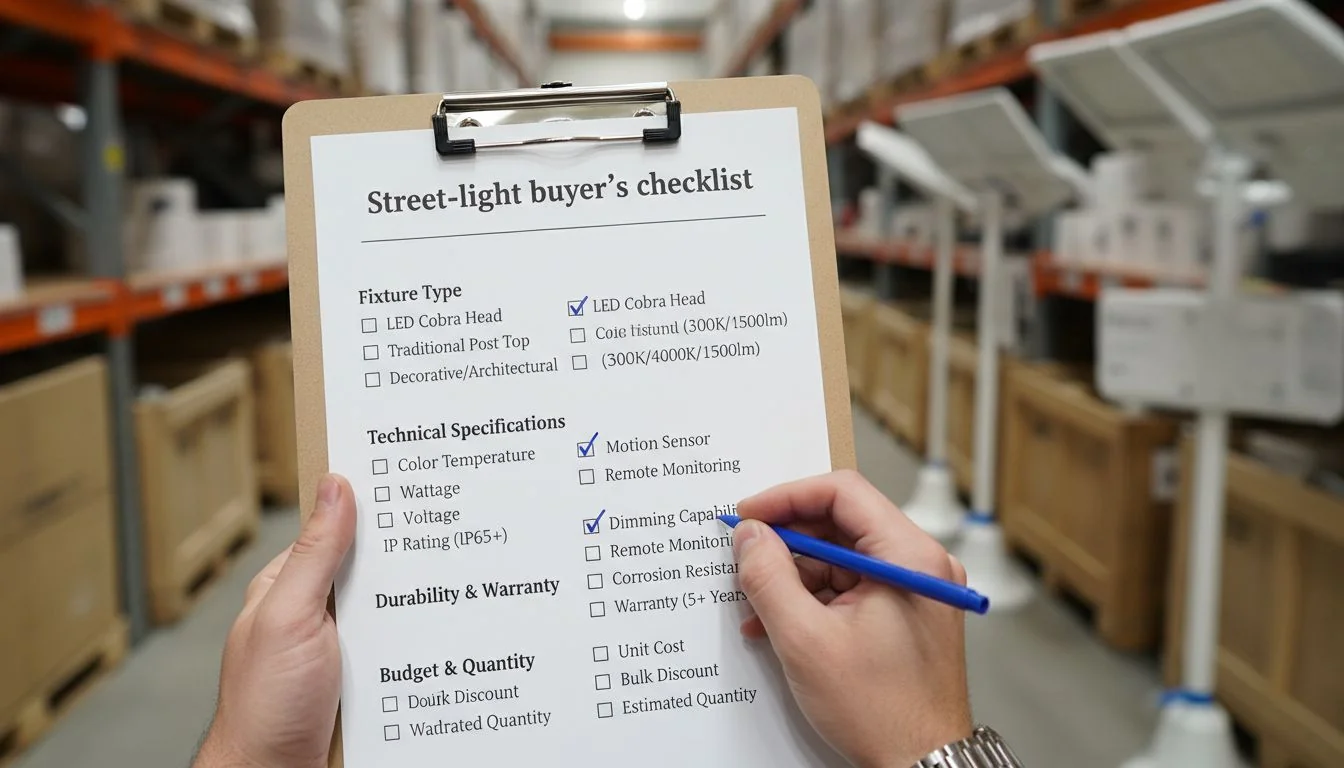
Choosing the right street light feels overwhelming when the prices match. It's a common problem for procurement managers and contractors I work with. They worry that a small oversight could lead to big problems, like failing an inspection, dealing with early failures, or missing a project deadline. This decision is about more than just a light fixture; it's about public safety, your budget, and your reputation. But you don't have to guess. I've spent over a decade helping clients navigate this, and there's a clear, logical way to make the right call. Let's break down the simple checklist that ensures you get the best value for your project, not just the best price on paper.
LED street lights can reduce energy consumption by up to 80% compared to traditional HID lamps.True
LEDs have much higher efficacy (lumens per watt), meaning they produce the same amount of light with significantly less power. Efficacies of 120-140 lm/W are common.
All street light distributions are the same.False
Light distribution types (e.g., Type II, III, IV) are designed for specific road widths and pole placements. Using the wrong one creates dark spots and safety hazards.
Spec-first decisions: Which distributions, poles, and wattages unlock safety at the lowest cost?
Choosing a street light with the wrong specs is a recipe for failure. It can create unsafe dark spots or fail inspections, forcing costly replacements. Here’s how to get it right.
The right specs are non-negotiable because they determine if the light can do its job safely and efficiently. If a light doesn't meet the photometric requirements for your road, no warranty or fast delivery can fix it. You must match the specs to the project's physical needs first.
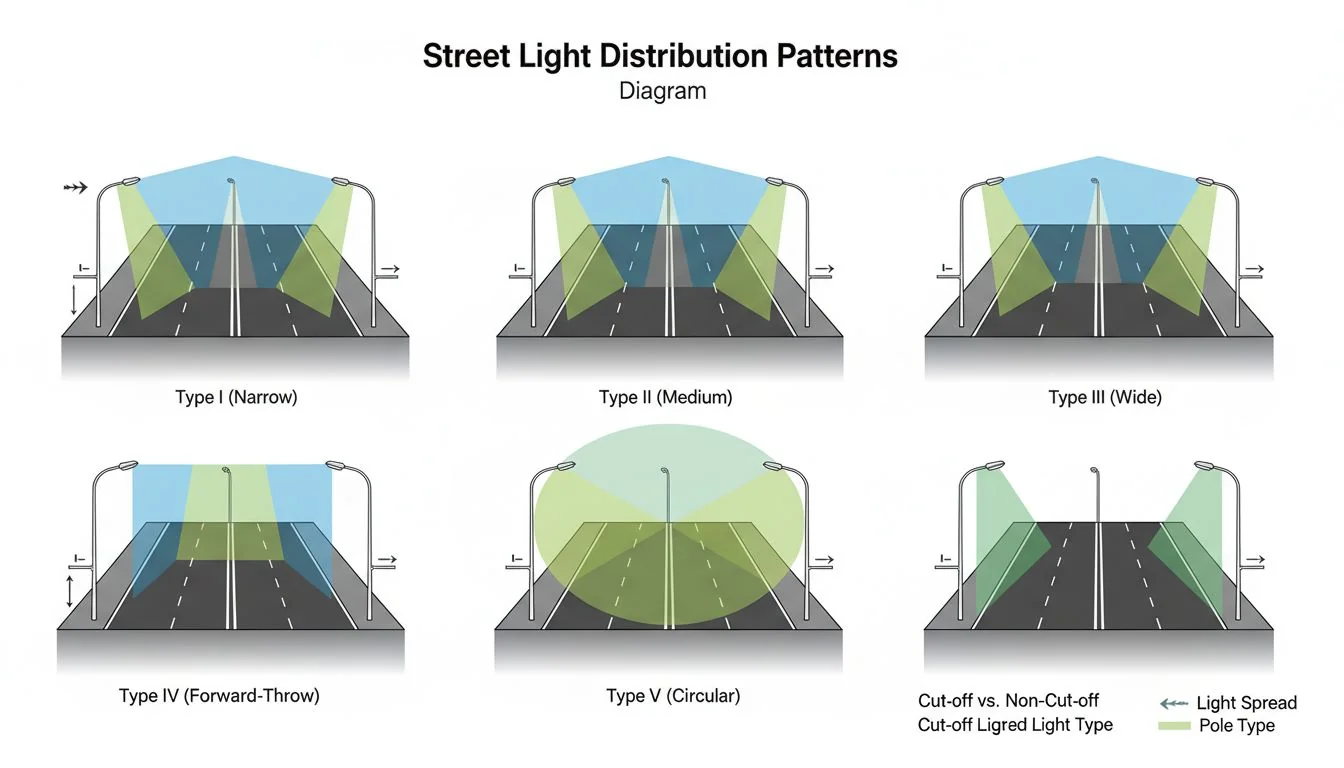
In my experience, the most successful projects start with a solid lighting design. This isn't just about picking a bright light; it's about precision. You need to ensure the light is distributed exactly where it's needed to guarantee public safety and meet local codes. Getting this wrong means you've failed before you even install the first pole. I once had a client who bought lights based on wattage alone, assuming more watts meant better light. They ended up with bright spots directly under the poles and dangerous darkness in between. We had to help them redo the entire project with lights that had the correct distribution type.
Here’s how to break down the core specs:
Matching Specs to Your Site
The three most critical technical specifications are wattage, distribution, and color properties. They work together to create a safe and comfortable environment.
- Wattage & Efficacy: Don't just look at watts. Look at lumens per watt (lm/W). A high-efficacy 100W LED can replace a 250W HID lamp, saving huge amounts on energy.
- Distribution Type: This determines the shape of the light on the ground. It must match your pole spacing and road width.
- CCT & CRI: Color Temperature (CCT) affects the feel of the space, while the Color Rendering Index (CRI) affects how clearly we see colors.
| Specification | What to Look For | Why It Matters |
|---|---|---|
| Wattage | Start with required illuminance (lux/fc), not just watts. Factor in mounting height. | Lower wattage with high efficacy (e.g., 140 lm/W) means lower energy bills for the same brightness. |
| Distribution | Type II for narrow roads, Type III for wider roads, Type IV for perimeter lighting. | Ensures uniform light coverage, eliminates dark spots, and prevents light trespass. |
| CCT/CRI | CCT: 3000K-4000K (residential), 4000K-5000K (highways). CRI: >70 is standard. | CCT impacts visual comfort. Higher CRI improves visibility and safety for pedestrians and drivers. |
A 150W LED street light is always brighter than a 100W LED street light.False
Brightness depends on lumens, not watts. A high-efficacy 100W LED (e.g., 150 lm/W = 15,000 lumens) can be brighter than a low-efficacy 150W LED (e.g., 90 lm/W = 13,500 lumens).
A CRI of 70 is sufficient for most street lighting applications.True
While higher CRI (>80 or >90) renders colors more accurately, a CRI of around 70 is the standard for roadway visibility, providing a good balance between performance and cost.
Warranty decoded: Years vs. coverage—how to read the fine print that actually protects you?
A 10-year warranty looks impressive, but it can be worthless if it has major exclusions. You could be stuck paying for repairs yourself. Let's decode what a strong warranty really covers.
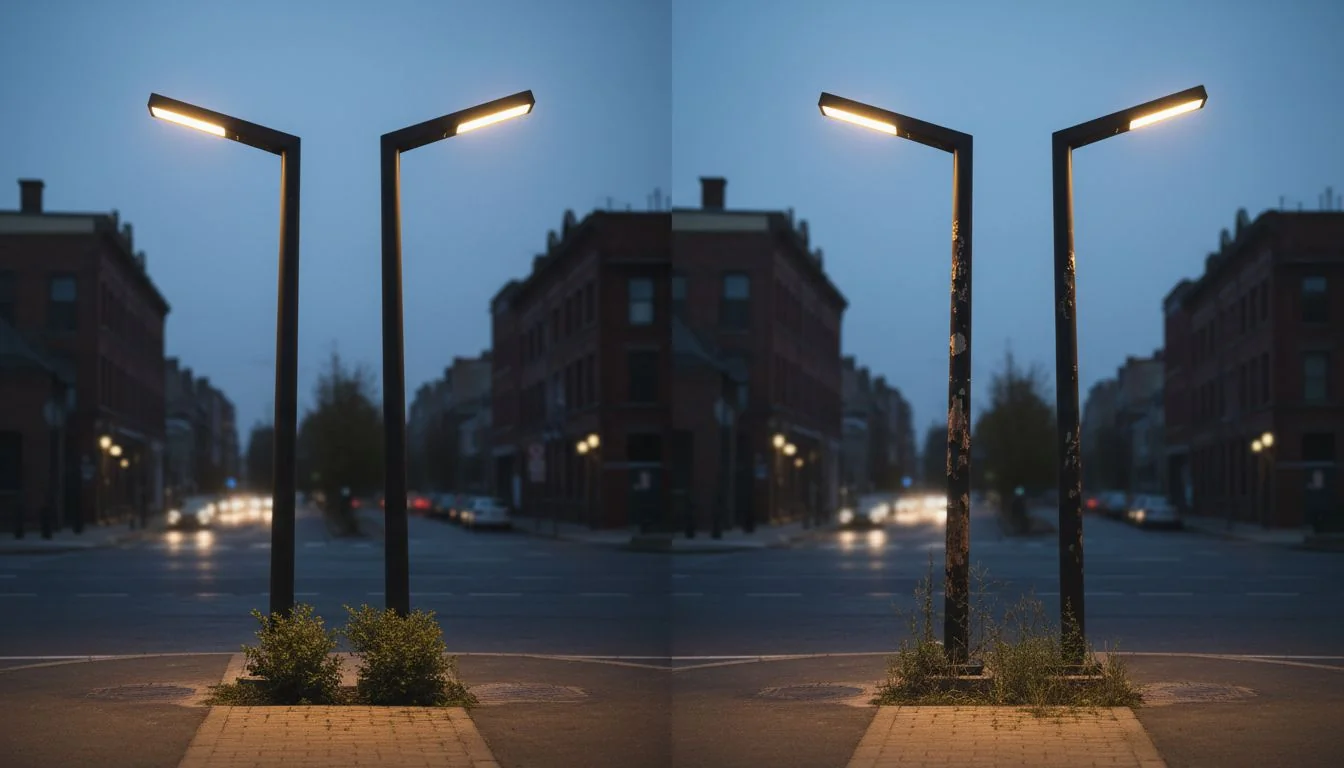
A truly protective warranty covers not just the LED chips but also the driver, surge protection, and labor or freight costs. The number of years means nothing if the terms are weak. A comprehensive 5-year warranty often provides better protection than a limited 10-year one.

I've seen clients get burned by this. A city manager once proudly told me he secured a 10-year warranty on his new street lights. Two years later, a third of the drivers failed after a power surge. When he filed a claim, he discovered the warranty excluded surge damage and didn't cover labor. He had to pay for new drivers and the crew to install them out of his own maintenance budget. The long warranty created a false sense of security. At Besenled, we make our warranty terms crystal clear from the start, because trust is built on transparency, not just big numbers.
What Makes a Warranty Valuable?
A warranty is a risk management tool. To evaluate it, you need to look past the headline number and check the coverage details.
- Component Coverage: Does it cover just the LEDs or the entire fixture, including the driver (the most common failure point)?
- Exclusions: Look for clauses that void the warranty, like power surges, improper installation, or acts of God.
- Lumen Maintenance: A good warranty guarantees the light will maintain a certain percentage of its initial brightness (e.g., L70 at 50,000 hours).
- Remedy: Does the company send parts, a new fixture, or do they also cover shipping and labor costs?
| Warranty Feature | Weak Warranty (High Risk) | Strong Warranty (Low Risk) |
|---|---|---|
| Coverage | LEDs only. | Entire fixture: LEDs, driver, housing, finish. |
| Duration | 10 years, but pro-rated after year 2. | 5-7 years, non-prorated. |
| Exclusions | Voids on power surge, humidity, heat. | Limited, reasonable exclusions. Includes surge protection up to a certain kV. |
| Lumen Maintenance | Not specified. | Guarantees L70 or L80 over the specified lifetime. |
| Remedy | Parts only, customer pays freight. | Full fixture replacement, freight included. Some may offer a labor allowance. |
A 10-year warranty always beats a 5-year warranty.False
Only if it covers all critical components (drivers, LEDs, surge), has reasonable terms, and includes a clear remedy for parts, labor, and freight. A comprehensive 5-year warranty is often more valuable than a limited 10-year one.
The LED driver is one of the most common points of failure in a street light.True
Drivers are complex electronic components sensitive to heat, moisture, and power fluctuations. A quality driver and a warranty that covers it are critical for long-term reliability.
Lead time as risk: When does delivery speed beat spec upgrades and prevent delay penalties?
You've found two compliant lights with good warranties. Now what? If your project has tight deadlines, slow delivery can cost you more than the lights themselves.
Lead time becomes the deciding factor when project delays trigger financial penalties or jeopardize funding. In these cases, a light that arrives in 2 weeks is better than a slightly superior one that arrives in 8 weeks, as long as both meet the minimum required specs.

I remember working with a contractor, let's call him Somchai, who was developing a large retail center in Thailand. He had two great options for pole lights, but his project was facing liquidated damages2 of thousands of dollars for every week he ran past the deadline. One supplier offered a light with 5% higher efficacy but had a 10-week lead time. We could deliver a fully compliant light in just 2 weeks. For him, the choice was simple. The small energy savings from the other light were nothing compared to the massive penalties he would avoid. He chose speed because, in his situation, time was literally money.
Calculating the Cost of a Delay
When should you prioritize speed? When the cost of waiting outweighs the marginal benefit of a better spec or warranty.
- Liquidated Damages: Many construction contracts include penalties for each day or week a project is late.
- Labor Costs: An idle installation crew is expensive. If your team is scheduled and the lights don't show up, you're paying them for nothing.
- Seasonal Constraints: In many regions, outdoor work can only be done during certain months. A delay could push your project into the next year.
| Scenario | When to Prioritize Specs/Warranty | When to Prioritize Lead Time |
|---|---|---|
| New Construction | Standard project timeline, no immediate penalties. | Fast-track project with high liquidated damages. |
| Retrofit Project | Phased rollout over several months. | Government grant with a "use-it-or-lose-it" deadline. |
| Emergency Repair | Replacing a few failed lights. | Replacing lights in a critical area after a storm or accident. |
| Client Type | Municipality with a long-term TCO focus. | Contractor whose profit depends on finishing on time. |
Average international shipping for LED lighting is 2-4 weeks.True
Depending on the origin, destination, and logistics provider, standard sea freight and customs clearance typically take several weeks. Air freight is faster but significantly more expensive.
Project delays are a minor inconvenience for contractors.False
Delays can be extremely costly, leading to financial penalties (liquidated damages), increased labor costs, and damage to a contractor's reputation, affecting their ability to win future bids.
Street-light TCO in practice: How do energy, maintenance, and failures affect your total cost?
The sticker price is just the beginning. A cheap light can become your most expensive if it consumes too much energy or fails early. True savings come from looking at the total cost.
Total Cost of Ownership3 (TCO) is the purchase price plus the costs of energy, maintenance, and potential failures over the fixture's life. A slightly more expensive but highly efficient and reliable light almost always has a lower TCO, making it the smarter long-term investment.
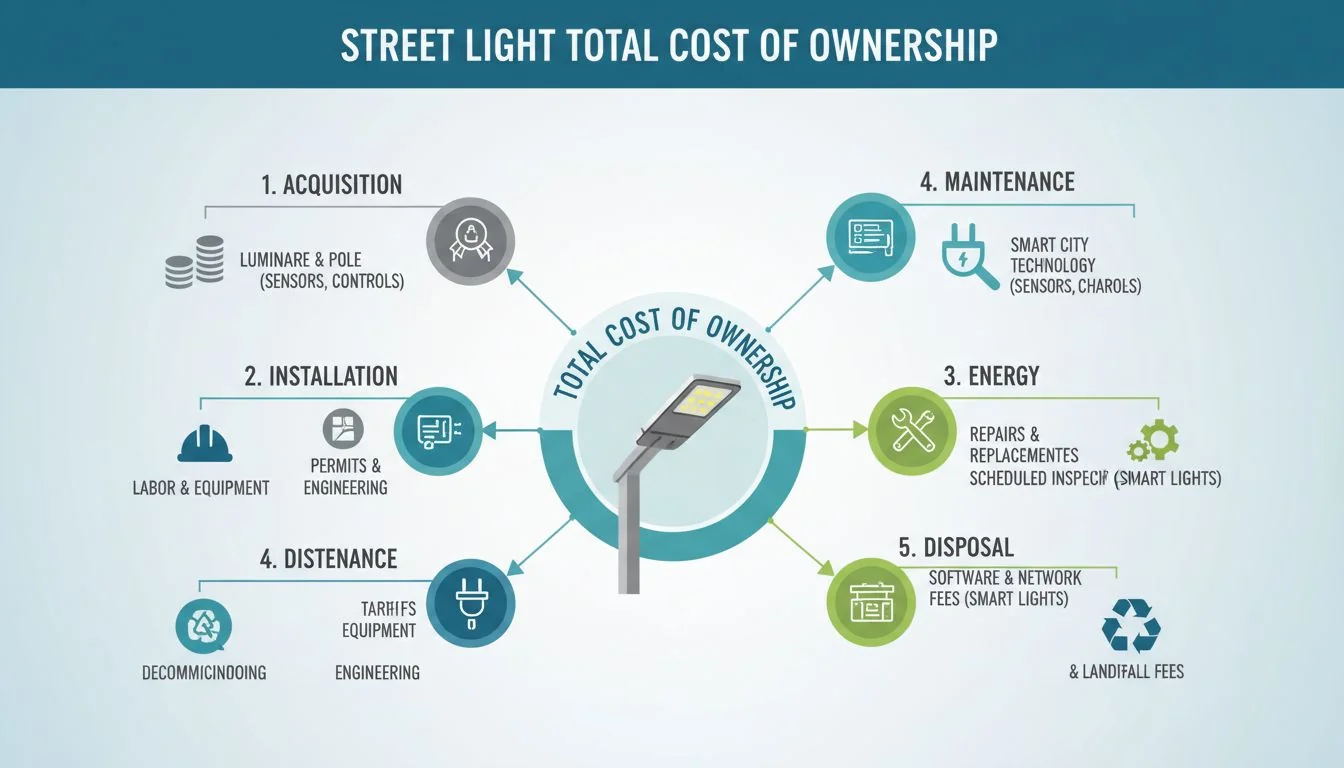
Thinking in terms of TCO is what separates savvy buyers from the rest. It shifts the focus from a one-time expense to a long-term asset. For example, a light with 140 lm/W efficacy might cost 10% more upfront than one with 110 lm/W, but it will save you far more than that in electricity over 10 years. Add in a strong warranty that eliminates replacement costs, and the decision becomes clear. We design our lights at Besenled with TCO in mind, using high-efficacy chips and reliable drivers because we know our clients, like developers and city managers, are judged on long-term performance, not just initial savings.
A Simple TCO Framework
To calculate TCO, you need to estimate costs over the expected lifespan of the light (e.g., 10 years).
- Initial Cost: The price of the fixture and installation.
- Energy Cost: (Wattage ÷ 1000) x Operating Hours/Year x Price/kWh x 10 Years.
- Maintenance Cost: Estimated cost of cleaning or repairs. A good warranty can make this zero.
- Replacement Cost: The cost to replace failed units not covered by warranty.
| Cost Component | Fixture A (Low Upfront Cost) | Fixture B (Higher Efficacy & Warranty) |
|---|---|---|
| Initial Price | $150 | $180 |
| Energy Cost (10 Yrs) | $350 (100W @ 110 lm/W) | $280 (80W @ 140 lm/W) |
| Maintenance (10 Yrs) | $50 (1-2 expected failures) | $0 (Covered by strong warranty) |
| Total Cost of Ownership | $550 | $460 |
In this example, the "cheaper" light ends up costing $90 more over its lifetime.
Labor for replacing a single street light can cost over $200.True
The cost includes sending a bucket truck and a qualified crew, which can often exceed the cost of the fixture itself. This makes reliability and warranty coverage for labor critical.
Energy costs typically account for over 60% of a street light's total cost of ownership.True
Over a 10-20 year lifespan, the cumulative cost of electricity far outweighs the initial purchase price, making energy efficiency the most important factor in TCO.
Conclusion
For street lights at the same price, always prioritize specs for safety, then warranty for risk, and use lead time as the final tie-breaker for urgent projects.
References
-
Understanding lead time can prevent costly project delays; it's essential for timely project completion. ↩
-
Understanding liquidated damages can help you avoid financial penalties; it's crucial for project management. ↩
-
Understanding TCO helps you evaluate long-term savings versus initial costs, ensuring smarter investment decisions. ↩