Bright but short life? Heatsink/package 101 with LM-80/TM-21
Your new LED luminaires look great, but they're dimming years before the datasheet promised. This premature failure costs you money and damages your reputation. The solution is understanding what lifetime numbers really mean.
Datasheet L70 values are projections made under ideal lab conditions. A luminaire's true lifetime depends entirely on its thermal management1—the heatsink, package type, and design—which dictates the actual operating temperature of the LED chip (TMPLED). A hot-running LED will always fail early, regardless of its rating.
I've been in the LED business for over 13 years, and I've seen this problem countless times. A client invests hundreds of thousands of dollars in a project, only to face massive maintenance costs because the lights didn't last. They look at the spec sheet and feel misled by terms like LM-802, TM-21, and L70. It's not your fault; these standards can be confusing. But if you don't understand the link between these lab tests and the real-world performance of a heatsink, you are making a risky bet. In this post, I'll break down exactly what you need to ask for to ensure the lifetime you pay for is the lifetime you get.
A bigger heatsink always guarantees a longer LED lifetime.False
Design and surface area are far more critical than sheer mass. A well-designed, lighter pin-fin heatsink can easily outperform a heavy, poorly designed block of aluminum by dissipating heat more effectively.
The L70 rating on a datasheet is a guarantee of the luminaire's minimum lifespan.False
L70 is a statistical projection based on component-level testing (LM-80). The actual luminaire's lifetime is determined by its in-situ operating temperature (TMPLED), which is a function of the entire system's thermal design.
LM-80 is a test of the complete LED luminaire's performance.False
LM-80 specifically tests the lumen maintenance of the LED package or module (the light-emitting component itself) under controlled temperatures, not the entire fixture.
How do LM‑80 and TM‑21 actually predict LED L70?
You're looking at a spec sheet, trying to compare two products. Both claim a long L70 lifetime, but the numbers are confusing. This uncertainty makes it hard to trust any prediction and invest with confidence.
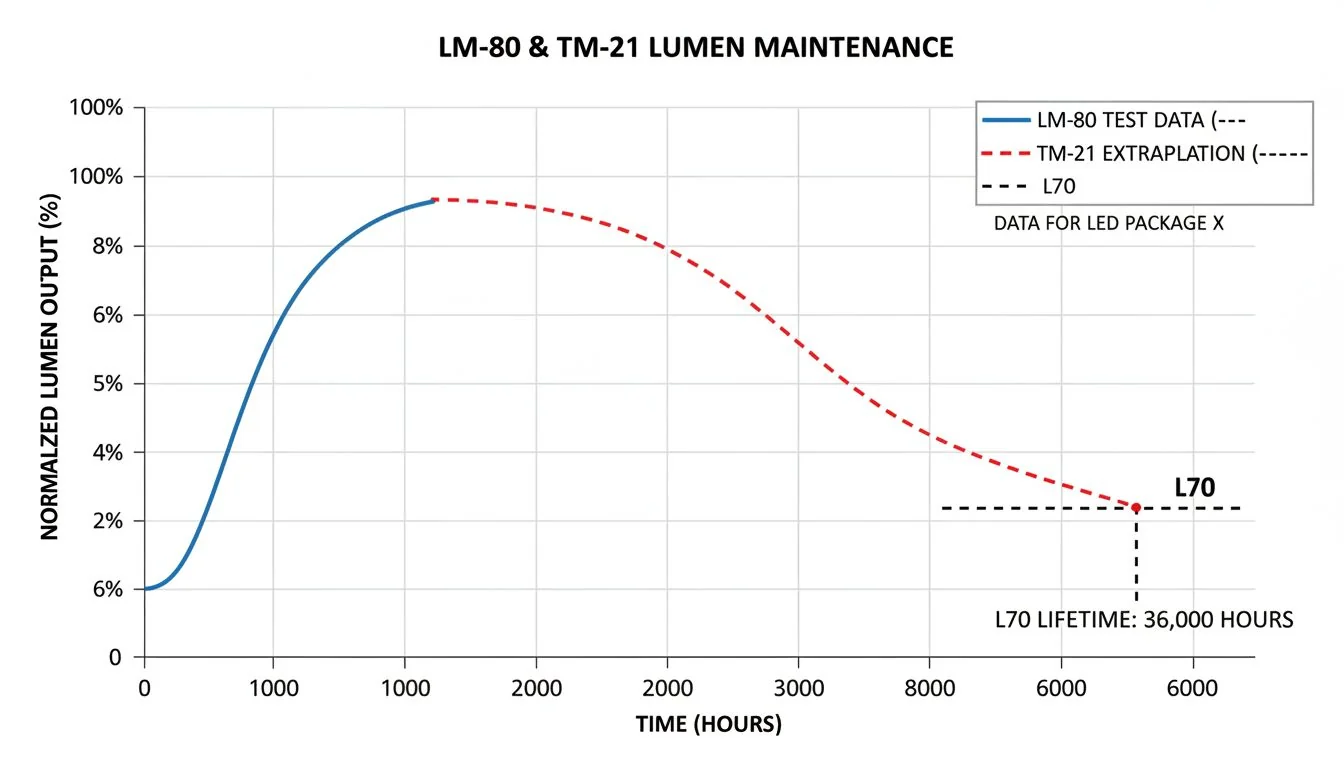
LM-80 is a standardized test that measures how much an LED package's light output fades over thousands of hours at specific temperatures (e.g., 55°C, 85°C). TM-213 is the mathematical formula that uses this LM-80 data to project the L70 lifetime, which is the point where light output drops to 70%.
The Two-Step Process: Test and Project
Understanding lifetime prediction is simple when you break it down. It's a two-step process: first, you test the component, then you project its future performance.
-
LM-80: The Test. This is where we get the raw data. The Illuminating Engineering Society (IES) created the LM-80 standard to test the LED package itself, not the whole light fixture. We run the LEDs for at least 6,000 hours (at Besenled, we insist on 10,000-hour tests for better data) and measure how much the light output drops. This test is done at three different case temperatures, typically 55°C, 85°C, and an optional higher temperature. The result is a report showing lumen depreciation curves.
-
TM-21: The Projection. Once we have 6,000+ hours of LM-80 data, we can use the TM-21 method to project that data forward. This formula calculates how many hours it will take for the LED to reach 70% of its initial brightness (L70).
Why "Reported" L70 is the Only Number That Matters
Here is the most important part. TM-21 has a critical rule: you cannot report a lifetime that is more than 6 times the LM-80 test duration.
- If the LM-80 test was 6,000 hours, the maximum reported L70 is 36,000 hours.
- If the LM-80 test was 10,000 hours, the maximum reported L70 is 60,000 hours.
The math might calculate a lifetime of 150,000 hours, but this is just a wild guess. The "6x rule" prevents unrealistic marketing claims. When you see a spec sheet, always look for the "reported" L70 and ignore the "calculated" value.
| Standard | What It Is | What It Does | Your Key Takeaway |
|---|---|---|---|
| LM-80 | A component-level test | Measures lumen fade at set temperatures | Provides the raw data. Insist on a 10,000-hour test. |
| TM-21 | A mathematical projection | Estimates L70 lifetime from LM-80 data | Only trust the "Reported" value, which is capped by the 6x rule. |
A 10,000-hour LM-80 test provides a more reliable TM-21 projection than a 6,000-hour test.True
A longer test provides more data points, which reduces the uncertainty of the mathematical extrapolation. It also allows for a longer and more trustworthy 'reported' L70 lifetime (up to 60,000 hours).
All L70 values greater than 100,000 hours are based on direct testing.False
No commercial LED has been tested for over 100,000 hours (11.4 years). Any such claim is a 'calculated' projection from TM-21, not a 'reported' value, and should be treated with extreme skepticism.
Does heatsink design change TM‑21 results in real streetlights?
You have a TM-21 report that promises over 60,000 hours of life at 85°C. But does that matter if the streetlight is installed in hot Thailand? The heatsink is what connects that lab report to reality.
Yes, absolutely. A TM-21 projection is only valid if the luminaire's heatsink can keep the LED's actual operating temperature (TMPLED4) at or below the temperature used in the test. A poorly designed heatsink will let the LED run hot, making the TM-21 report completely irrelevant and drastically shortening its life.
The Journey of Heat
Think of heat as traffic on a highway. It starts at the LED chip and needs a clear road to get out into the air. The path is:
- LED Junction: Where light and heat are created.
- Solder Point (TMPLED): The critical point we measure.
- PCB: The circuit board the LEDs are mounted on.
- TIM (thermal interface material5): A special paste or pad that fills microscopic air gaps between the PCB and the heatsink.
- Heatsink: The metal structure that transfers heat to the air.
A failure at any point in this chain creates a traffic jam, causing heat to build up and destroy the LED. I've seen projects fail because the manufacturer used a cheap, low-quality TIM, creating a thermal bottleneck that a great heatsink couldn't overcome.
Why Shape Matters More Than Size for Outdoor Lights
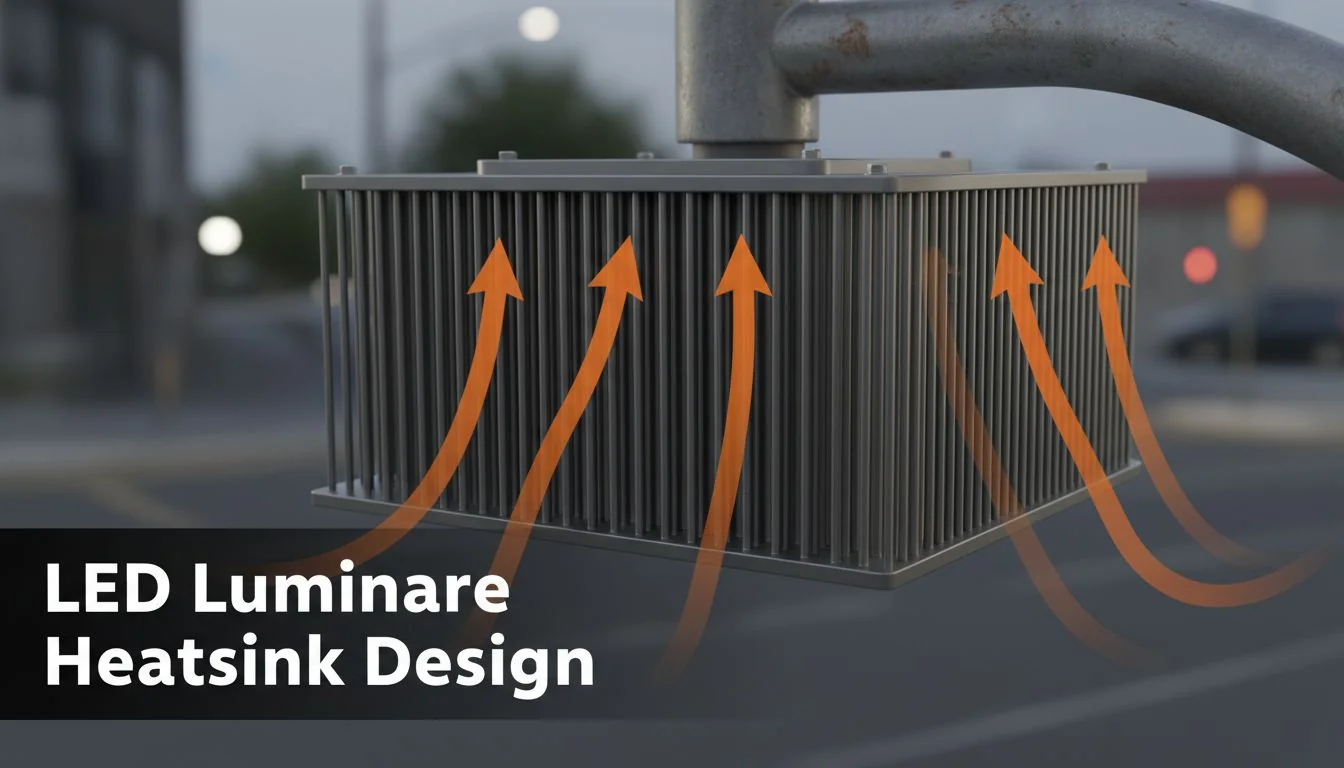
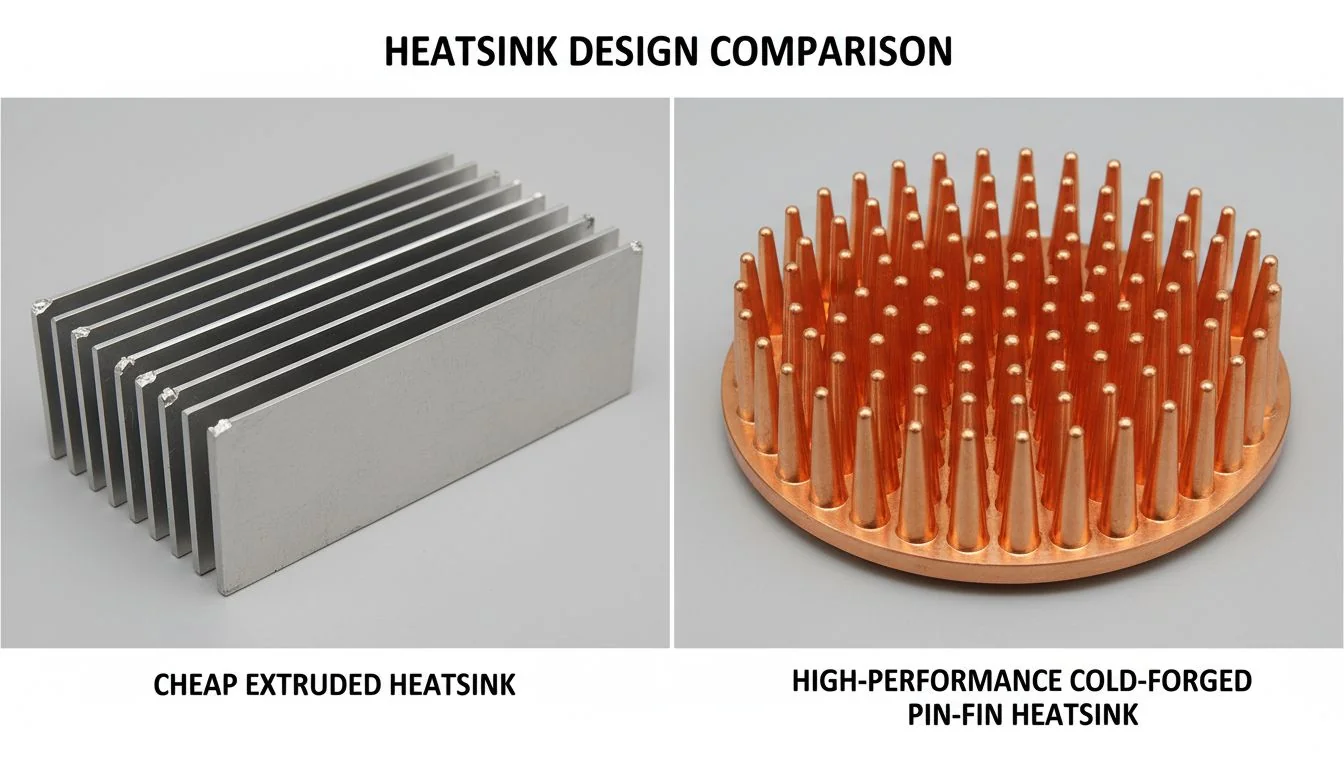
For an outdoor luminaire like a streetlight, the heatsink design6 is critical. Wind comes from all directions, so the design must be ready for anything.
| Heatsink Type | Design | Outdoor Performance | My Recommendation |
|---|---|---|---|
| Extruded | Long, straight fins. | Poor. Only works well with airflow in one direction. Wind from the side does little to cool it. | Avoid for outdoor use. Best for indoor, controlled environments. |
| Pin-Fin | Round pins forged from aluminum. | Excellent. The pins create air turbulence, pulling heat away regardless of wind direction. They also have a huge surface area. | The best choice for streetlights and floodlights. |
At Besenled, we specify cold-forged, pin-fin heatsinks for our outdoor products. They cost more to make, but they provide the reliable, long-term thermal performance our clients in places like the Middle East and Southeast Asia depend on.
The weight of a heatsink is the best indicator of its cooling performance.False
Surface area and design are far more important. A well-designed, lighter pin-fin heatsink has more surface area to interact with the air and will outperform a heavy, solid block of aluminum.
A heatsink painted black dissipates heat better than a bare aluminum one.True
A dark, matte surface has higher emissivity, meaning it radiates heat more effectively than a shiny metal surface. This is a small but meaningful detail in passive cooling design.
COB vs SMD: which LED package lasts longer at high TMPLED?
You're deciding between two high bays, one using a single COB LED and the other using an array of SMD LEDs. This choice seems small, but it has a huge impact on how the fixture handles heat and how long it will last.
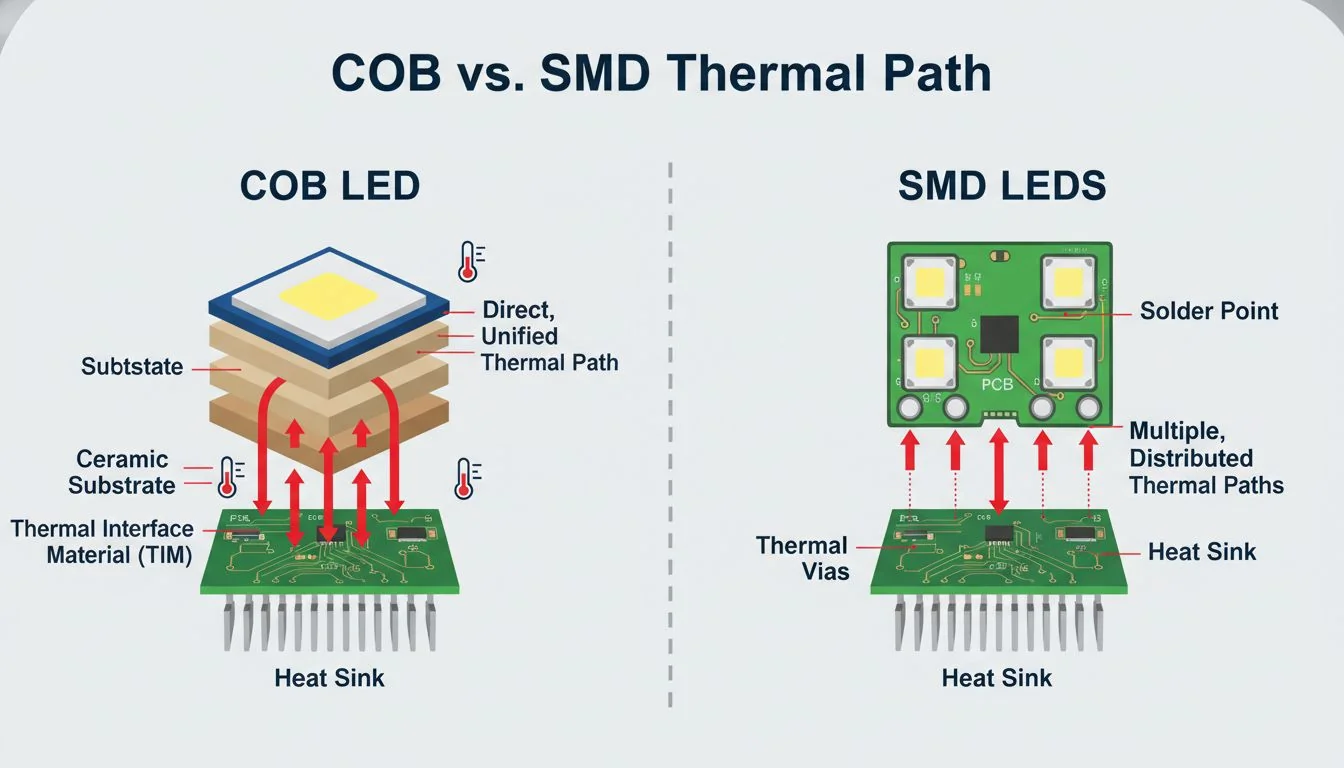
For high-power applications, SMD (Surface-Mount Device) packages almost always last longer because they manage heat better. Each SMD chip has its own path to the heatsink, spreading the thermal load. COB (Chip-on-Board) packages concentrate all the heat in one small spot, making them much harder to cool.
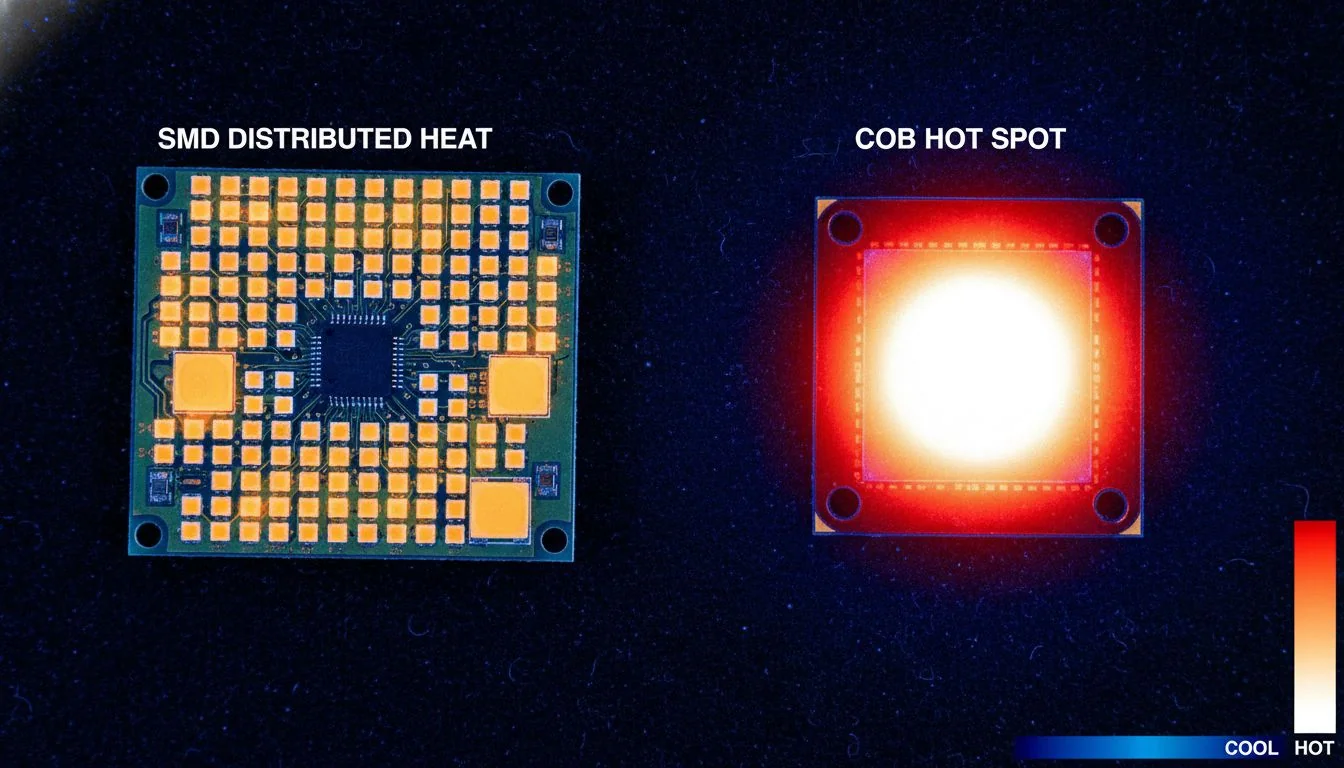
Distributed vs. Concentrated Heat
To understand why, let's look at their structures.
-
SMD (Surface-Mount Device): These are individual LEDs, like the 3030 or 5050 chips you see on a board. Each one is a self-contained package with its own thermal pad. Think of them as single-family homes, each with its own foundation connected to the ground (the heatsink). Heat from each home has a direct, easy path out.
-
COB (Chip-on-Board): This is where many tiny, unpackaged LED chips are bonded directly to a single, small substrate. Think of it as a high-rise apartment building. All the heat from every apartment has to travel down through one shared foundation. This creates a massive thermal bottleneck.
At high power, that COB bottleneck becomes a serious problem. The temperature at the center of the COB can get extremely high, even with a good heatsink. With SMDs, the heat is spread evenly across a large PCB, so no single point gets overwhelmed. This distributed approach is inherently more reliable and robust, which is why we use high-quality SMD chips in our industrial high bays and streetlights.
| Package Type | Thermal Management | Best Application | Why? |
|---|---|---|---|
| SMD | Distributed Heat: Each chip has its own thermal path. | High Bays, Streetlights, Floodlights | More robust and reliable under high power and high temperatures. |
| COB | Concentrated Heat: All chips share one small thermal path. | Spotlights, Downlights | Good for creating a single point of light, but struggles with high thermal loads. |
SMD LEDs allow for better optical control in streetlights.True
Because SMDs are individual light sources, each one can be paired with a small, custom-engineered lens. This allows us to create precise light distribution patterns (like Type II or Type III) to illuminate a road efficiently without wasting light.
COB LEDs are a newer and more advanced technology than SMD LEDs.False
Both are mature technologies. The choice between them is not about which is 'newer,' but which is the right tool for the job. For high-power, high-reliability industrial lighting, SMD is the superior engineering choice due to its thermal advantages.
What is ISTMT and how do I use TMPLED to verify lifetime?
You're tired of being burned by products that don't live up to their datasheet claims. You need proof. ISTMT7 is the test that provides that proof, connecting the lab report to the physical product in your hand.
ISTMT (In-Situ Temperature Measurement Test) is the physical measurement of the LED's temperature point (TMPLED) while it's operating inside the fully assembled luminaire. You use this measured TMPLED value to confirm that it is at or below the temperature used for the LM-80 test, thereby validating the L70 lifetime claim.
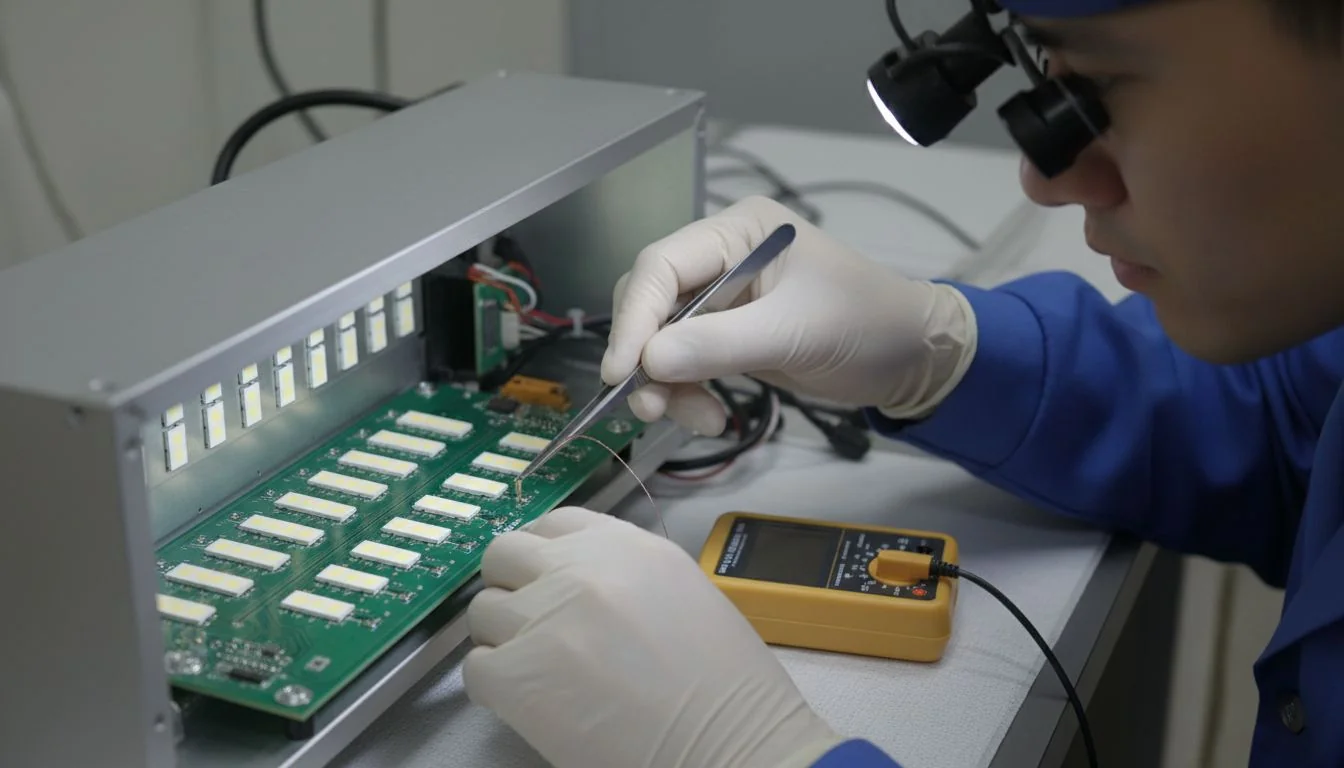
Your 3-Step Verification Checklist
This is the single most important process for verifying a supplier's lifetime claims. As a professional buyer, you should make this a non-negotiable part of your procurement process.
-
Request the LM-80 Report: Get the report for the exact LED package used in the luminaire. Find the L70 projection at a specific temperature. For example: L70 (10k) > 60,000 hours @ 85°C.
-
Request the ISTMT Report: This must be for the exact luminaire model you are buying, running at its full power. The report will state the measured temperature at the designated solder point. For example: Measured TMPLED = 78°C.
-
Compare and Verify: Compare the two numbers.
- The measured TMPLED (78°C) is lower than the LM-80 test temperature (85°C).
- Conclusion: The luminaire is running cooler than the test conditions. You can be confident it will meet or exceed the L70 > 60,000-hour lifetime.
If the ISTMT report showed a TMPLED of 95°C, the 85°C lifetime projection would be meaningless. The light is running too hot and will fail prematurely. This simple check separates reliable manufacturers from those making empty promises. Never accept surrogate data from a "similar" luminaire; the housing, driver, and even paint finish can alter the result.
You can accurately measure the TMPLED with a handheld infrared (IR) temperature gun.False
IR guns are not accurate enough for this. They measure the surface temperature, which is affected by the material's emissivity. ISTMT requires a thermocouple to be physically attached to the precise solder point (Ts) designated by the LED manufacturer.
ISTMT should be performed at an ambient temperature relevant to the project's location.True
A standard test is done at 25°C. But for a project in Dubai or Bangkok, you should ask for ISTMT data at a higher ambient temperature (e.g., 45°C) to ensure the luminaire remains thermally stable in its real-world environment.
FAQ?
I get asked these questions all the time. Here are quick, direct answers to help you make better procurement decisions.
How do I read L70(Yk) on a spec sheet?
L70 means lifetime until 70% lumen output. The number in parentheses, like (10k), is the LM-80 test duration in thousands of hours. So, "L70(10k) > 60,000 hours" means the projection is based on a solid 10,000-hour test and is reliably reported as over 60,000 hours.
How often should I clean streetlight heatsinks?
This depends on your location. In dusty industrial zones or coastal areas with salt, annual cleaning is wise to maintain performance. However, a well-designed pin-fin heatsink is largely self-cleaning with rain and wind, unlike flat-finned designs that trap debris.
How does overdrive current change TM‑21 projections?
Driving an LED with more current makes it brighter but also much hotter. This increases the TMPLED and dramatically shortens its life. A TM-21 projection is only valid for the exact drive current used during testing. Overdriving voids the lifetime claim.
What’s the difference between LM‑79, LM‑80, and TM‑21?
- LM-79: Tests the entire luminaire for its initial performance (lumens, watts, efficacy, CCT).
- LM-80: Tests the LED component only for lumen depreciation over time.
- TM-21: A mathematical projection that uses LM-80 data to estimate L70 lifetime.
Why does my luminaire not reach the datasheet’s L70?
The most common reason is that its real-world operating temperature (TMPLED) is higher than the temperature used for the L70 projection. This is caused by a poor heatsink, high ambient temperature8, or incorrect installation.
Does a bigger heatsink guarantee longer life?
No. A smart design is better than a big one. Surface area and airflow management are what matter. A well-engineered pin-fin heatsink will outperform a heavy, solid block of metal every time.
Is COB or SMD better for longevity?
For high-power industrial and outdoor lights, SMD is better. It distributes heat across a large area, leading to a lower, more manageable TMPLED and better long-term reliability.
What is TMPLED and where do I measure it?
TMPLED is the temperature at a specific point on the LED package, defined by the LED manufacturer (often marked 'Ts' for solder point). For an accurate ISTMT, a thermocouple must be attached directly to this exact spot.
Reported vs calculated TM‑21: which should I trust?
Always trust the "reported" value. It is capped at 6 times the LM-80 test duration (e.g., max 60,000 hours for a 10,000-hour test). The "calculated" value is an uncapped, often unrealistic mathematical guess and should be ignored.
How does ambient temperature affect L70 in streetlights?
It has a direct and significant impact. A higher ambient temperature reduces the heatsink's ability to cool the LED, which raises the TMPLED. A general rule is that for every 10°C increase in junction temperature, an LED's life is cut in half.
Which heatsink shapes work best outdoors?
Pin-fin and other open, multi-dimensional shapes are superior. They maximize surface area and promote turbulent airflow, ensuring effective cooling from wind coming from any direction, which is typical for outdoor installations.
Does driver location influence LED lifetime?
Yes, significantly. A driver generates its own heat. Mounting it in a separate, isolated compartment prevents its heat from transferring to the LED module. This keeps the LED's TMPLED lower and extends its life.
Can IP67 enclosures trap heat and reduce L70?
They can if poorly designed. A sealed enclosure has no airflow, so it must use the entire luminaire body as a heatsink. Look for IP67-rated fixtures with substantial external fins designed for conductive and radiative cooling.
What LM‑80 sample counts are acceptable?
The IES standard requires a minimum of 20 LED package samples to be tested for a statistically valid result. If a manufacturer's report uses fewer, the TM-21 projection is less reliable. Always ask for the full report.
Conclusion
Don't just trust a datasheet's L70 number. Verify it. By demanding the LM-80 report, the "reported" TM-21 value, and an ISTMT report, you can ensure your luminaire's real-world temperature aligns with its lifetime claims.
References
-
Understanding thermal management is crucial for ensuring LED longevity and performance. ↩
-
The LM-80 test provides essential data on LED performance over time, making it vital for buyers. ↩
-
TM-21 is a mathematical projection that helps estimate LED lifespan based on LM-80 data. ↩
-
TMPLED is a critical measurement for LED performance; knowing it can help in assessing product quality. ↩
-
TIM plays a vital role in heat transfer; understanding it can improve LED efficiency and lifespan. ↩
-
Heatsink design directly affects LED performance; exploring this can lead to better product choices. ↩
-
ISTMT is crucial for verifying LED temperature during operation, ensuring reliability in performance. ↩
-
Ambient temperature significantly impacts LED lifespan; knowing this can help in making better installation choices. ↩