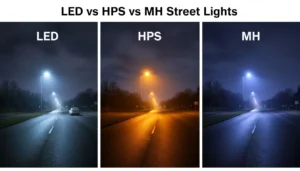
Which Street Light is Best: LED, HPS, or Metal Halide?

Choosing the wrong street lights means high bills and unsafe roads. Don't let outdated tech drain your budget. I'll explain the key differences to help you choose wisely.
For most street lighting projects, LED is the clear winner. It provides the best energy savings, longest lifespan, and superior visibility. While HPS and MH are older options, LED's lower total cost of ownership and smart features make it the modern standard for safety and efficiency.

I've spent over 13 years in the lighting industry, helping contractors and developers navigate these choices. I've seen projects succeed or fail based on this single decision. It's not just about the light source; it's about the entire system, from the driver inside to the optics that shape the beam. Making the right choice upfront saves you a decade of headaches and unexpected costs. Let's dive into what really matters when you're making this critical decision for your project.
LED street lights can reduce energy consumption by up to 80% compared to HPS.True
LEDs have much higher system efficacy, converting more electricity into useful light on the target surface, while HPS wastes significant energy as heat.
HPS lights have better color rendering than Metal Halide lights.False
HPS lights have a very low CRI (20-30), producing a monochromatic yellow light. Metal Halide lights have a much better CRI (65-80), rendering colors more accurately.
What Really Matters When Choosing Street Lights?
Picking lights based on initial price alone is a common mistake. This leads to hidden costs and poor performance. I'll show you the five key factors for a successful project.
Focus on five things: energy efficiency1, system optics, visibility (CRI/CCT), lifecycle cost, and control readiness. These factors determine long-term performance, safety, and total cost of ownership, ensuring you get the best value and reliability for your investment.
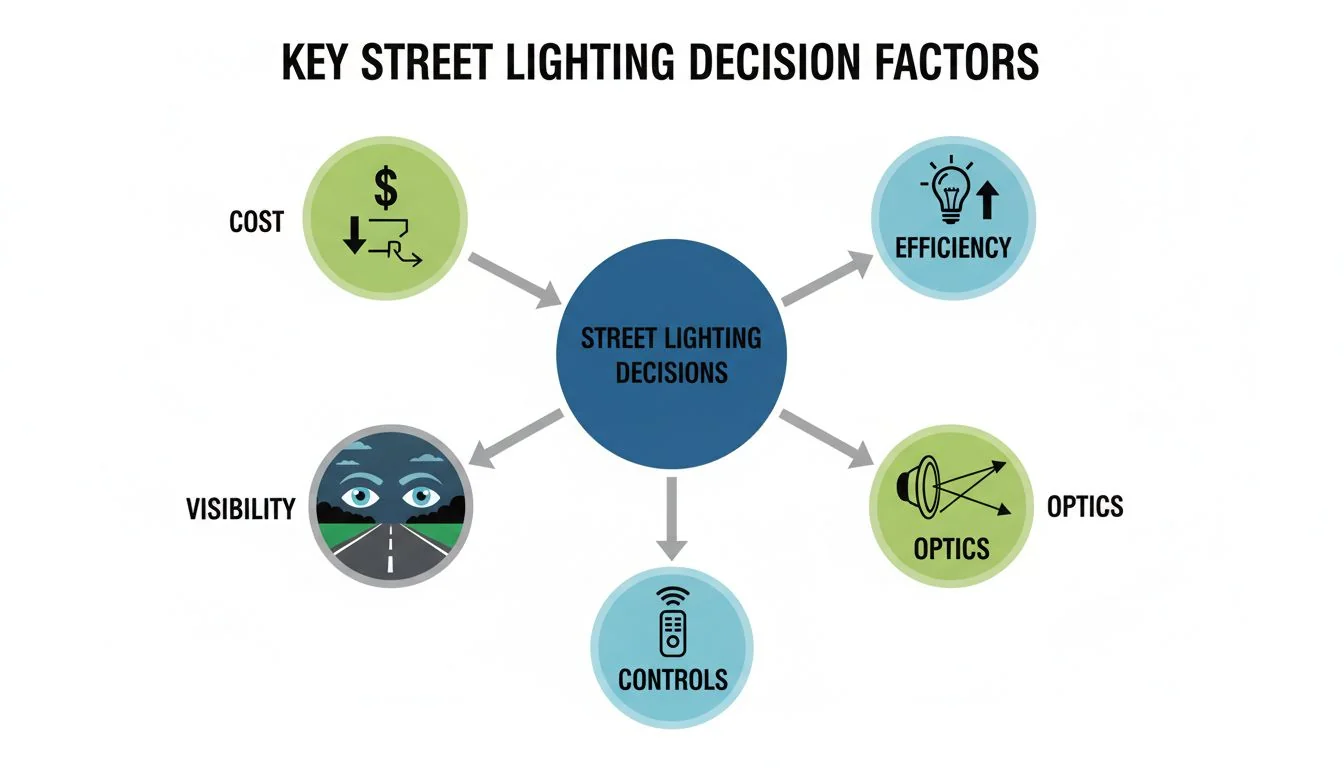
When I work with a developer like Somchai in Thailand, we don't just talk about the price of a fixture. We talk about the total cost over 10 or 20 years. It's a long-term partnership, and the decisions we make on day one impact the project's profitability for years. Here’s what we focus on.
1. System Efficiency, Not Just Source Efficacy
Don't be fooled by a high lumen-per-watt (lm/W) number on a spec sheet. What matters is system efficiency2—how much light actually hits the road. This includes power losses from the driver and, most importantly, the precision of the optics. A well-designed optic (like a Type II for long roads or Type III for wider areas) directs light precisely where it's needed, minimizing wasted light that causes pollution and trespass. This is what I call "useful lumens," and it's the most important metric for efficiency.
2. Visibility: More Than Just Brightness
Visibility is about the quality of light, not just the quantity. We look at two key metrics:
- Color Rendering Index (CRI): A measure from 0-100 of how accurately a light source shows colors. HPS is terrible at this (CRI ~25), making everything look a sickly yellow. A good LED has a CRI of 70-80+, so colors look natural.
- Correlated Color Temperature (CCT): This describes the "color" of the white light, from warm yellow (3000K) to neutral white (4000K) to cool blue (5000K+).
3. Lifecycle Cost and Control Readiness
The initial purchase is just one part of the cost. You must consider energy use, maintenance (relamping), and component replacement (drivers/ballasts) over the fixture's life. Modern LEDs are also "control ready" with systems like 0-10V or DALI, allowing for dimming and smart city integration, which saves even more money down the line.
A higher CRI always means better visibility at night.False
While higher CRI improves color recognition, scotopic/photopic (S/P) ratio is also critical for night vision. 'Cooler' CCT light with a higher S/P ratio can improve peripheral vision and reaction times even if the CRI is the same.
System optics can improve light utilization by over 40% compared to a bare lamp.True
Specialized optics like Type II, III, or V distributions shape the light beam to match the roadway geometry, directing lumens onto the pavement and sidewalks instead of into the sky or private property.
How Do LED, HPS, and MH Really Compare on the Road?
Spec sheets can be confusing and misleading. You're trying to compare apples and oranges with different metrics. I'll give you a harmonized, real-world comparison of these three technologies.
LED outperforms HPS and MH in almost every category. It has a much longer L70 lifespan (100,000+ hours vs. ~24,000), higher system efficiency on the road, and superior light quality. HPS and MH suffer from rapid lumen depreciation3 and poor color rendering.

I remember a project in North America where the client was stuck on the initial lm/W of an HPS lamp. It looked good on paper, but I had to show them the real-world numbers after accounting for ballast losses and wasted light. Let's look at a clear, side-by-side comparison.
A Harmonized Look at the Technologies
To make a fair comparison, we need to look at the whole system, not just the lamp. This includes the driver or ballast and the fixture optics.
| Feature | LED | High-Pressure Sodium (HPS) | Metal Halide (MH) |
|---|---|---|---|
| System Efficacy | 120-170 lm/W | 80-110 lm/W | 70-95 lm/W |
| L70 Lifespan | 100,000+ hours | ~24,000 hours | ~15,000 hours |
| CRI | 70-90+ | 20-30 (Poor) | 65-80 (Good) |
| CCT | 2700K-5000K | ~2200K (Yellow) | 3000K-4200K (White) |
| Control | Instant-on, Dimmable | Slow start, Not dimmable | Slow start, Limited dimming |
| Failure Mode | Gradual dimming | End-of-life cycling, failure | Color shift, failure |
What "L70 Lifespan" Really Means
L70 isn't when the light burns out. It's the point when it has dimmed to 70% of its original brightness. For HPS and MH, this happens much faster. In hot climates, like many projects I've supplied in the Middle East and South Asia, this degradation is even quicker for these old HID sources. Quality LEDs with robust heat sinking and reliable drivers, like the ones we use at Besenled, maintain their output far more predictably. This means fewer dark spots and fewer emergency truck rolls for maintenance.
An L70 lifespan of 100,000 hours equals over 22 years of operation.True
Assuming an average operation of 12 hours per night (4,380 hours per year), a 100,000-hour lifespan equates to approximately 22.8 years.
All LED drivers are rated for 100,000 hours.False
Driver lifespan is a critical, and often separate, rating. Lower-quality drivers can fail long before the LEDs themselves, so it's essential to specify drivers tested to at least 100,000 hours for long-term reliability.
What is the True 10-Year Cost of a Street Light?
Focusing only on the fixture price is a trap. The real cost includes energy, maintenance, and replacements over a decade. I'll show you how to calculate the Total Cost of Ownership (TCO).
The 10-year Total Cost of Ownership (TCO) for LED is significantly lower than for HPS or MH. While the initial cost may be higher, massive energy savings and virtually zero relamping costs mean LED provides a much faster return on investment.
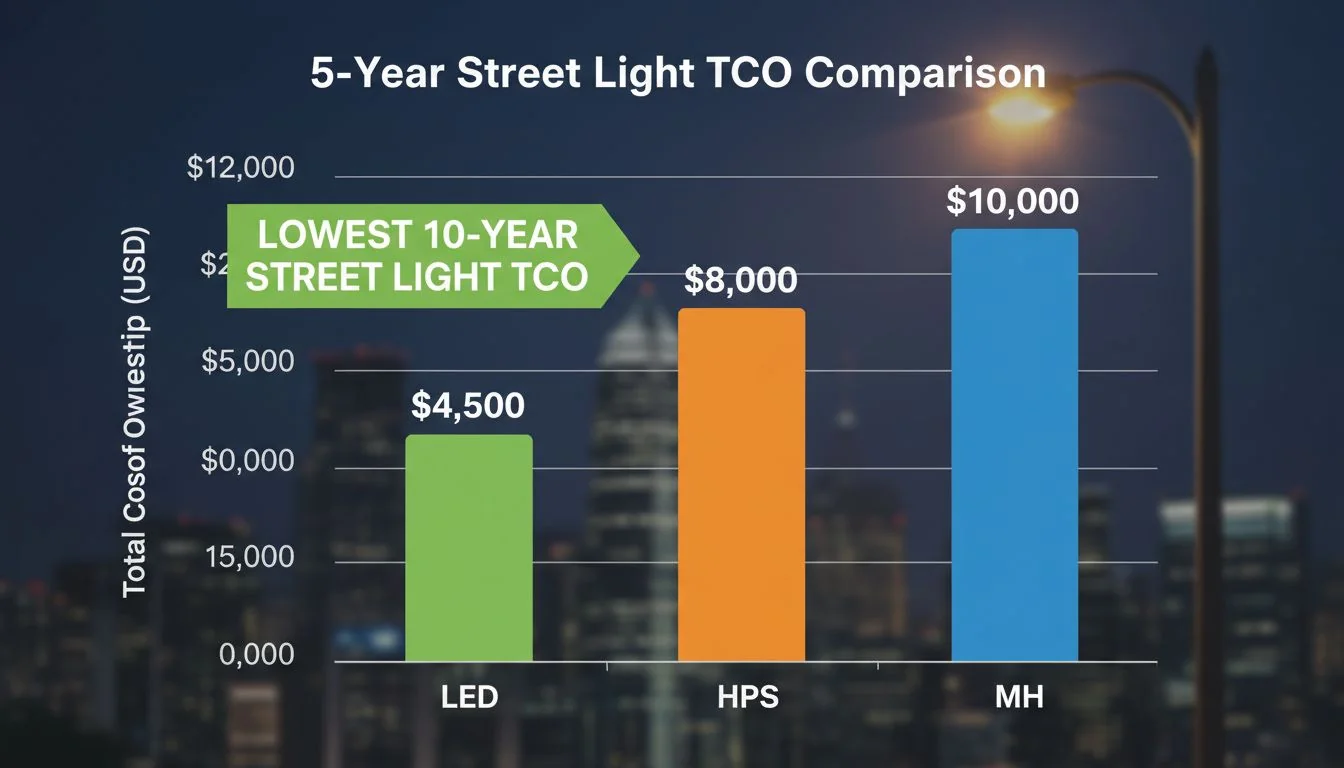
Let's run the numbers for a single fixture over 10 years. This is the kind of analysis we do for large-scale developers to justify the switch to LED. We'll compare a typical 150W HPS fixture with a modern 70W LED equivalent that delivers the same amount of useful light on the ground.
10-Year TCO Breakdown (Per Fixture)
This model assumes an electricity cost of $0.12/kWh and 4,380 operating hours per year.
| Cost Component | 70W LED | 150W HPS |
|---|---|---|
| Initial Fixture Cost | $150 | $80 |
| Energy Cost (@$0.12/kWh) | $368 | $788 |
| Relamping Cycles (Lamps) | 0 | 2 (@$40/lamp) = $80 |
| Relamping Labor | $0 | 2 (@$100/trip) = $200 |
| Ballast/Driver Replacement | 0 | 1 (@$50) = $50 |
| Ballast Labor | $0 | 1 (@$100/trip) = $100 |
| Total 10-Year Cost | $518 | $1,298 |
As you can see, the HPS fixture costs more than double the LED over a decade, even with a lower initial price. The savings come from two places: over 50% reduction in energy use and the complete elimination of relamping and ballast replacement cycles. For a city with thousands of street lights, these savings run into the millions. This is why municipalities and large developers are switching to LED so aggressively.
Labor for relamping can cost more than the lamp itself.True
The cost of dispatching a bucket truck and a qualified technician for a single fixture replacement often exceeds $100, which is typically more than the cost of a replacement HPS or MH lamp.
LEDs don't require any maintenance for 10 years.False
While LEDs don't need relamping, fixtures may still require periodic cleaning of the lens and heat sink to maintain performance, especially in dusty or polluted environments. However, this is far less frequent and costly than HID maintenance.
How Do You Choose the Right Light Color for Maximum Safety?
Is brighter always safer? Not necessarily. The wrong color temperature can create harsh glare and poor visibility. I'll explain how to select the right CRI and CCT for different road types.
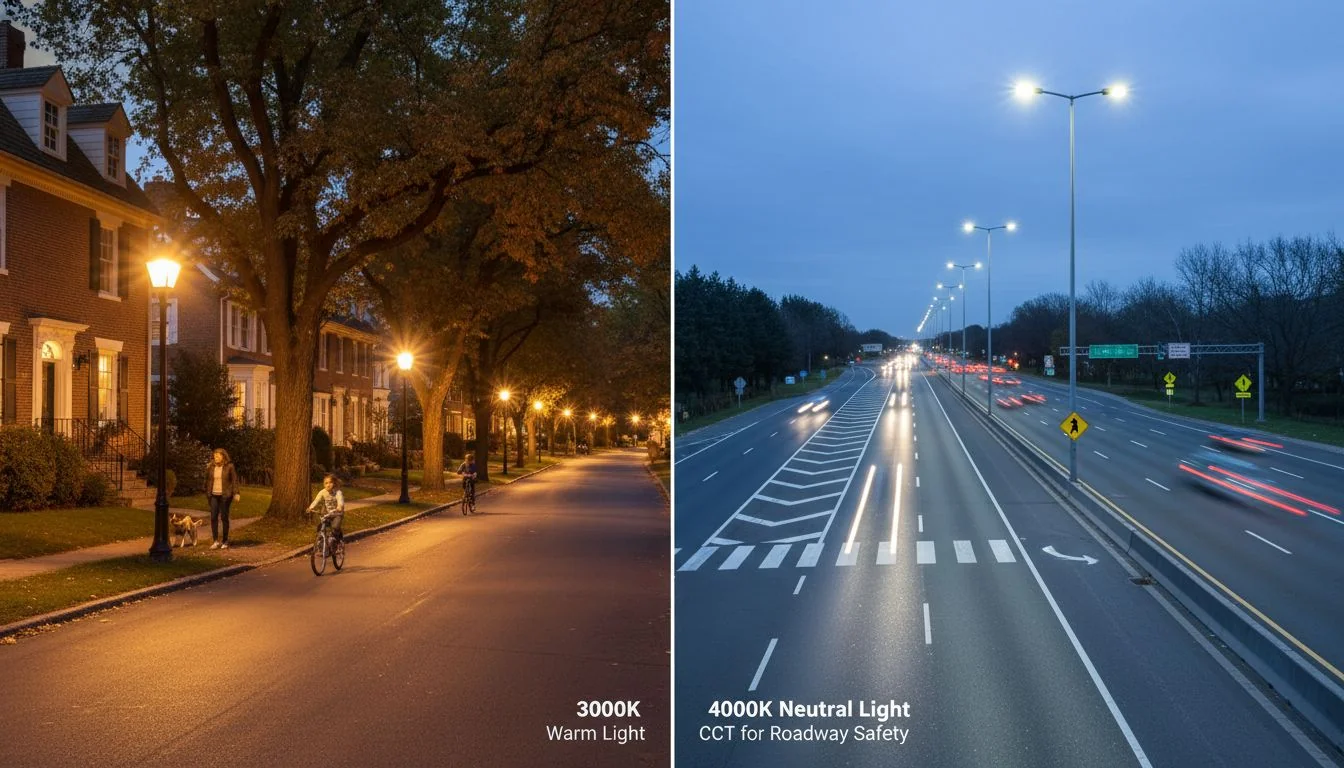
For optimal safety, use a higher CRI (70+) to see colors accurately. Choose a warmer CCT (3000K) for residential streets to reduce glare and a neutral CCT (4000K) for main roads and commercial areas to improve alertness and visibility.
I once consulted on a residential project where the developer installed 5000K lights. The residents complained constantly about the harsh, "prison-yard" glare. It was a costly mistake to fix. Choosing the right light color is crucial for public acceptance and real-world safety.
Matching CCT to Roadway Type
There's no single "best" color temperature; it depends entirely on the environment.
- Residential Streets (3000K): A warmer, slightly yellowish-white light is ideal here. It feels more welcoming and is less disruptive to human sleep patterns (circadian rhythm). With a high CRI (70+), you still get excellent color definition, making it easy to identify people, cars, and objects.
- Arterial Roads & Commercial Zones (4000K): A neutral white light is better for high-traffic areas. This color temperature improves visual acuity and alertness for drivers. It makes road markings and potential hazards stand out more clearly.
Controlling Glare is Non-Negotiable
The best light is useless if it's blinding. Glare is a major safety hazard. We control it in two main ways:
- advanced optics4: Using precise optics (like Type II for long, narrow roads or Type V for intersections) ensures light goes down onto the pavement, not sideways into drivers' eyes or residents' windows.
- Proper Pole Height & Spacing: Taller poles allow for wider light distribution with less direct glare. We model this in software to ensure uniform coverage without dangerous bright or dark spots.
4000K light is twice as safe as 3000K light.False
While 4000K light can improve driver alertness, safety is a complex function of illuminance, uniformity, glare control, and CRI. 3000K light with good design can be just as safe, and is often preferred in residential areas to minimize ecological and residential disruption.
The American Medical Association (AMA) recommends 3000K or lower for residential street lighting.True
In 2016, the AMA issued guidance recommending the use of lower CCT lighting (3000K or below) to reduce potential negative impacts on human health and the environment from high-intensity, blue-rich LED lighting.
Can You Make Street Lights Smarter and More Efficient?
Your street lights are on at full power all night, wasting energy when no one is around. There's a smarter way. I'll show you how modern controls can cut costs even further.
Yes, LED street lights are perfect for smart controls5. Their instant-on capability allows for dimming, adaptive lighting with motion sensors, and easy integration with control systems like 0-10V or DALI, unlocking significant additional energy savings and data collection.

For a large warehouse parking lot project in South America, we integrated motion sensors with our pole lights. The lights stay at 20% brightness until a truck or employee enters an area, then ramp up to 100%. The client saw an additional 40% energy savings on top of the LED conversion. This is the power of smart controls.
How Smart Controls Work with LEDs
Legacy HPS and MH lights are "dumb." They are either on or off, and they need time to warm up. LEDs are inherently digital and controllable.
- Scheduled Dimming: The simplest form of control. You can program the lights to dim during off-peak hours, for example, from 100% down to 50% between midnight and 5 AM. This is easy to implement and provides immediate savings.
- Adaptive Lighting: By adding sensors, the lights can react to their environment. A motion sensor can trigger a light to go from a dimmed state to full brightness when a vehicle or person is detected, enhancing safety on demand while saving energy.
- Networked Systems (0-10V & DALI): These are the backbones of smart lighting.
- 0-10V: A simple, reliable analog protocol for dimming groups of lights together.
- DALI: A more advanced digital protocol that allows you to control each light individually. You can get status updates, monitor energy use, and receive failure alerts right on your computer. This is the foundation for a true smart city grid.
Smart controls can double the energy savings of an LED conversion.False
While smart controls provide significant additional savings, typically in the range of 20-40%, they don't double the initial 50-70% savings from the LED conversion itself. The total savings are cumulative.
DALI systems can report lamp and driver failures remotely.True
DALI (Digital Addressable Lighting Interface) is a two-way communication protocol. It allows fixtures to report their status, including lamp failures, driver failures, and energy consumption, back to a central management system, eliminating the need for manual inspections.
How Do You Choose the Perfect Street Light in 4 Simple Steps?
Feeling overwhelmed by all the options? It's easy to get lost in the technical details. I'll give you a simple 4-step framework to specify the right light every time.
Follow this 4-step rubric: 1) Identify the road class (residential, arterial). 2) Determine pole height and spacing. 3) Set the target illuminance and uniformity. 4) Match the right fixture (wattage, optics, CCT) to your budget and TCO goals.
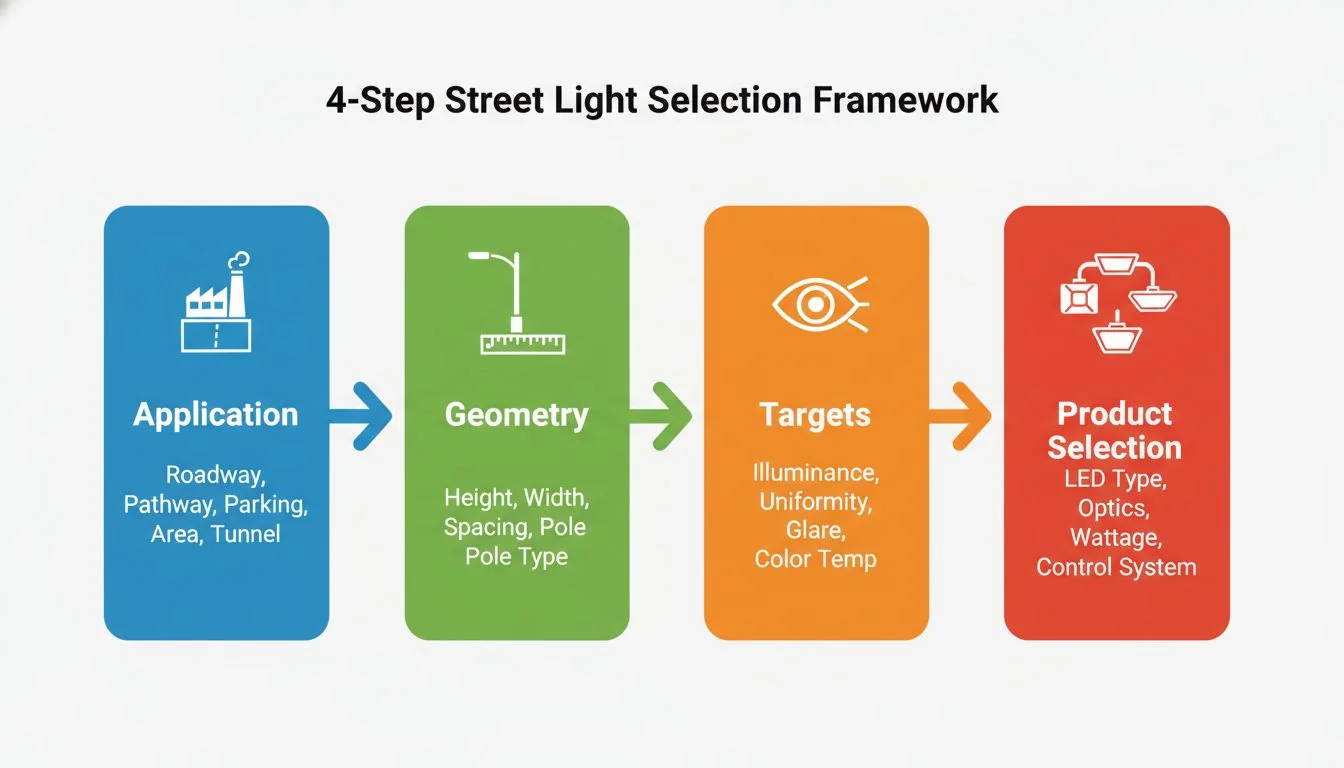
When a new client comes to me, I don't start by showing them a catalog. I start by asking questions. This process helps us build the perfect specification together. Here is the simple framework I use.
A 4-Step Rubric for Success
- Define the Application: First, what are we lighting? A residential street in a European suburb has very different needs than a major highway in the Middle East or a commercial parking lot in North America. This determines your priorities for CCT, CRI, and light levels.
- Map the Geometry: Next, we look at the physical layout. What is the pole height? How far apart are they? This information is essential for choosing the correct optical distribution type to ensure light goes where it's needed without creating dark spots or glare.
- Set Performance Targets: Based on the application, we define the required light levels (illuminance) and uniformity. These are technical targets, often guided by local codes or standards like IESNA RP-8, to ensure safety and performance.
- Select the Right Product: Only now do we select the fixture. Based on the first three steps, we can pinpoint the exact wattage, CCT, CRI, and optic needed. We often run a DIALux simulation to create a 3D model that proves our selected fixture will meet the performance targets before a single dollar is spent.
DIALux is a software used to design buildings.False
DIALux is a professional lighting design software used to plan, calculate, and visualize lighting for indoor and outdoor spaces, including roadways and parking lots. It is not a general architectural design tool.
Pole spacing is more important than pole height for choosing optics.True
While both are important, the ratio of pole spacing to mounting height is the key determinant for selecting the correct optical distribution type (e.g., Type I, II, III, IV, V) to achieve uniform light coverage.
Have More Questions About Street Lighting?
You still have some specific questions about lifespan, viability, and ROI. Getting clear answers is tough. I've compiled the most common questions I get from clients and answered them directly.
Here are quick answers to your top questions. LEDs last longest (100,000+ hours). LEDs offer the best visibility (high CRI). Yes, LEDs are more efficient on the road due to superior optics. And yes, solar LED is now a viable option for many applications.

What lasts longer: LED or HPS street lights?
LED, by a huge margin. A quality LED fixture has an L70 lifespan of over 100,000 hours (22+ years). HPS lamps last around 24,000 hours (5-6 years) but often need replacement sooner due to rapid light loss.
Which has better visibility: LED, HPS, or metal halide?
LED provides the best visibility. Its high CRI (70+) renders colors naturally, making it easier to identify objects, people, and potential hazards. MH is second best (CRI 65-80), while HPS is the worst (CRI <30), making everything look monochromatic yellow.
Are LEDs more efficient on roads than their lm/W suggests?
Yes, absolutely. This is about system efficiency. Advanced optics in LED fixtures direct light precisely onto the road surface ("useful lumens"), whereas HPS lamps waste a lot of light upwards and sideways into the sky.
Do LEDs work with motion sensing and dimming?
Yes, perfectly. Their instant-on/off nature makes them ideal for all smart controls, including dimming schedules and motion-based adaptive lighting. This is impossible with HPS or MH, which require a long warm-up time.
What’s the typical CRI/CCT for roadway safety?
For safety and visibility, a CRI of 70+ is recommended. For CCT, use 3000K for residential areas (less glare, better for residents) and 4000K for arterial roads and commercial zones (improves driver alertness).
Is solar LED viable for streets?
Yes, it's increasingly viable, especially for areas without reliable grid access, new developments, and parks. Battery and panel efficiency have improved dramatically, making it a cost-effective, sustainable option for many projects we handle.
Any municipal ROI references?
Many. For example, the City of Los Angeles replaced 140,000 streetlights with LEDs, saving over $7 million and 60% in energy annually. Detroit's project saved $1.5 million annually. These case studies prove the financial benefits are massive.
Solar street lights work well in cloudy regions like Northern Europe.False
While solar technology has improved, performance is still highly dependent on available sunlight (insolation). In regions with long, cloudy winters, systems require significantly oversized panels and batteries to ensure reliability, which can make them less cost-effective than grid-tied solutions.
The City of Los Angeles's LED street light conversion was the largest in the world at the time.True
Completed in 2013, the project to replace over 140,000 HPS lights with LEDs was a landmark initiative and served as a model for many other cities globally.
Conclusion
Choosing the right street light is simple when you look at the total picture. LED offers the best long-term value, safety, and efficiency for any modern infrastructure project.
References
-
Understanding energy efficiency can help you make informed decisions that save costs and enhance safety. ↩
-
Discovering system efficiency can lead to better lighting choices that maximize performance and minimize waste. ↩
-
Learning about lumen depreciation is essential for understanding the longevity and performance of lighting systems. ↩
-
Understanding advanced optics can help you choose lighting solutions that direct light effectively and reduce glare. ↩
-
Exploring smart controls can show how technology improves energy savings and operational efficiency. ↩