What Are The Main Types Of Street Lights?
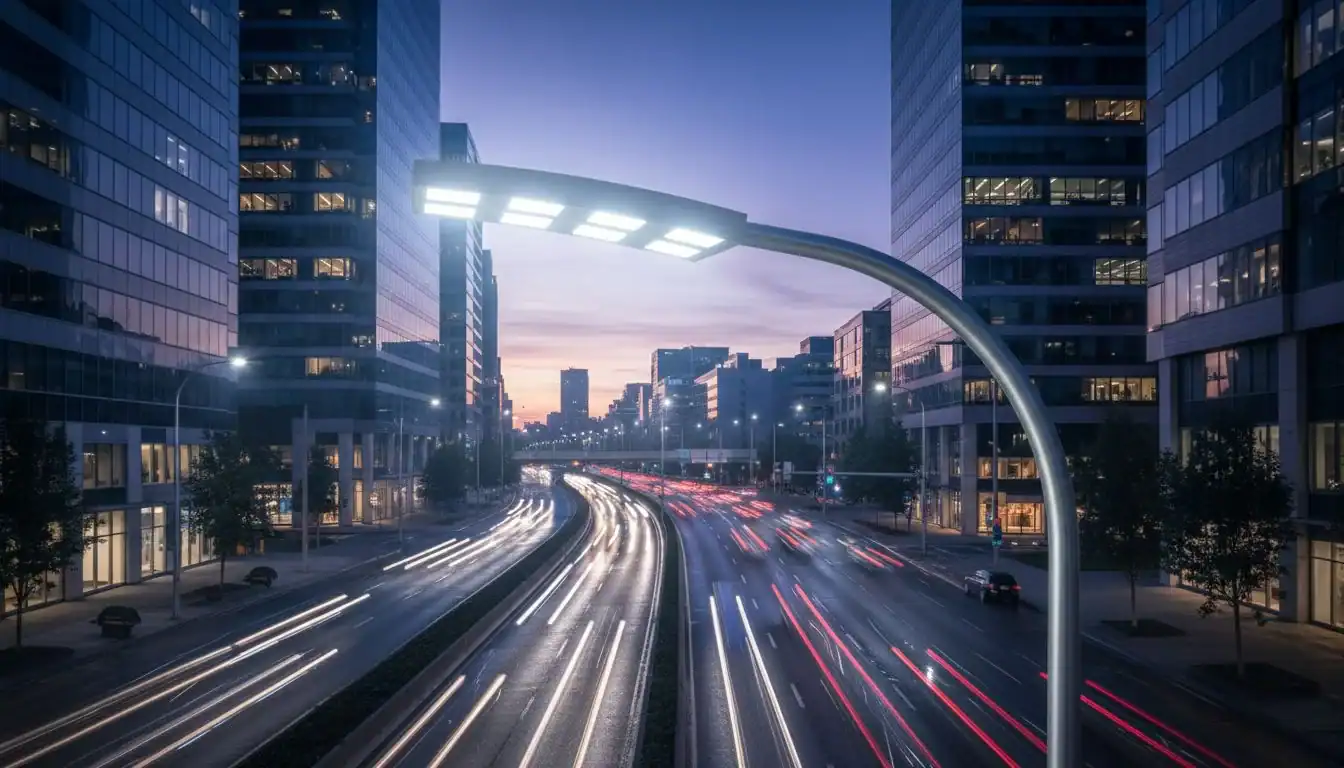
Rising electricity bills and frequent maintenance are draining your budget. Outdated street lights offer poor visibility and fail often, creating safety risks and constant headaches for your team.
The main types of street lights are High-Pressure Sodium (HPS), Light Emitting Diode (LED), and Solar LED1. LED is the modern standard for grid-power due to its high efficiency and long life, while solar is ideal for areas without grid access, offering energy independence.
Choosing the right street light feels overwhelming. You have to balance upfront costs with long-term savings, meet complex safety standards, and ensure reliability for years to come. A wrong choice leads to budget overruns, compliance failures, and public complaints. But making the right decision can secure massive energy savings, reduce maintenance to almost zero, and improve public safety overnight. In my 13 years in the lighting industry, I've helped hundreds of clients navigate this process. This guide gives you the clear, numbers-backed data you need to make a confident decision and end your search.
Switching a city's street lights to LED can reduce energy consumption by up to 64.5%.True
The City of Los Angeles reported a 64.5% energy reduction and $10.6 million in annual savings after its LED street light conversion program, as documented by the LA Bureau of Street Lighting.
Solar street lights do not work on cloudy days.False
Modern solar street lights use oversized battery systems designed to store enough energy for 3-5 consecutive cloudy or rainy days, ensuring reliable operation.
Lamp vs. Fixture: How do you choose the right technology and housing for your road?
Your old fixtures are failing, but you're not sure if you need a whole new unit or just a new bulb. This confusion can lead to buying the wrong parts or overspending.
Think of the "lamp" as the light source (like an LED chip or HPS bulb) and the "fixture" as the protective housing that holds it and directs the light. Choosing the right combination is key for performance, durability, and meeting project requirements for light distribution.
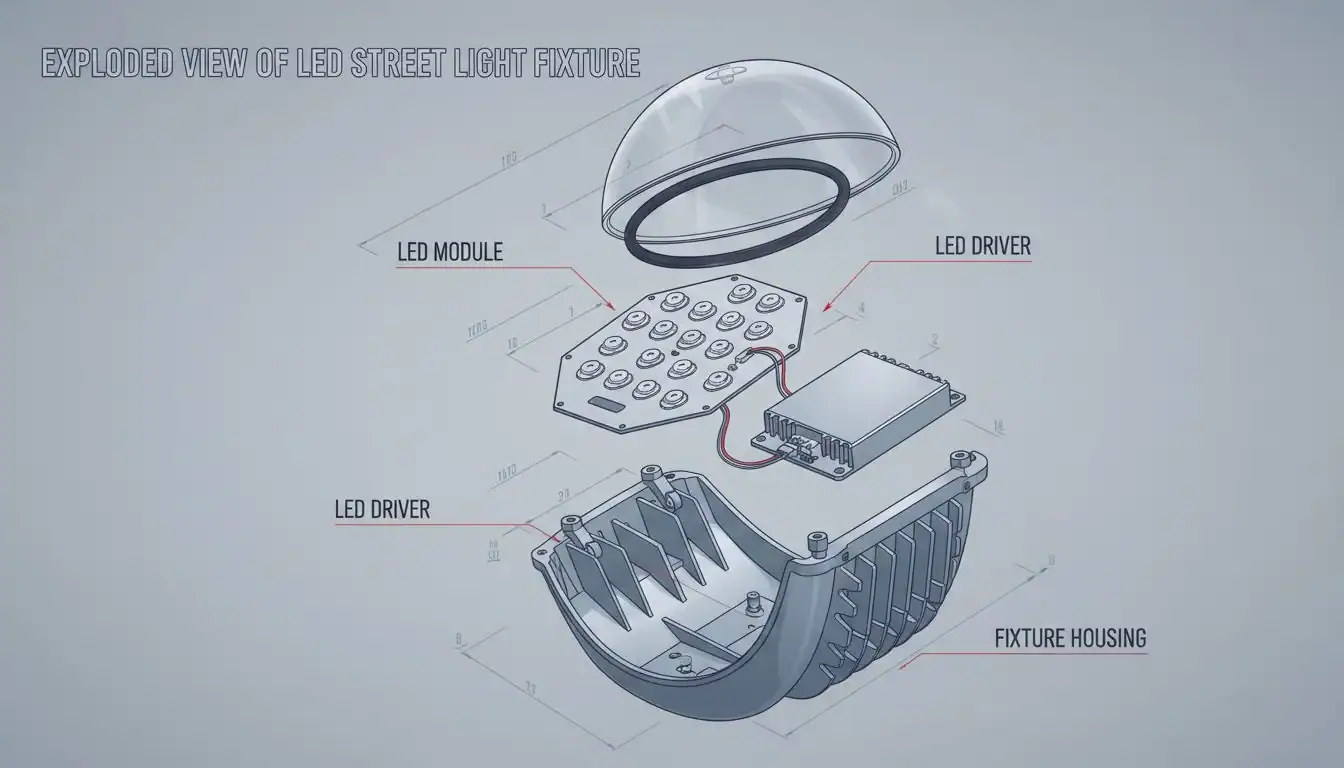
When I talk to project managers, many focus only on the lamp's technology, like LED versus HPS. That's only half the story. The fixture, or housing, is just as critical. It protects the sensitive electronics from water, dust, and impact (look for IP65/IP66 ratings). It also manages heat, which is vital for an LED's long lifespan. A poorly designed fixture will cause even the best LED chips to fail early.
More importantly, the fixture's Optics2 shape how light is distributed on the ground.
Key Housing Considerations
- Material: Die-cast aluminum is the standard for a reason. It's durable and excellent at dissipating heat, extending the life of the internal components.
- IP Rating3: An IP65 rating is the minimum for outdoor use. It ensures the fixture is dust-tight and can withstand water jets. For harsh environments, IP66 or higher is better.
- Optics: The lens inside the fixture determines the light distribution pattern (e.g., Type II, III, IV). You must match the optics to your road or area's geometry to ensure uniform light and avoid dark spots.
Choosing the right fixture ensures your investment is protected and performs exactly as specified for decades.
A street light's fixture is only for aesthetics.False
The fixture is critical for thermal management, environmental protection (IP rating), and optical control (light distribution), directly impacting the lamp's performance and lifespan.
Die-cast aluminum is the preferred material for high-quality LED street light fixtures.True
Die-cast aluminum offers an excellent combination of strength, corrosion resistance, and thermal conductivity, which is essential for dissipating heat from the LED components.
Standards to Specs: How do you map RP-8 and EN 13201 to your project?
You're told your project must comply with RP-8 or EN 13201, but these documents are dense and confusing. You risk over-specifying and wasting money, or under-specifying and failing inspections.
These standards simply tell you how much light is needed for a specific type of road to be safe. They translate complex requirements into clear targets for Illuminance4 (brightness) and uniformity, which you can then match to a product's specifications.
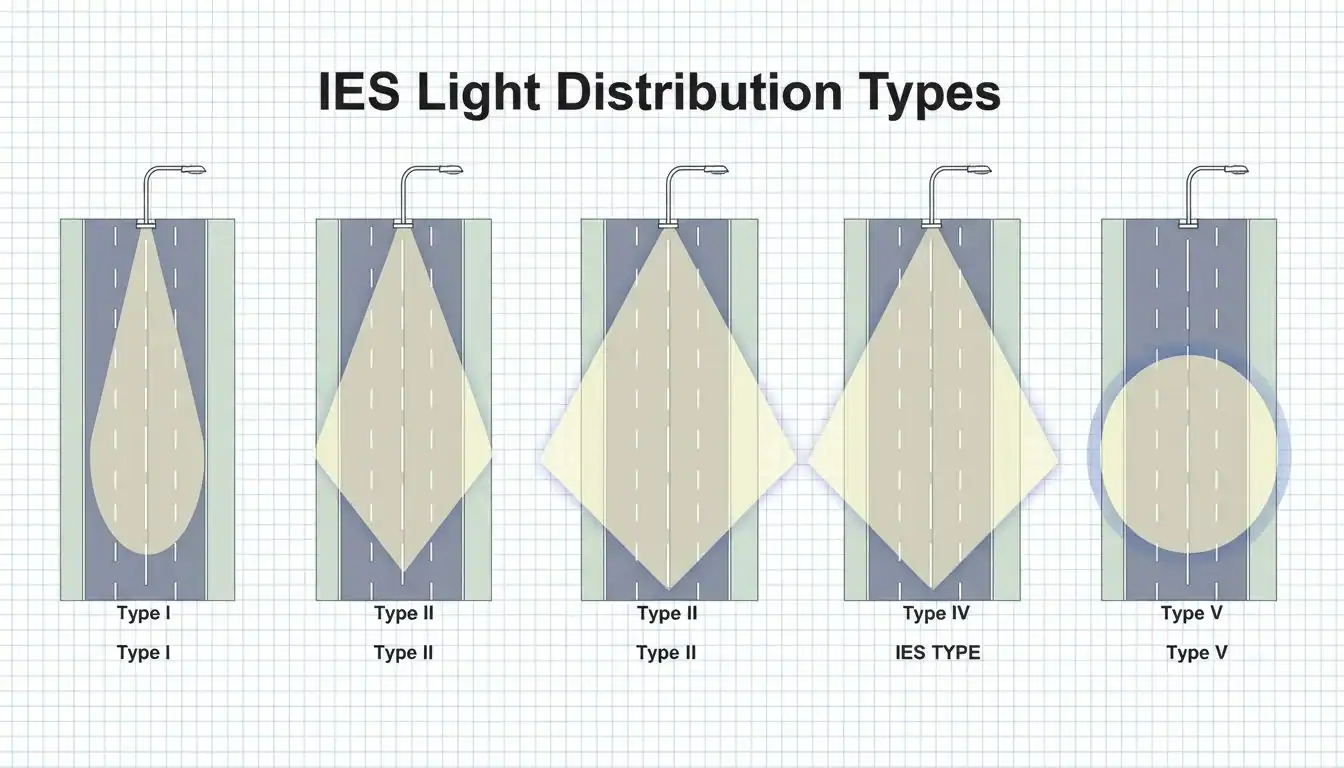
Let's break this down. As a supplier, I see clients get stuck here all the time. Think of standards as a recipe. They don't tell you which brand of flour to buy, but they tell you how much you need. RP-8 (from the Illuminating Engineering Society, or IES, common in North America) and EN 13201 (common in Europe) classify roads based on traffic volume and pedestrian use. Your job is to find a light that delivers the "recipe" for your specific road class.
Translating Standards to Product Specs
First, identify your road class in the standard. Then, look for two main things:
- Illuminance/Luminance: How bright the surface should be. Measured in lux or footcandles (fc).
- Uniformity: The ratio of average to minimum light levels. This prevents dangerous dark spots between poles.
Here’s a simplified table to show how this works.
| Road/Area Type (Example) | Standard Class (Example) | Required Avg. Illuminance (Lux) | Uniformity Ratio5 (Avg:Min) | Recommended Light Distribution |
|---|---|---|---|---|
| Major Urban Road | RP-8: M2 / EN 13201: ME2 | 12-20 lux | 3:1 | Type II or Type III |
| Collector Road | RP-8: M3 / EN 13201: ME3a | 8-12 lux | 4:1 | Type II |
| Local Residential Street | RP-8: M4 / EN 13201: ME4a | 4-6 lux | 6:1 | Type I or Type II |
| Commercial Parking Lot | RP-8: General Parking | 5-10 lux | 4:1 | Type IV or Type V |
With this information, you can ask a supplier like me for a "100W LED fixture that delivers an average of 15 lux with a 3:1 uniformity ratio using Type III optics." That's a request we can act on immediately, providing you with a photometric layout to prove compliance.
EN 13201 and RP-8 are interchangeable standards.False
While both are roadway lighting standards, they use different methodologies and classification systems. EN 13201 is primarily based on luminance (light reflected from the surface), while RP-8 often uses illuminance (light falling on the surface).
Light distribution 'Types' (e.g., Type II, Type III) are defined by the IES to describe the shape of the light pattern on the ground.True
These classifications help lighting designers match a fixture to the geometry of the roadway or area, ensuring efficient and uniform coverage.
LED vs. HPS in Numbers: What efficiency, lifespan, and maintenance can you budget for?
You know LED is better, but you need hard numbers for your budget proposal. Without a clear cost-benefit analysis, it's hard to justify the upfront investment over cheaper, older HPS technology.
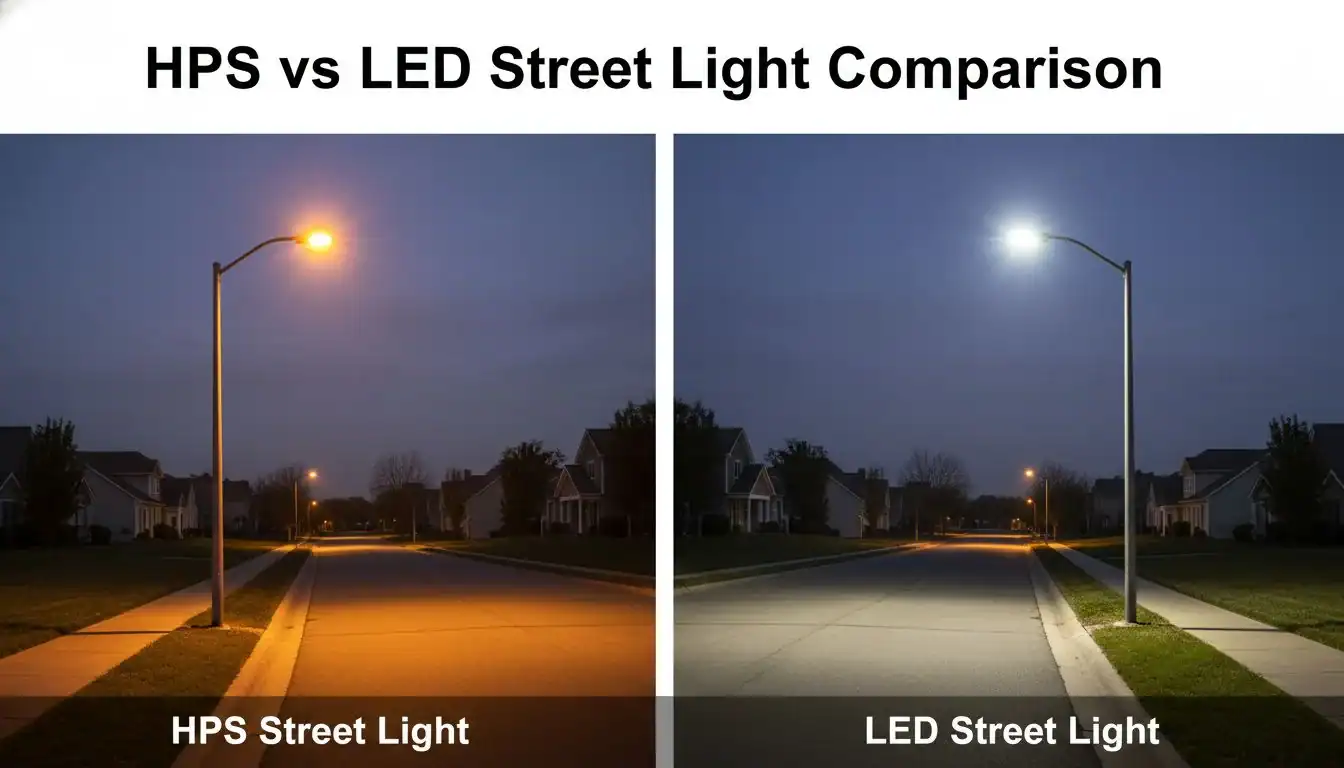
LEDs offer over 75% energy savings, last 5-10 times longer than HPS, and require almost no maintenance. This translates directly into lower electricity bills and operational costs, with a typical payback period of 2-4 years.
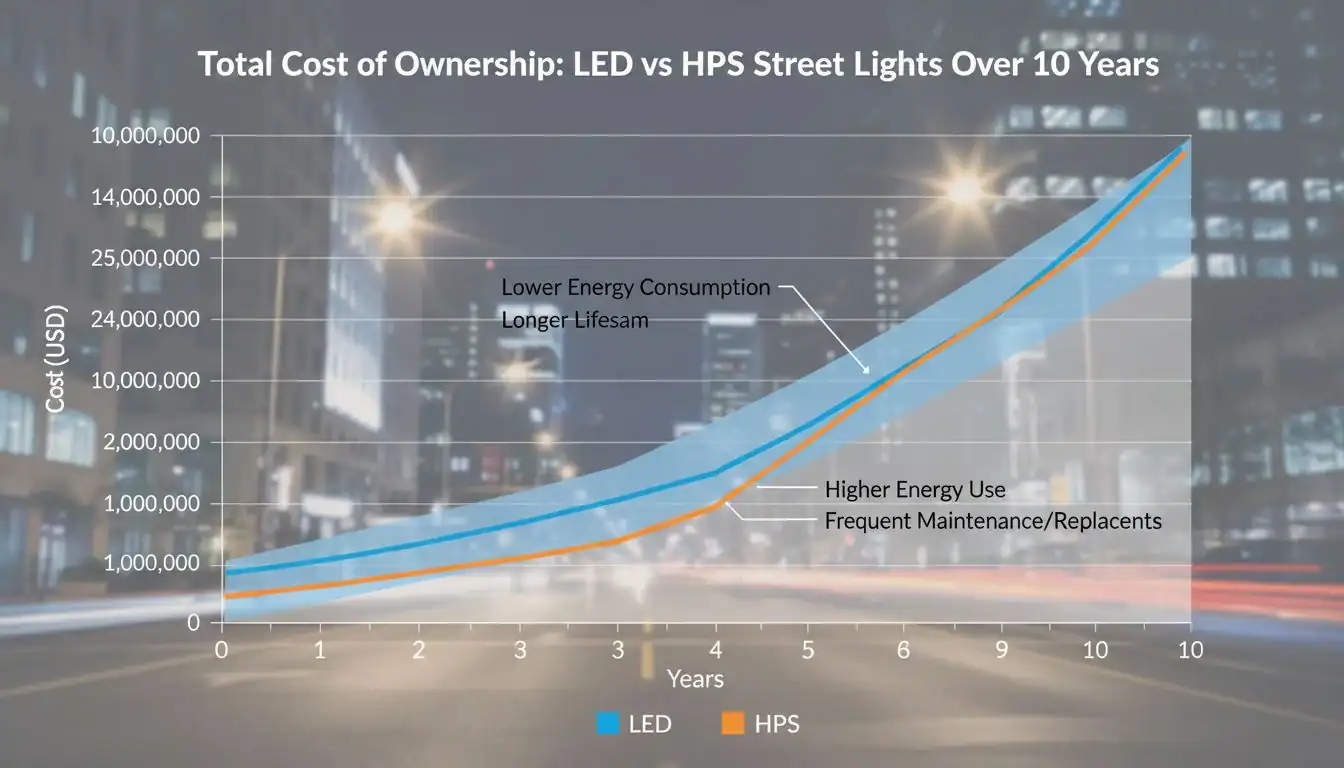
When I present the numbers to procurement directors, the decision becomes simple. The initial cost of HPS is tempting, but the total cost of ownership is a budget killer. Let's look at a direct comparison based on a typical 150W HPS equivalent.
Head-to-Head: LED vs. HPS
| Feature | High-Pressure Sodium (HPS) | Modern LED (e.g., Besenled) | The Financial Impact |
|---|---|---|---|
| Power Draw | ~180W (with ballast) | ~50W | ~72% immediate energy savings. |
| Efficiency (lm/W) | 80-100 lm/W | 140-170 lm/W | More light for less energy. |
| Lifespan (Hours) | 10,000 - 24,000 hours | 50,000 - 100,000 hours | 5-10x fewer replacements. |
| Maintenance Cycle | Replace lamp every 2-4 years | Replace fixture every 10-20 years | Drastically reduced labor costs. |
| Color Rendering (CRI) | 20-30 (Poor, yellow light) | 70-80+ (Good, white light) | Improved visibility and safety. |
| Failure Mode | Fails completely | Dims gradually (L70) | Predictable end-of-life. |
The U.S. Department of Energy has documented these savings extensively. Cities like Los Angeles saved over $10 million annually after their conversion. The numbers are clear. While an HPS lamp is cheap, you'll pay for it multiple times over in electricity and maintenance crews. An LED fixture is an asset that pays for itself. And regarding quality issues like the "purple light" phenomenon you may have seen, that's a sign of low-quality phosphor degradation. At Besenled, we use high-stability chips and robust quality control to ensure color integrity for the entire lifespan of the fixture.
LED street lights have a payback period of over 10 years.False
With significant energy savings (50-80%) and reduced maintenance, the typical payback period for an LED street light conversion is 2-4 years, depending on electricity rates and operating hours.
L70 lifespan means the LED will produce 70% of its initial light output at the end of its rated life.True
This is the industry standard for measuring the useful life of an LED product. Unlike traditional lamps that burn out, LEDs dim gradually over a very long period.
Form Factors that Perform: Which housing—Cobrahead, shoebox, or post-top—fits best?
You need to light a road, a parking lot, and a park, but using the same fixture everywhere is inefficient. Choosing the wrong form factor leads to poor light distribution, wasted energy, and a mismatched aesthetic.
Match the form factor to the function: use Cobraheads for roadways, Shoebox Fixtures6 for large open areas like parking lots, and Post-Tops for pedestrian pathways and decorative applications. This ensures optimal performance and efficiency.
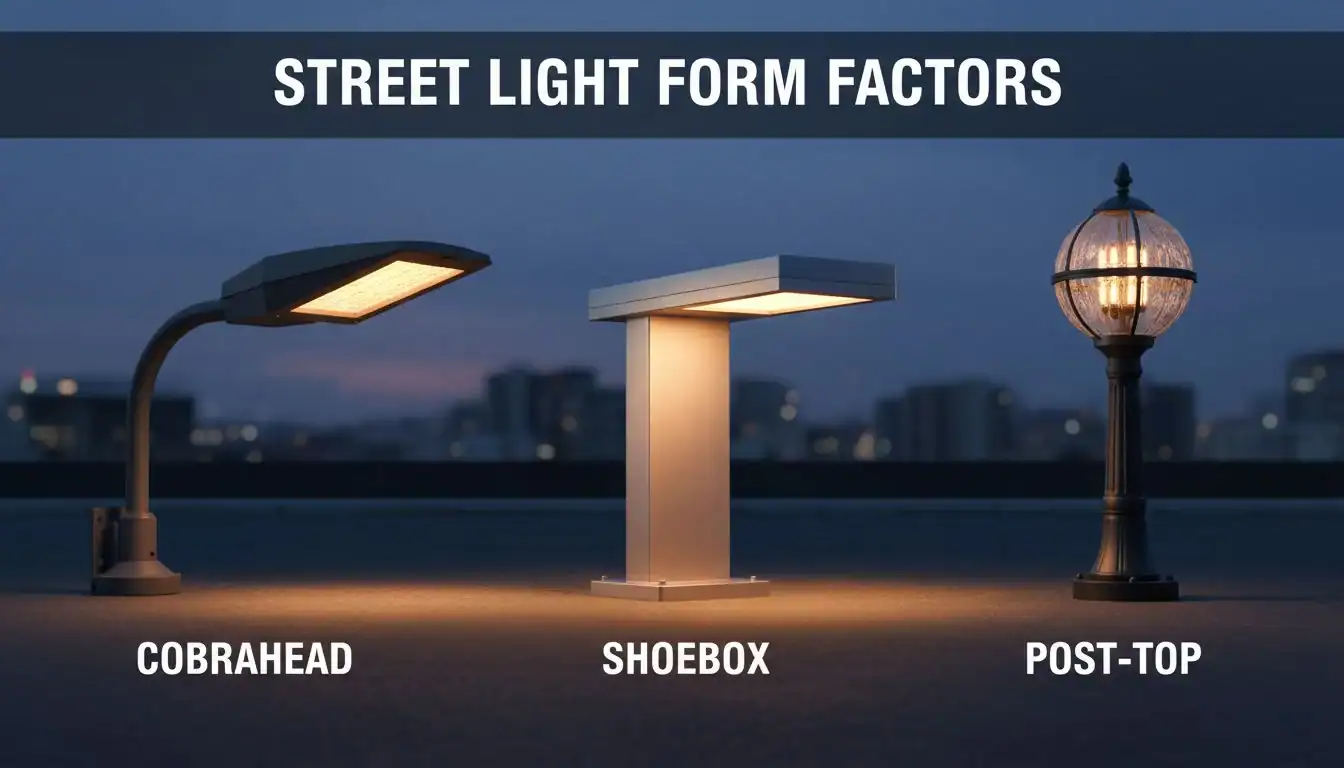
This is a common final step in the selection process. After you've chosen your technology (LED) and determined your required specs (lux levels and distribution type), you select the physical housing that delivers it. Each form factor is engineered for a specific job.
Matching Form Factor to Application
-
- What it is: The classic, traditional street light shape with a distinct head that juts out over the road.
- Best for: Roadways and highways. Its design is perfect for holding optics like IES Type II and III, which cast long, rectangular patterns of light ideal for illuminating long stretches of road efficiently.
- Why it works: It places the light source directly over the area that needs it most, minimizing light trespass into adjacent properties.
-
Shoebox Fixtures
- What it is: A rectangular, boxy fixture, often mounted on a pole with a straight arm (tenon mount).
- Best for: Parking lots, sports courts, and large commercial areas. They are designed to hold IES Type IV and V optics, which create broad, circular or square patterns of light.
- Why it works: They provide powerful, uniform illumination over wide areas, maximizing safety and visibility for both vehicles and pedestrians.
-
- What it is: A decorative fixture that sits directly on top of a pole.
- Best for: Parks, university campuses, pedestrian walkways, and historic districts.
- Why it works: They often prioritize aesthetics and creating a comfortable, welcoming ambiance. While they can be equipped with high-performance optics, their primary role is often to provide localized, human-scale lighting.
Choosing the right form factor is the final piece of the puzzle, ensuring the light not only meets technical standards but also fits the physical and aesthetic context of your project.
A single street light form factor is suitable for all outdoor applications.False
Different form factors like cobrahead, shoebox, and post-top are designed with specific optics and mounting options to efficiently light different environments, such as roadways, parking lots, and pathways, respectively.
Shoebox fixtures are named for their rectangular, box-like shape.True
This descriptive name refers to the common form factor for area lights used in parking lots and other large open spaces.
FAQ
What are the main types of street lights?
The primary types are High-Pressure Sodium (HPS), which are older and less efficient; grid-powered LED, which is the modern standard for efficiency and lifespan; and Solar LED, which operates off-grid and is ideal for remote locations or areas where trenching is too expensive.
Which is best: LED or HPS?
LED is definitively better. It uses over 75% less energy, lasts up to 10 times longer, and provides superior visibility with a higher Color Rendering Index (CRI). The total cost of ownership for LED is significantly lower than for HPS.
How do standards guide selection?
Standards like IES RP-8 and EN 13201 provide the minimum lighting requirements (illuminance and uniformity) for safety on different types of roads and public areas. These standards dictate the performance specifications your chosen street light must meet.
Do LEDs improve safety?
Yes, significantly. LEDs produce a white light with a high CRI (70+), which helps drivers and pedestrians better distinguish colors and objects at night compared to the monochromatic yellow glow of HPS (20-30 CRI). Better uniformity also eliminates dangerous dark spots.
What housing should I use?
Choose the housing based on the application. Use Cobraheads for roadways, Shoebox fixtures for parking lots and large areas, and decorative Post-Tops for walkways and parks. Each is designed to distribute light effectively for its specific environment.
Conclusion
Choosing the right street light means matching modern LED technology with the correct fixture and standards. This ensures long-term savings, superior safety, and reliability for any infrastructure project.
References
-
Learn about the advantages of Solar LED street lights, especially for off-grid applications. ↩
-
Find out how optics influence the effectiveness of street lights in illuminating areas uniformly. ↩
-
Understand the importance of IP ratings in ensuring the durability and safety of outdoor lighting. ↩
-
Learn about the significance of illuminance levels in ensuring safety and visibility on roads. ↩
-
Explore the concept of uniformity ratio and its impact on lighting quality and safety. ↩
-
Learn about the effectiveness of Shoebox fixtures in providing uniform illumination in large areas. ↩
-
Discover the applications and benefits of Cobrahead fixtures in roadway lighting. ↩
-
Understand the aesthetic and functional roles of Post-Top fixtures in various environments. ↩