Traditional vs. Solar Street Lights: Which Is the Smarter Investment for Your Project?
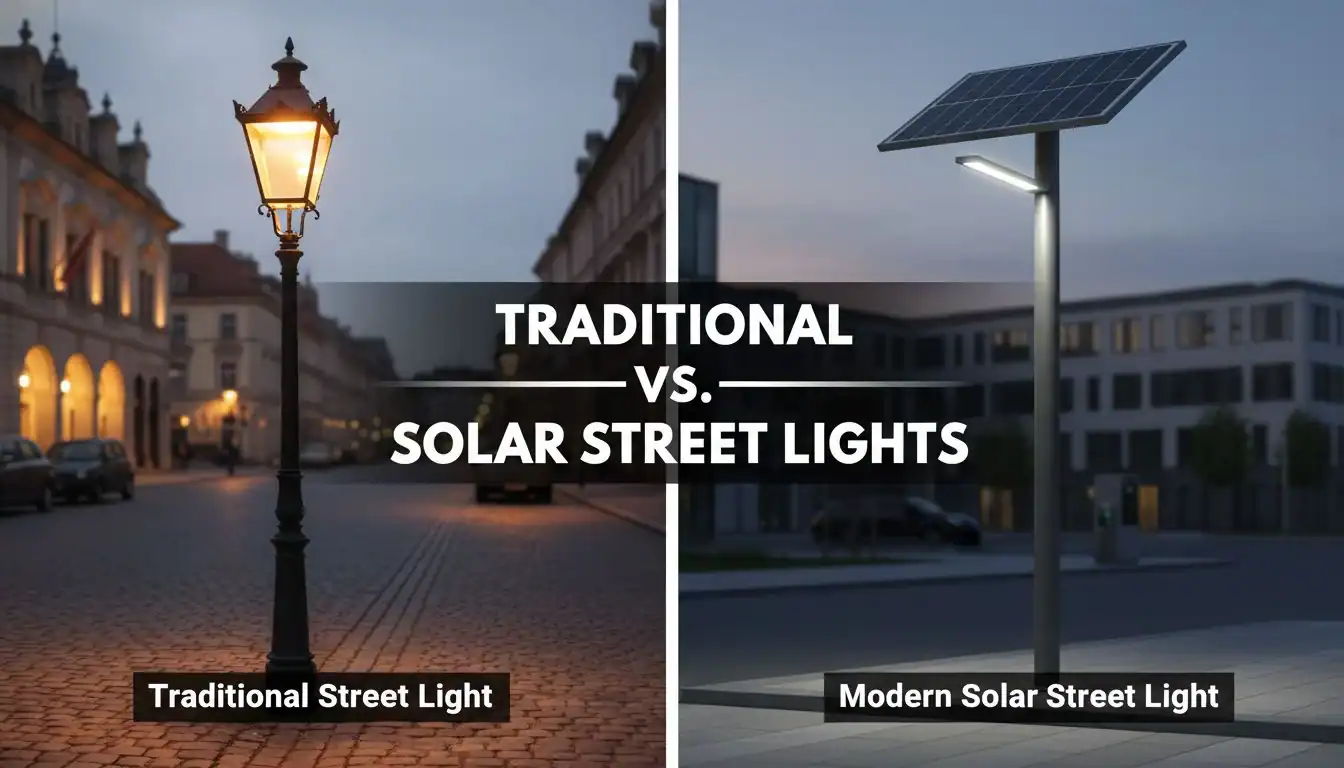
You're juggling rising electricity tariffs, surprise trenching costs, and the risk of grid outages. These problems inflate budgets and delay projects, making you wonder if there's a better way.
Solar street lights are often cheaper in the long run. While the initial purchase price is higher, they eliminate electricity bills and expensive trenching for grid connection. This leads to a lower Total Cost of Ownership1 (TCO) over 10 years, with a typical payback period of 3-5 years.

I've been in the LED lighting business for over 13 years, and I've seen countless project managers and developers struggle with this decision. The choice isn't just about the initial price tag. It's about long-term value, reliability, and project efficiency. A bad decision can lead to years of high operational costs or unreliable performance. But a smart one can save you millions and enhance your project's value.
To make the right choice, you need to look at the complete picture. Let's break down the numbers and performance data so you can make a decision with confidence.
The U.S. Department of Energy reports that switching to LED street lighting can yield energy savings of more than 75%.True
The DOE's research confirms significant energy reduction from LED technology, which is the foundation for both modern grid-tied and solar street lights.
Solar street lights do not work at all during the winter or on cloudy days.False
Modern solar street lights are designed with battery autonomy for 3-5+ days, allowing them to function through extended periods of low sunlight.
Total Cost of Ownership: From Trenching to Tariffs, Who Really Pays Less Over 10 Years?
Hidden installation and energy costs are derailing your project budget. Trenching, cabling, and unpredictable electricity tariffs can turn a profitable plan into a financial headache, making you second-guess your initial estimates.
Over a 10-year lifespan, solar street lights have a significantly lower Total Cost of Ownership (TCO). The higher upfront cost is offset by zero electricity bills and the elimination of expensive trenching and cabling, which can cost thousands of dollars per pole in grid-connected projects.
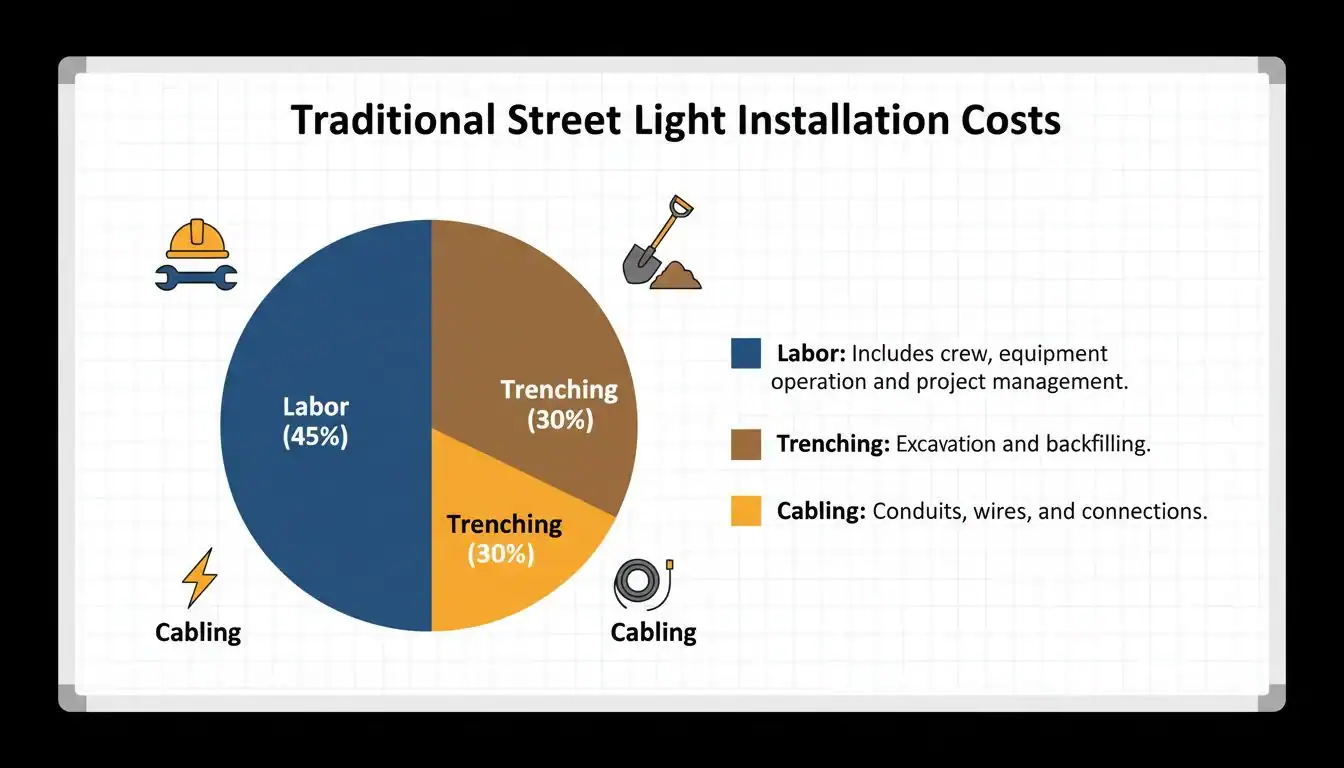
When my clients, like developers building new commercial parks, look at lighting, they often focus on the unit price. But the real cost is much bigger. I always ask them to consider the Total Cost of Ownership. Let's break it down.
Upfront Costs vs. Long-Term Savings
The initial cost of a solar street light is higher than a traditional one. You're buying the fixture, the panel, the battery, and the controller all at once. But for a traditional light, the fixture is just the beginning. You also have to pay for trenching, running electrical cables, and connecting to the grid. I remember a project in a remote area where trenching costs were going to be astronomical. We switched the spec to solar, and the client saved nearly 40% on the total installation cost right away.
The 10-Year Financial Picture
Here’s a simple comparison for a single street light over 10 years.
| Cost Factor | Traditional Grid-Powered LED | Solar-Powered LED |
|---|---|---|
| Initial Cost | Fixture: $300, Installation (incl. trenching): $2,000+ | All-in-One Unit: $400 - $800, Installation: $500 |
| 10-Year Energy Cost | ~$1,500 (based on $0.15/kWh, 12hrs/day) | $0 |
| 10-Year Maintenance | Bulb/Driver replacements | Battery replacement (1x): ~$150 |
| Total 10-Year TCO | ~$3,800+ | ~$1,150 |
Note: Costs are estimates and vary by region and project scale.
As you can see, the savings come from eliminating energy costs and complex installation. The City of Los Angeles, for example, reported saving $10.6 million annually just by switching to more efficient LEDs. With solar, those savings are even greater because the energy is free.
Trenching and wiring for a single grid-powered street light can cost over $4,000.True
Depending on the distance from the grid, terrain, and labor rates, the cost of trenching, conduit, wiring, and connection can easily exceed the cost of the light fixture itself.
Solar street lights never require any maintenance.False
While low-maintenance, solar lights require periodic panel cleaning and a battery replacement every 5-8 years to ensure optimal performance.
Reliability in the Real World: How Do Solar Street Lights Perform in Cloudy Weather and Grid Outages?
You worry that solar lights will fail during a week of rain or on the darkest winter days. An unreliable lighting system creates safety hazards, exposes you to liability, and damages your reputation.
Modern solar street lights provide reliable, year-round illumination, even with multiple cloudy days. They use oversized batteries (typically LiFePO4) and smart controllers to store enough energy for 3-5 nights of operation without any sun, ensuring they work when you need them most—especially during grid outages.
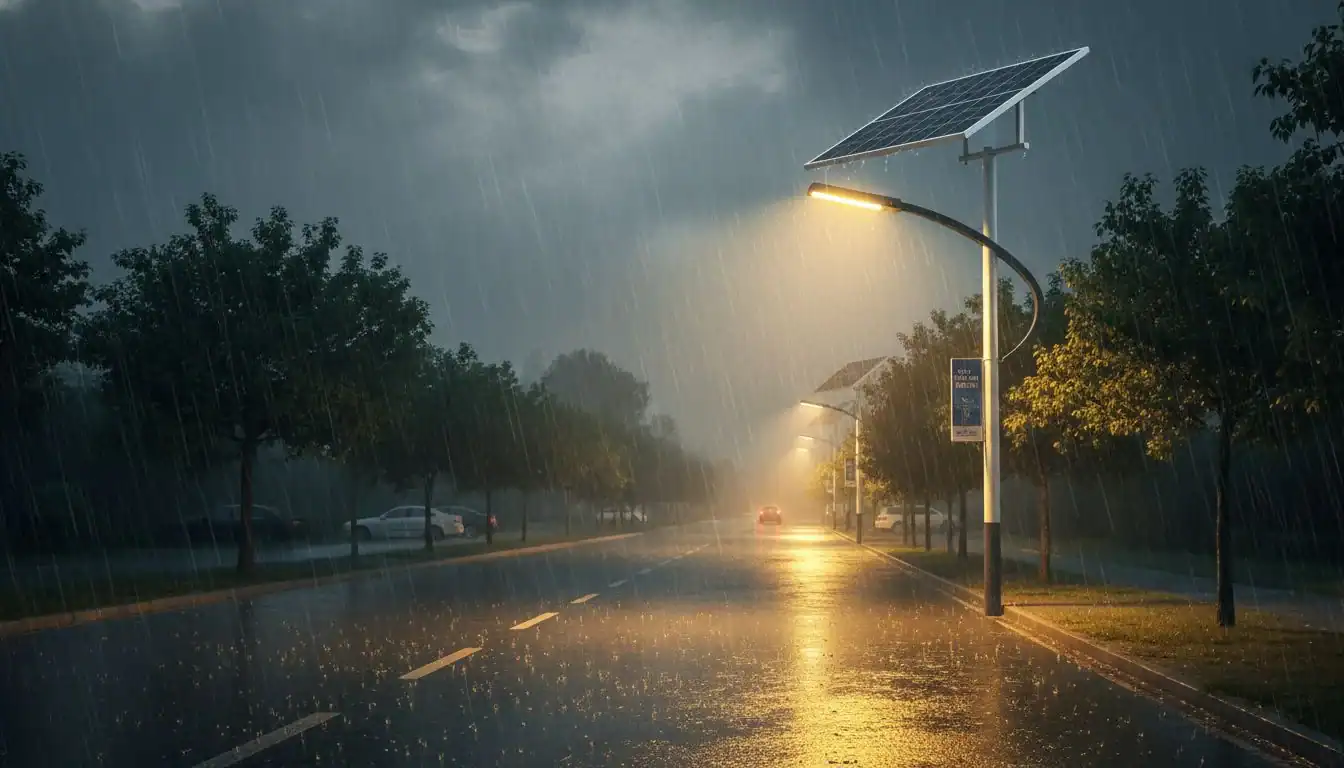
For projects in regions like South Asia with monsoon seasons or North America with heavy winters, reliability is the number one concern I hear. "Will they work?" is the first question. The answer lies in the technology inside the unit.
The Brains and Brawn: MPPT Controllers and LiFePO4 Batteries
It's not just about the solar panel. The system's reliability depends on two key components:
- MPPT Controller2: A Maximum Power Point Tracking (MPPT) controller is the "brain." It optimizes the charge from the solar panel to the battery, capturing up to 30% more energy than older PWM controllers, especially on cloudy days. This means the battery charges faster and more efficiently.
- LiFePO4 Battery3: This is the "brawn." Lithium Iron Phosphate (LiFePO4) batteries are the standard for high-quality solar lights. They have a long lifespan (5-8 years), can handle deep discharge cycles, and perform well in a wide range of temperatures.
What is "Autonomy"?
Autonomy is the number of days a fully charged solar light can run without any sunlight. For a professional project, you should never accept less than three days of autonomy.
| Autonomy Level | Performance Expectation | Best For |
|---|---|---|
| 1-2 Days | Low reliability; may fail after one cloudy day. | Residential, non-critical areas. |
| 3-5 Days | High reliability; performs through storms and winter. | Commercial, industrial, and public infrastructure. |
| 5+ Days | Extreme reliability; for critical security areas. | High-security zones, remote infrastructure. |
When the grid fails, traditional street lights go dark. This is a major safety and security risk. Solar street lights are completely independent, providing uninterrupted illumination during blackouts and natural disasters. This makes them ideal for critical infrastructure like roadways, parking lots, and public spaces.
LiFePO4 batteries used in quality solar lights last for over 2,000 charge cycles.True
LiFePO4 battery technology offers a lifespan of 5-8 years (2000-3000 cycles) under normal operating conditions, far superior to older lead-acid batteries.
Any solar panel can fully charge a street light battery in a few hours.False
Charging time depends on panel wattage, battery capacity, and sunlight intensity (insolation). A properly sized system is engineered to charge fully over a typical day's sun exposure in its specific geographic location.
Brightness and Standards: Can Solar Meet IES Distributions, CCT, and Uniformity Without Wasting Watts?
You're concerned that solar lights won't be bright enough or won't meet strict public lighting standards. Failing to meet IES distribution or uniformity requirements can get your project rejected and create serious safety liabilities.
Yes, high-quality solar street lights are engineered to meet the exact same IES Standards4 as grid-powered lights. Using advanced LED chips and precision optics, they deliver specified brightness levels, distribution types (e.g., Type II, III), and uniformity, ensuring full compliance and safety.

A common myth I have to bust is that "solar" means "dim." That might have been true a decade ago, but today's technology is completely different. At Besenled, our solar pole lights use the same high-efficacy LED modules and optical lenses as our top-tier grid-powered fixtures. The power source doesn't dictate the quality of light.
Meeting the Standards That Matter
When a city planner or engineer reviews your project, they aren't looking for "bright." They are looking for compliance with specific metrics:
- IES Light Distribution: This defines how light is cast onto a surface. A Type II distribution is for narrow roads, while Type III is for wider ones. A quality supplier must provide photometric files (IES files) to prove their fixtures meet these patterns.
- Correlated Color Temperature (CCT): This is the color of the light, measured in Kelvin (K). Most street lighting is between 3000K (warm white) and 5000K (neutral white). We avoid the harsh, blue-tinted light above 5700K.
- Uniformity: This measures how evenly light is spread across an area, preventing dark spots between poles. A good uniformity ratio (e.g., 3:1) is critical for safety.
Avoiding the "Purple Light" Problem
You may have seen news stories about street lights turning purple. This is caused by the failure of a phosphor coating on low-quality LED chips. It is a sign of poor manufacturing, not a problem with LED or solar technology itself. Choosing a supplier with a proven track record and quality components (like we use at Besenled) is the best way to avoid this issue and ensure a long, stable lifespan for your lighting.
Solar street lights cannot produce more than 5,000 lumens.False
Modern solar street lights are available in a wide range of outputs, with many models easily exceeding 10,000 or even 20,000 lumens, making them suitable for highways and large commercial lots.
IES standards are mandatory for all public street lighting projects in North America.True
The Illuminating Engineering Society (IES) provides the standards and recommended practices for roadway and parking facility lighting, which are widely adopted by transportation departments and municipalities to ensure safety.
Maintenance Cycles and Lifespans: What Replacements Should You Budget For?
You're not sure what to expect for the long-term upkeep of a solar lighting system. Unplanned maintenance and frequent component replacements can destroy your operational budget and create logistical nightmares.
Solar street light maintenance is minimal and predictable. It primarily involves cleaning the solar panels annually and replacing the LiFePO4 battery once every 5-8 years. The LED fixture itself has a lifespan of over 50,000 hours, lasting more than a decade without intervention.

When planning a large-scale project, your operational budget is just as important as the capital expense. The beauty of solar lighting is its predictability. You know exactly what to budget for and when.
Component Lifespan Breakdown
Let's compare the key components and their expected service life.
| Component | Traditional Grid-Powered Light | Solar-Powered Light |
|---|---|---|
| Light Source (LED) | 50,000 - 100,000 hours (10-20 years) | 50,000 - 100,000 hours (10-20 years) |
| Driver/Ballast | Replace every 5-10 years | Integrated into controller; long lifespan |
| Power Source | Grid (ongoing cost) | Solar Panel: 20-25 years |
| Energy Storage | None | LiFePO4 Battery: Replace every 5-8 years |
| Primary Maintenance | Driver/ballast failure, wiring issues | Battery replacement, panel cleaning |
The most significant maintenance item for a solar light is the battery. Budgeting for a battery replacement in year 6 or 7 is a simple, predictable cost. In contrast, traditional lights can have random failures in drivers, ballasts, or underground wiring, which are harder to predict and often more expensive to fix. The copper wiring in traditional systems also presents a theft risk that is completely eliminated with off-grid solar lights.
For a project with 100 lights, you can confidently budget for 100 battery replacements in year 7. This is far easier than managing unpredictable electrical faults across a large, grid-connected system.
Solar panels lose 50% of their efficiency after just 5 years.False
High-quality monocrystalline solar panels have a very low degradation rate, typically guaranteed to retain at least 80% of their original efficiency after 25 years.
The lifespan of an LED street light fixture is over 10 years.True
With a typical L70 rating of 50,000 to 100,000 hours, an LED fixture running 12 hours a night will last from 11 to 22 years before its light output degrades to 70% of its initial brightness.
FAQ
Are solar street lights cheaper in the long run?
Yes. While the initial purchase price is higher, they have a lower total cost of ownership over 10 years because they have no electricity costs and avoid expensive grid installation (trenching and cabling).
Do solar street lights work in cloudy or rainy weather?
Yes. Professional-grade solar lights are designed with 3-5 days of Battery Autonomy5, meaning they can run for several nights without any direct sunlight, ensuring reliable operation through storms and winter.
How bright are solar street lights compared to traditional?
They are equally bright. Modern solar street lights use the same high-output LED technology and can be specified to meet the exact same brightness (lumen) and IES distribution standards required for roads and public areas.
What maintenance do solar street lights require?
Maintenance is very low. It consists of periodic cleaning of the solar panel to remove dust or snow and a scheduled battery replacement every 5 to 8 years.
What is the typical payback period?
The typical Payback Period6 for a solar street light project is between 3 and 5 years. This can be even faster in areas with high electricity rates or where grid connection costs are prohibitive.
Conclusion
Choosing between traditional and solar lighting comes down to total cost and reliability. Solar offers long-term financial savings and complete energy independence, making it a smart, resilient investment for modern projects.
References
-
Understanding TCO helps in evaluating long-term savings and making informed investment decisions. ↩
-
MPPT controllers optimize energy capture, ensuring efficient operation even in low sunlight. ↩
-
LiFePO4 batteries enhance reliability and lifespan, making them ideal for solar applications. ↩
-
Familiarity with IES standards ensures compliance and safety in public lighting projects. ↩
-
Understanding battery autonomy is crucial for assessing reliability during adverse weather conditions. ↩
-
Knowing the payback period helps in evaluating the financial viability of solar investments. ↩