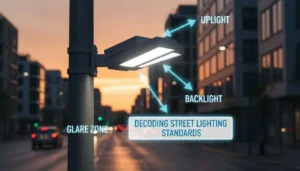
Confused by Street Lighting Jargon Like BUG, RP-8, and L70?

Street lighting specifications are full of confusing acronyms. This confusion can lead to project delays, permit rejections, and unhappy clients. This one-page glossary decodes them for you.
This guide explains key terms like BUG ratings1 (light trespass), RP-8 (roadway design), and LM-80/TM-21 (LED lifespan). Understanding them helps you specify the right fixtures, meet dark-sky rules, and get your projects approved faster. It's the practical knowledge you need for success.

In my 13+ years in the LED lighting business, I've seen countless contractors and developers get bogged down by technical jargon. A project manager in North America once told me, "Rain, I just want to light a parking lot, not get a degree in optical physics!" He's right. You need practical answers, not academic theories. These standards aren't just letters and numbers; they are the rules that determine if your project gets a green light or a red flag from reviewers. Let's break them down into simple, actionable terms so you can get back to what you do best: building.
All 'full cutoff' fixtures are automatically dark-sky compliant.False
This is a common misconception. 'Full cutoff' is an outdated term that primarily addresses uplight (U). Modern dark-sky compliance also requires control of backlight (B), glare (G), and color temperature (CCT), which are covered by the BUG rating system.
Using a U0-rated fixture is a key requirement for most dark-sky ordinances.True
A U0 rating means the fixture emits zero uplight, which is the primary cause of artificial skyglow. This is a foundational requirement for certifications from groups like the International Dark-Sky Association (IDA).
What is a BUG rating and how do I choose the right one for my site?
Choosing the wrong street light causes light pollution and neighbor complaints. This can halt your project, forcing costly redesigns and damaging your reputation. Understanding BUG ratings helps you prevent this.
A BUG rating measures a fixture's Backlight, Uplight, and Glare. For sites near homes or sensitive areas, I always recommend choosing low B (B0–B1) and U (U0) ratings to minimize light trespass2 and skyglow, which speeds up permit approvals.
Breaking Down B, U, and G
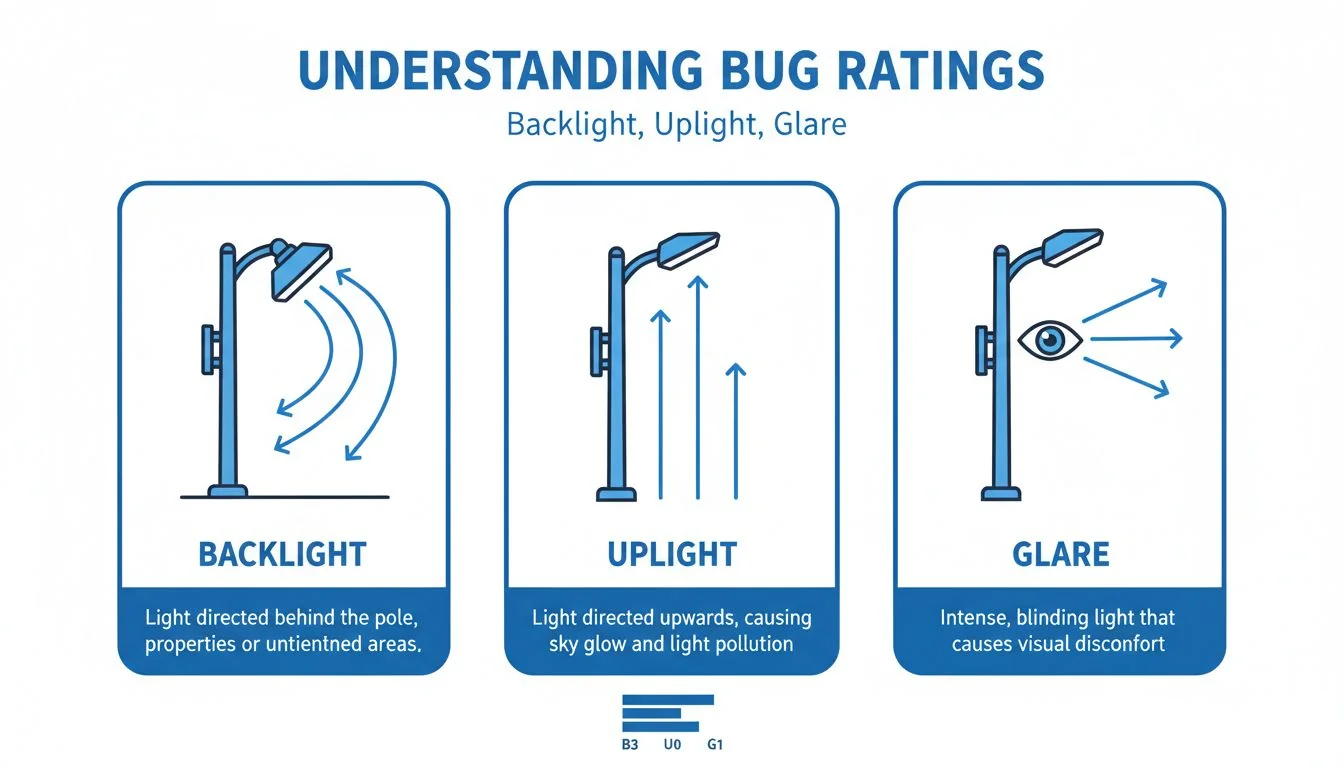
The BUG rating system was created by the Illuminating Engineering Society (IES) to give a much clearer picture of a luminaire's light distribution than old terms like "cutoff." Think of it as a nutritional label for light. Each letter represents a potential nuisance.
- B is for Backlight: This is the light that spills behind the fixture, onto adjacent properties. For a pole light on a street, this is the light that could shine into someone's bedroom window.
- U is for Uplight: This is any light directed above the horizontal plane of the fixture. It's wasted energy that contributes to skyglow, washing out the stars.
- G is for Glare: This is high-angle forward light that can cause discomfort or disability glare for drivers and pedestrians.
Choosing the Right BUG Rating for Your Project
The right rating depends entirely on the location. A fixture for a large industrial yard in Kazakhstan will have very different needs than one for a residential street in a US suburb. Here’s a simple guide I use with my clients:
| Application Area | Recommended B Rating | Recommended U Rating | Recommended G Rating | Why It Matters |
|---|---|---|---|---|
| Residential Streets | B0 – B1 | U0 | G1 – G2 | Minimizes light trespass into homes and keeps skies dark. |
| Commercial Parking Lots | B1 – B2 | U0 | G1 – G2 | Balances site security with preventing light spill into neighboring areas. |
| Major Roadways | B2 – B3 | U0 | G2 – G3 | Focuses light on the road for safety, with moderate glare control3. |
| Industrial/Port Areas | B3 – B5 | U0 – U1 | G3 – G5 | Prioritizes high illumination for safety and operations over light control. |
When you submit your lighting plan, including the BUG rating, CCT (≤3000K is best for dark-sky), and uniformity ratios shows reviewers you've done your homework.
A B2 rating is always better than a B4 rating.False
It's not about 'better' but 'appropriate.' A B2 rating is better for a site next to a residential area, but a B4 might be necessary for illuminating a large, isolated industrial zone where backlight is needed for security.
The BUG rating system applies to both outdoor and indoor lighting.False
The BUG rating system (defined in IES TM-15) was specifically developed for outdoor luminaires to quantify light trespass, skyglow, and glare.
How does IES TM-15 assign BUG subzones, and what do U0 and BVH mean in practice?
Just knowing the BUG rating isn't always enough. You might still fail a dark-sky audit or have a glare issue if you don't understand the details behind the numbers. Learn how TM-15 defines these ratings.
IES TM-15 is the technical document that defines the BUG rating system. It divides the space around a luminaire into zones to measure light. U0 means zero uplight, a must for dark-sky compliance4. BVH (Backlight Very High) is a specific zone behind the pole.
A Deeper Look at TM-15 Zones
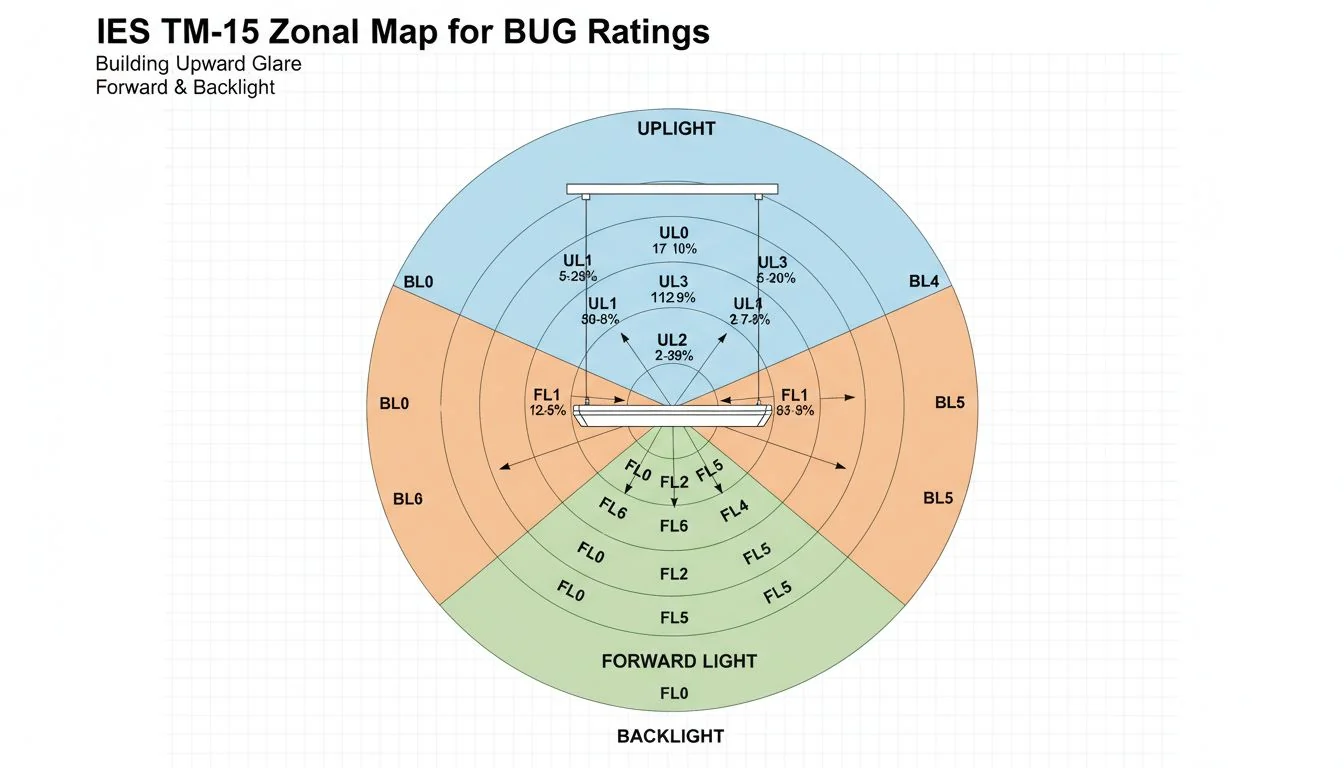
TM-15 provides the framework for calculating BUG ratings by measuring the lumens (light output) that fall into specific angular zones. It’s a bit technical, but understanding the basics helps you read a photometric report5 and challenge a bad specification.
The system is based on a grid projected from the luminaire.
- Uplight Zones (U): This is the simplest. It's divided into Low (UL, 90-100 degrees) and High (UH, 100-180 degrees). For a U0 rating, the lumens in both zones must be zero. This is non-negotiable for dark-sky projects.
- Forward Light Zones (F): This is the "useful" light aimed at the target area. It's not part of the BUG rating itself but defines the boundary for Backlight.
- Backlight and Glare Zones (B & G): This is where it gets more detailed. The space is divided by vertical angles into High, Medium, Low, and Very High zones.
What Do the Sub-Ratings Mean in Practice?
Let's look at the Backlight zones as an example. The rating (B0-B5) is determined by the maximum lumens found in any of these subzones.
| Zone Name | Angle (Vertical) | Practical Implication |
|---|---|---|
| BVH (Backlight Very High) | 80-90° | Light aimed almost horizontally behind the pole. High values here are a major cause of light trespass complaints from residents in nearby high-rise buildings. |
| BH (Backlight High) | 60-80° | The most common source of light trespass into first or second-story windows of adjacent properties. A B1 rating requires very low lumens here. |
| BM (Backlight Medium) | 30-60° | Light that falls on the ground or lower parts of buildings behind the pole. Less intrusive but still needs to be controlled. |
| BL (Backlight Low) | 0-30° | Light that falls on the ground immediately behind the pole. Generally not a major issue for trespass. |
So, when a spec calls for a B1 rating, it's really putting a strict limit on the lumens in the BH and BVH zones. As a manufacturer, we design optics to precisely control this, ensuring our pole lights meet these tough requirements for our clients' residential and commercial projects.
TM-15 is a law that must be followed for all outdoor lighting projects.False
TM-15 is a technical memorandum (a recommended practice) from the IES, not a law. However, many municipal codes, green building standards (like LEED), and dark-sky ordinances have adopted it as their legal requirement.
A luminaire's BUG rating can change if you tilt it.True
BUG ratings are calculated based on the luminaire being mounted at 0 degrees tilt. Any upward tilt will direct light into the uplight zones, immediately voiding a U0 rating and changing the B and G ratings.
What does ANSI/IES RP-8-22 require, and why did it replace “full cutoff”?
Relying on the outdated term "full cutoff" is a recipe for trouble. It can lead to spec conflicts and non-compliant designs because it's too vague. You need to use the modern RP-86 standard instead.
ANSI/IES RP-8-22 is the current recommended practice for roadway lighting. It replaced "full cutoff" with specific, performance-based criteria for glare control (Veiling Luminance), uniformity, and light levels, using BUG ratings as a tool to achieve compliance.
Why "Full Cutoff" Was Not Enough
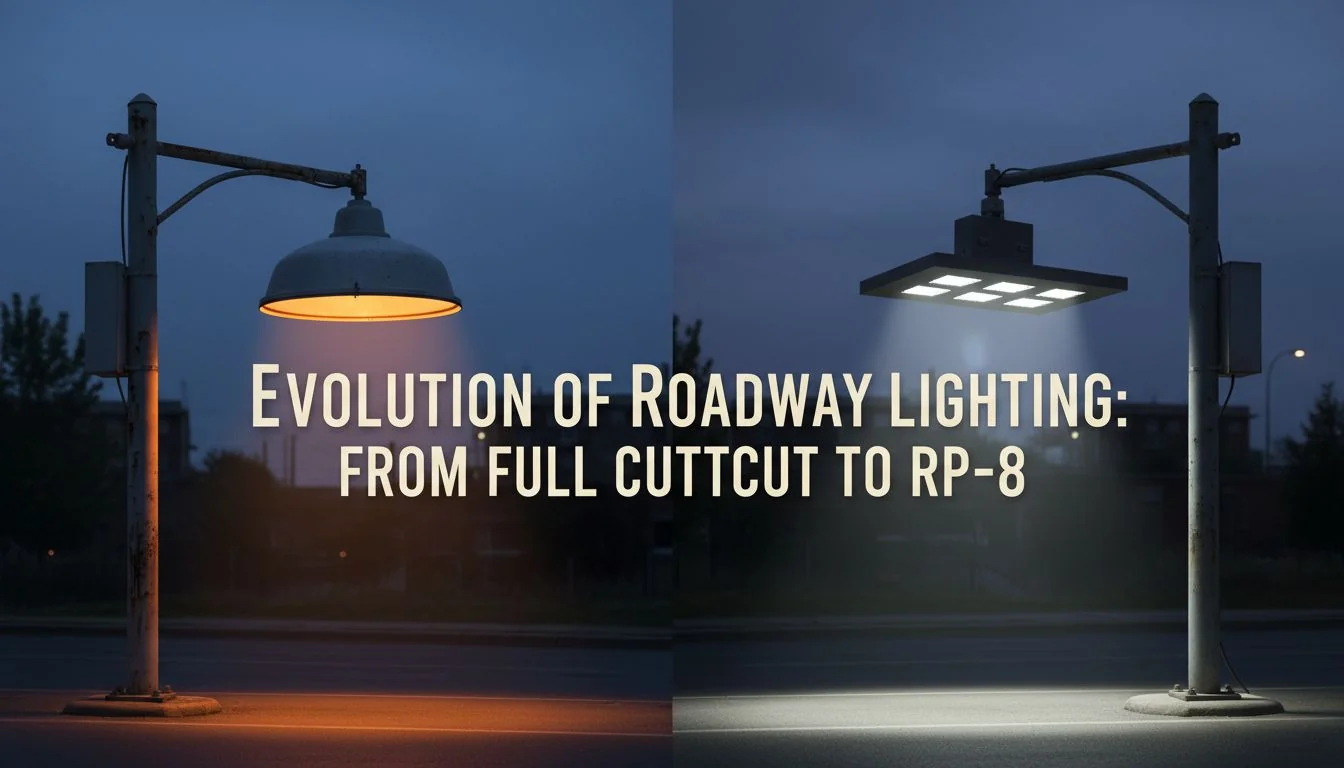
For years, "full cutoff" was the go-to spec for responsible lighting. It simply meant the fixture had no direct uplight. While that was a good start, it was a very blunt instrument. It told you nothing about two other critical factors:
- Glare: A "full cutoff" fixture could still produce blinding glare for drivers, creating a serious safety hazard.
- Light Trespass: It didn't address backlight, so a compliant fixture could still dump huge amounts of light onto an adjacent property.
I remember a project in the Middle East where the contractor specified "full cutoff" fixtures for a highway. The fixtures had zero uplight, but the glare was so bad that drivers complained constantly. The design met the old standard but failed in the real world. This is exactly the problem RP-8 solves.
Key Requirements of RP-8-22
RP-8 moves away from simple equipment labels and focuses on the actual performance of the lighting system on the road. It asks, "Is the road safely and comfortably lit?" To answer this, it sets criteria for:
| RP-8 Metric | What It Is | Why It Matters |
|---|---|---|
| Luminance/Illuminance Levels | The amount of light on the road surface (luminance) or falling on it (illuminance). | Ensures there is enough light for drivers to see obstacles and navigate safely. |
| Uniformity Ratios | The ratio of average-to-minimum or max-to-min light levels across the road. | Prevents "hot spots" and dark patches, which can be dangerous. A smooth, even light is safer. |
| Veiling Luminance (Lv) | A measure of disability glare. It calculates the "veil" of light that reduces your ability to see contrast. | This is the direct replacement for just controlling glare with a G rating. RP-8 sets a maximum Lv ratio to ensure driver comfort and safety. |
When I work with a developer like Somchai in Thailand on a new commercial complex, we anchor our lighting submittals in RP-8 criteria. We provide photometric layouts showing the design meets the required light levels, uniformity, and veiling luminance ratios. This is the professional language that engineers and reviewers understand and trust.
Meeting RP-8 requirements always means using more poles.False
Not necessarily. While stricter glare or uniformity requirements can sometimes lead to tighter spacing, advanced optics in modern LED fixtures can often achieve RP-8 compliance with the same or even wider spacing than older HID systems.
RP-8-22 is only for highways and major roads.False
RP-8-22 provides lighting criteria for a wide range of roadway and area classifications, including local residential streets, collector roads, commercial parking lots, and pedestrian conflict areas.
How do LM-80 and TM-21 prove LED L70 life for rebates and specifications?
You need to prove your fixture's lifespan to qualify for rebates and win client trust. Manufacturer claims alone are not enough. You need to back them up with LM-807 and TM-21 data.
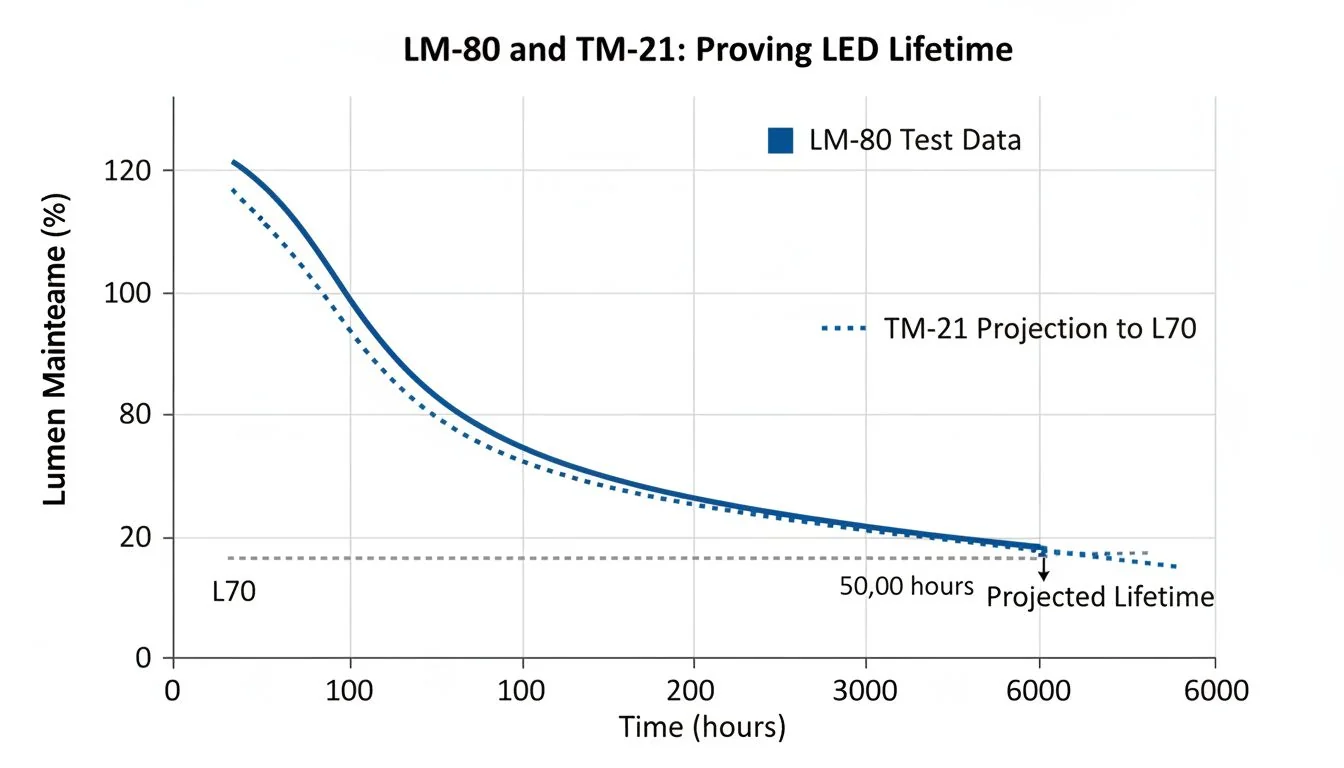
LM-80 is a standardized test report on how an LED chip's light output depreciates over thousands of hours. TM-218 is the mathematical method used to project that test data to calculate the L70 lifetime (when light output drops to 70%).
The Difference Between a Test and a Projection
This is the most important distinction to understand. Many people get this wrong.
- LM-80 is a test of the component. It is NOT a test of the entire fixture. An LED chip manufacturer (like Cree or Nichia) runs their LEDs in a lab for 6,000 to 10,000 hours at specific temperatures and currents. The result is a report—the LM-80 report—that shows how much the light output has faded.
- TM-21 is the calculation for the system. As a fixture manufacturer, we take the LM-80 report for the LEDs we use. Then, we measure the temperature of those same LEDs inside our fixture (the "in-situ" temperature). Using the TM-21 formula, we can project how long it will take for our fixture's light output to fall to 70% (L70).
How Test Duration Affects Your L70 Claim
The TM-21 standard includes a crucial rule: you can only project the lifetime for a maximum of 6 times the LM-80 test duration. This prevents unrealistic claims. If a supplier claims a 100,000-hour L70 life, you should ask for the LM-80 report.
| LM-80 Test Duration | Maximum TM-21 Projection (6x Rule) | What This Means |
|---|---|---|
| 6,000 hours | 36,000 hours | A common test duration. Any L70 claim beyond 36,000 hours is a "calculated" value, not a "projected" one, and may not be accepted for strict rebates. |
| 10,000 hours | 60,000 hours | This is the gold standard. It provides reliable data for long-life projections, which is what we use at Besenled for our premium pole lights and high bays. |
| 15,000+ hours | 90,000+ hours | Provides very high confidence in long-term performance for critical infrastructure projects. |
When a client asks for proof of our 50,000-hour warranty, I don't just give them a number. I provide the LM-80 report for our LED packages and the TM-21 calculation based on our fixture's thermal management. This transparency builds trust and proves our quality.
LM-80 is a test of the complete lighting fixture.False
This is incorrect. LM-80, officially IES LM-80-15, specifically tests the lumen maintenance of LED packages, arrays, and modules. It does not test the driver, optics, or housing of the final luminaire.
A longer LM-80 test duration allows for a more reliable and longer L70 projection under TM-21.True
Yes, the TM-21 standard allows for a projection up to 6 times the actual test duration. Therefore, a 10,000-hour LM-80 test allows for a more credible 60,000-hour L70 projection than a 6,000-hour test allows for a 36,000-hour projection.
Your Top Street Lighting Questions Answered?
You still have specific, nagging questions about how these standards apply to your job. Unanswered questions can stall decisions and create risk. Here are quick, direct answers to the most common queries I hear.
This section provides rapid-fire answers to key questions about dark-sky compliance, pole spacing, LM-80 testing, L70 projection limits, and the practical impact of glare ratings on your lighting design.
Dive Deeper into Common Questions
After discussing these standards with hundreds of contractors and developers, the same practical questions always come up. Here are the straight answers.
What BUG rating is “dark-sky compliant”?
There is no single BUG rating that is universally "dark-sky compliant." However, the foundation is always U0. Any amount of uplight is an automatic failure. Beyond that, most ordinances and the International Dark-Sky Association (IDA) look for low backlight ratings (typically B1 or B2, depending on the lighting zone) and a Correlated Color Temperature (CCT) of 3000K or less. They are also increasingly looking at overall site luminance to prevent over-lighting.
How does RP-8 affect my pole spacing?
RP-8's uniformity and veiling luminance criteria are the main drivers of pole spacing. If you choose a fixture with a very tight, low-glare optic (a low G rating) to meet the veiling luminance limit, its light distribution might be less wide. To maintain the required average-to-minimum uniformity ratio on the ground, you may need to place the poles closer together. It's a trade-off between glare control and coverage efficiency that we solve with photometric analysis.
Is LM-80 a fixture test?
No. I want to be very clear on this: LM-80 tests the LED package/module/array only. It is performed by the LED manufacturer. The fixture manufacturer (like us) then uses that data to perform a TM-21 calculation for the complete fixture. If a supplier tells you they have an "LM-80 report for their fixture," they are misunderstanding the standard.
How far can I project L70 with TM-21?
You can project the L70 lifetime for a maximum of 6 times the duration of the LM-80 test data. For example, if the LED chip was tested for 10,000 hours, the maximum reported L70 life you can claim is 60,000 hours. Any claim beyond that (e.g., 100,000 hours) must be listed as a "calculated" life, not a "projected" one, and carries less weight.
Does lowering G (Glare) always help?
Not always. While lowering the G rating is excellent for controlling discomfort glare, it often means the optic is directing light more sharply downwards. This can sometimes reduce the forward throw of the light, impacting pole spacing as mentioned above. For a wide road, a G2 or G3 fixture might provide better uniformity than a G1, even if the G1 is "better" on paper for glare. The key is to balance glare control with meeting the overall performance goals of RP-8.
A 3000K CCT is required for all dark-sky projects.False
While 3000K is widely recommended and often required, some stricter ordinances, particularly in environmentally sensitive areas, may require 2700K or even amber LEDs. The IDA's Fixture Seal of Approval program now has a preference for ≤2200K.
The '6x rule' in TM-21 is just a guideline.False
The '6x rule' is a firm limit defined within the IES TM-21-11 standard. Projections that exceed 6 times the available LM-80 data are not compliant with the TM-21 methodology and should not be presented as such.
Conclusion
Mastering these terms—BUG, RP-8, L70—moves you from confusion to confidence. It ensures your lighting projects are compliant, efficient, and approved without delay. We can help you navigate it all.
References
-
Understanding BUG ratings is crucial for minimizing light pollution and ensuring compliance with dark-sky regulations. ↩
-
Minimizing light trespass is essential for maintaining neighborhood harmony and meeting regulatory standards. ↩
-
Effective glare control enhances safety for drivers and pedestrians, making it a critical aspect of lighting design. ↩
-
Dark-sky compliance is important for reducing light pollution and protecting nocturnal environments. ↩
-
A photometric report provides essential data for ensuring compliance with lighting standards and regulations. ↩
-
RP-8 provides essential guidelines for roadway lighting, ensuring safety and comfort for drivers. ↩
-
LM-80 testing is vital for verifying LED lifespan claims, ensuring reliability in lighting projects. ↩
-
TM-21 is key for calculating the projected lifespan of LEDs, helping to establish trust in lighting products. ↩