My LED Street Light Failed, Where Do I Start Troubleshooting?
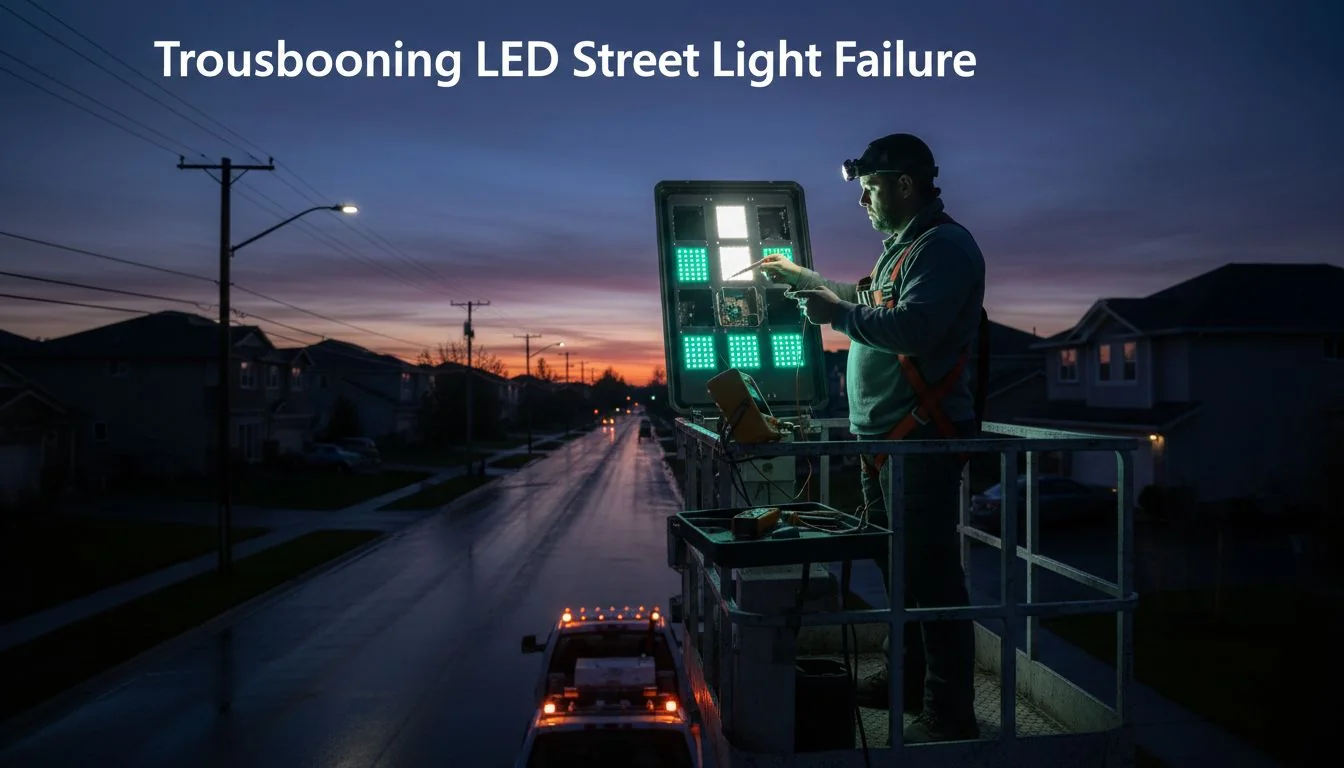
A flickering or dead street light causes project delays and safety risks. You need a fast, reliable way to diagnose the problem without wasting time or money on guesswork.
When an LED street light fails, start with the most likely causes. First, check the Surge Protection Device (SPD) for damage from grid transients. Next, inspect the luminaire for any signs of water ingress1. Finally, test the LED driver's output and protections. This order saves time.
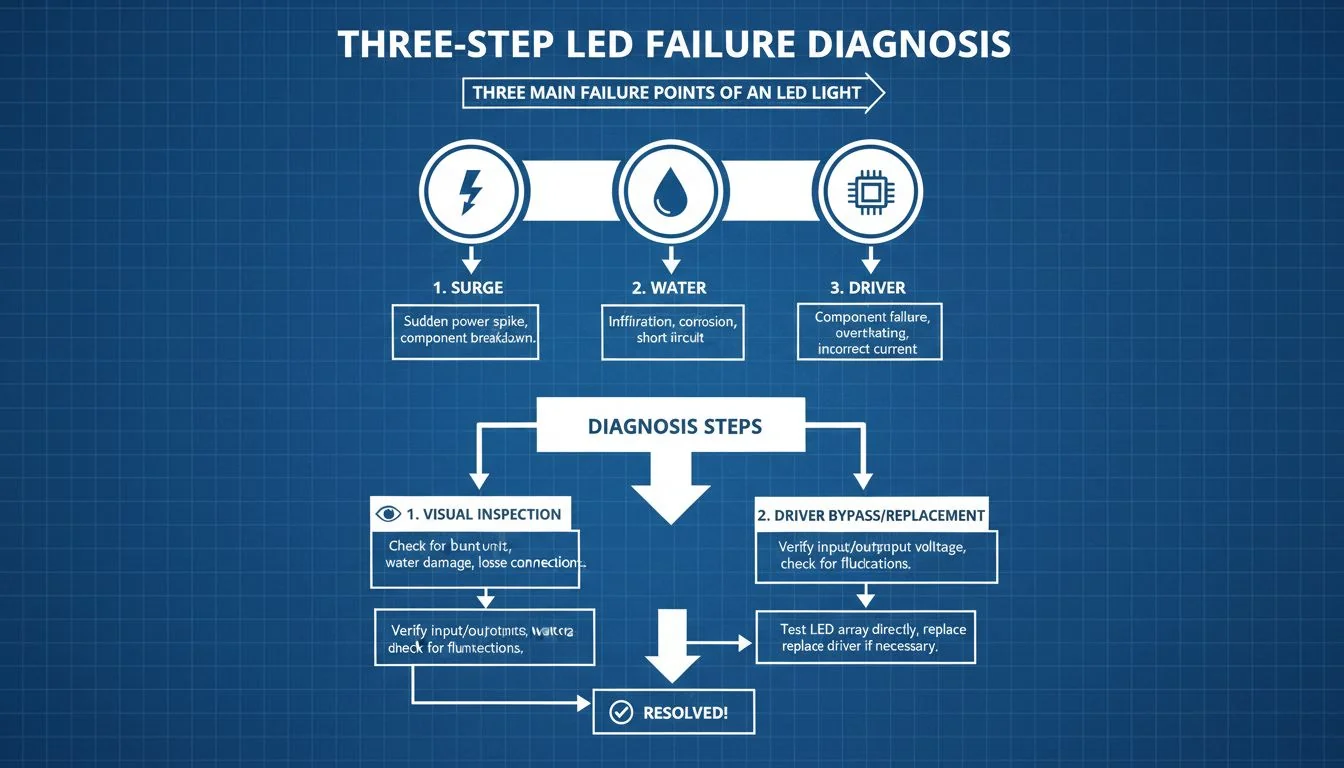
I've seen it all in my 13+ years in the LED business. A brand new installation in a stadium starts flickering after the first big storm. A whole street of lights goes dark. The client is frustrated, and the pressure is on. But finding the root cause doesn't have to be a guessing game. There's a simple, logical order to follow that will get you to the answer fast. Let's break down my field-tested, three-step process.
All outdoor LED lights are inherently waterproof and don't require specific IP ratings.False
This is false. 'Waterproof' is not a technical term. Lights need specific Ingress Protection (IP) ratings, like IP65 or IP66, to withstand environmental conditions like water jets or rain.
Power surges are a leading cause of premature failure in outdoor LED lighting.True
True. Outdoor luminaires are highly exposed to grid transients from lightning or utility switching. A properly rated Surge Protection Device (SPD) is critical for longevity.
Is a Power Surge the Culprit? How to Check Your SPD in 3 Minutes?
A hidden power surge can silently kill your expensive luminaires, leading to repeated failures. You need a quick way to confirm if your surge protection is still working.
Check the Surge Protection Device (SPD) first. Many SPDs have a visual indicator (like a small light or window) that shows their status. If the indicator shows 'end-of-life' or is dark, the SPD has likely sacrificed itself to protect the light and needs replacement.
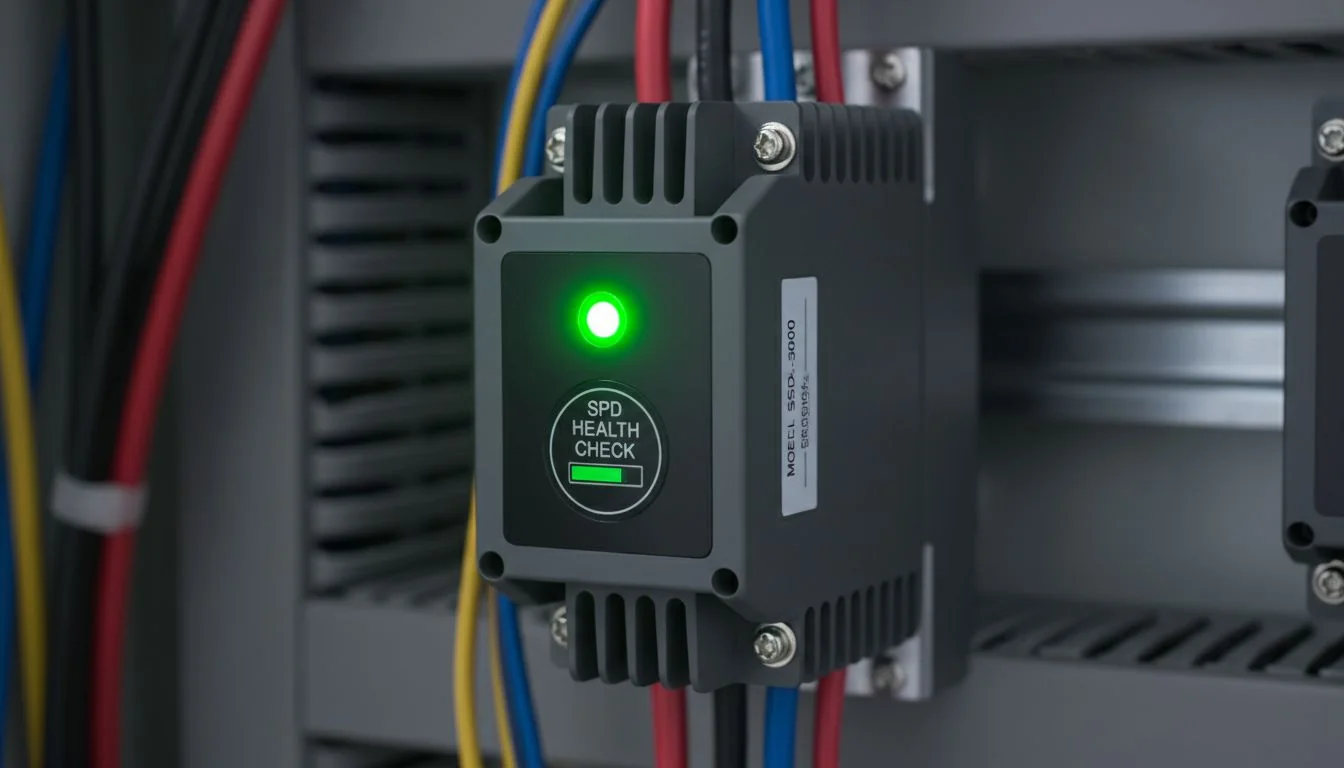
In my experience, especially after a storm, the SPD is the first hero to fall. Grid transients are no joke. The ANSI C136.22 standard gives us a clear roadmap for this. It classifies exposure levels and sets targets for how much of a hit a light should take. For critical infrastructure like roadways, airports, or stadiums, we always specify the "Extreme" level. This means the system—the luminaire, driver, and SPD—must withstand a 20kV/10kA surge. A lower-rated SPD in a high-exposure area is a recipe for failure. When I work with clients like developers in North America or for infrastructure projects in the Middle East, matching the SPD to the environment is non-negotiable. It's the difference between a reliable system and a maintenance nightmare.
ANSI C136.2 Surge Levels
| Level | Surge Immunity | Typical Application |
|---|---|---|
| Typical | 6kV / 3kA | Low-exposure areas |
| Enhanced | 10kV / 5kA | Medium-exposure areas |
| Extreme | 20kV / 10kA | Roadways, Airports, Stadiums |
Once an SPD is installed, it never needs to be replaced.False
This is incorrect. SPDs are sacrificial devices. They degrade or fail after absorbing significant surges to protect the equipment. Many have indicators to signal when they need replacement.
Street lights in areas like airports and major roadways often require 20kV/10kA surge protection.True
This is true. According to ANSI C136.2, these are considered 'Extreme' exposure locations, and a 20kV/10kA rating is the recommended level to ensure reliability and reduce failures.
Could Water Be Damaging Your Lights? How to Spot and Stop Ingress?
You thought your lights were sealed, but now they're flickering or corroded inside. Water ingress is a silent killer, destroying your investment from the inside out.
Look for condensation inside the lens, rust on components, or water stains. Check that gaskets are not cracked or compressed and that all cable glands are tightly sealed. Ensure any drain holes are clear and facing down, allowing moisture to escape instead of building up.
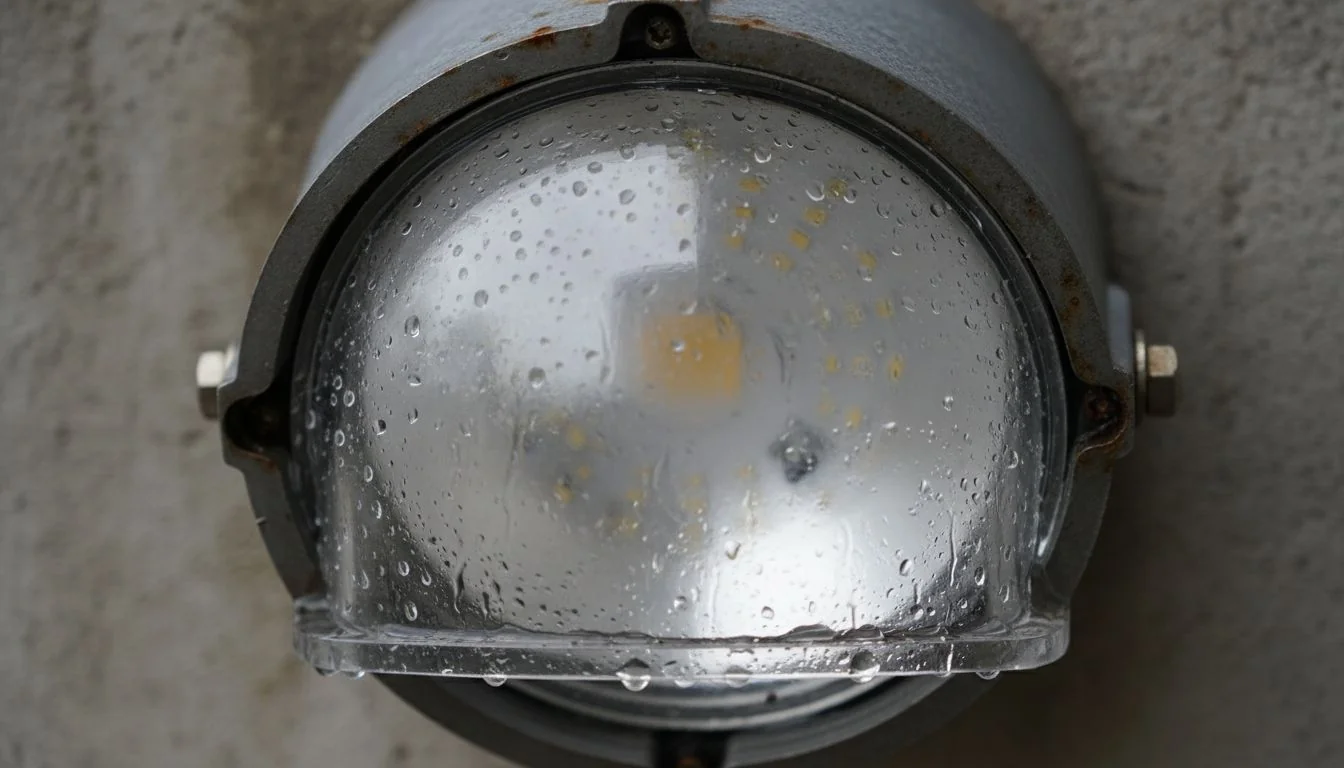
Water is the most common physical enemy of outdoor electronics. I've seen countless failures caused by something as simple as a poorly tightened cable gland or an aged gasket. People often get confused by IP ratings3. The first digit is for solids (dust), and the second is for liquids. An IP65 rating is fine for water jets from any direction, making it suitable for most pole lights that get hit with rain. But if a light could be temporarily submerged during flooding, you need IP67. For our clients building commercial properties in regions with heavy monsoons, like South Asia, we always recommend at least IP66. This rating ensures protection against powerful water jets, mimicking wind-driven rain. It's a small specification detail that prevents huge, costly problems down the line.
Understanding IP Ratings (IEC 60529)
| Rating | Protection Against Liquids | Common Use Case |
|---|---|---|
| IP65 | Water jets from any direction | General outdoor, street lights |
| IP66 | Powerful water jets | High-exposure, marine, wash-down |
| IP67 | Immersion up to 1m | Flood-prone areas, temporary submersion |
| IP68 | Continuous immersion | Underwater, fountains |
IP68 is always better than IP65 for all outdoor lighting.False
Not necessarily. Higher IP ratings often mean less breathability, which can trap condensation if not designed properly. IP65 or IP66 is sufficient and often more appropriate for standard street lights that aren't submerged.
Temperature and pressure cycles can cause condensation inside a sealed luminaire.True
This is a common issue. As the luminaire heats up and cools down, the air inside expands and contracts, which can pull in moist air from the outside, leading to condensation if not properly vented or sealed.
Is the LED Driver Dead? Here's How to Quickly Test It?
The light is dim, flickering, or completely dead, but the power is on. The driver might be the problem, but replacing it without being sure is a costly gamble.
A bad driver often causes flickering, dimming, or total failure. To test it, disconnect it from the LED module and use a multimeter to check its output. For a constant-current driver, you should see a stable voltage within its specified range when under load. No output means it's likely failed.
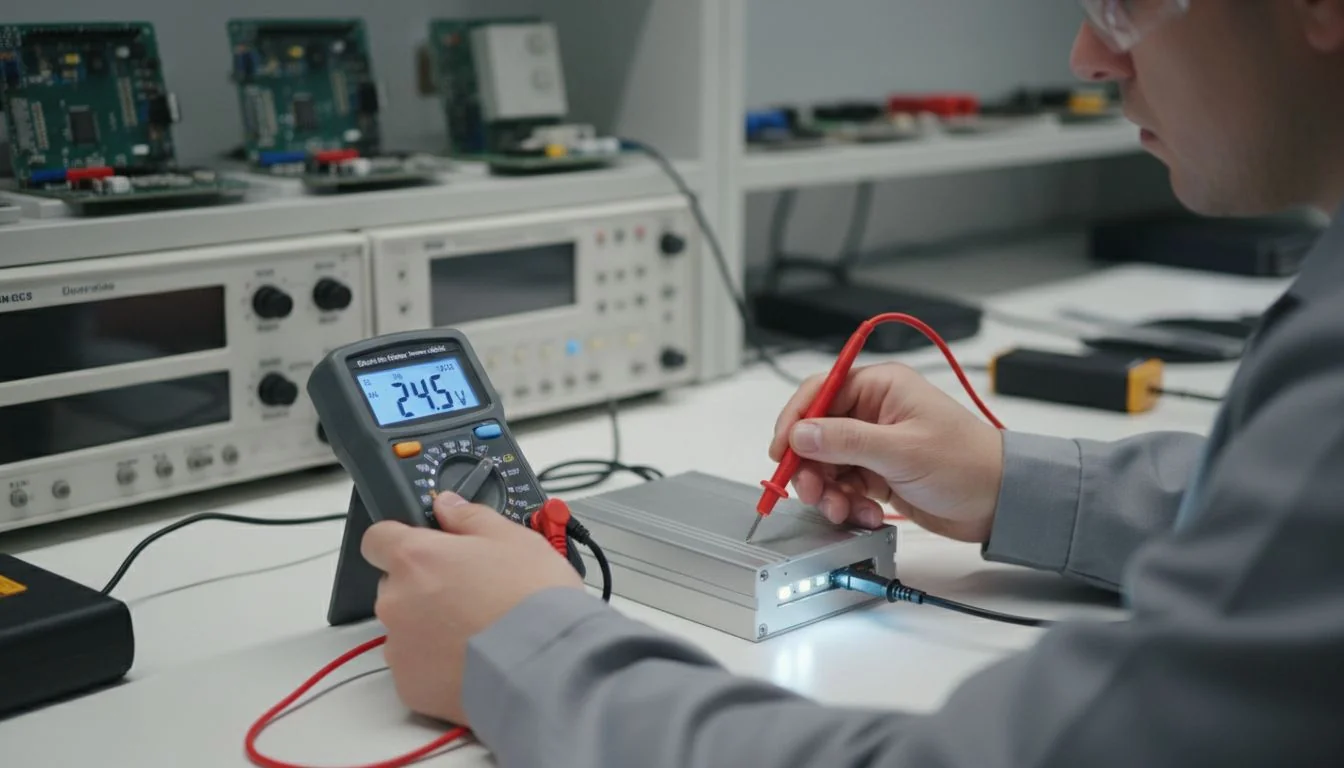
The driver is the electronic heart of the luminaire. It takes the AC input and converts it to the precise DC power the LEDs need. Most roadway lights use constant-current drivers, meaning they maintain a fixed current (e.g., 700mA) by adjusting the output voltage. When a driver starts to fail, the symptoms can vary. You might see flickering, a sign of unstable output. Or the light might shut down intermittently, which could be its thermal protection kicking in because it's overheating. I remember a project where a contractor used drivers that weren't matched to the LED's current class. The lights worked for a few weeks and then started failing one by one. The mismatch was over-stressing the drivers, leading to early death. That's why verifying specs per IEC 61000-4-5 and ensuring proper thermal management4 is a core part of our quality control at Besenled.
Common LED Driver Failure Symptoms
| Symptom | Potential Cause | Quick Check |
|---|---|---|
| Flickering | Unstable output, poor connection | Check output with multimeter, inspect wiring |
| Dimming | Output current degradation | Measure output current under load |
| Intermittent Off/On | Thermal shutdown | Check for overheating, ensure proper airflow |
| No Light | Complete driver failure | Check for DC voltage at the output |
Any LED driver can be used with any LED module as long as the wattage is similar.False
This is a dangerous misconception. Drivers must be matched to the LED module's specific requirements, including constant current (mA), forward voltage range (Vf), and dimming protocol.
Overheating is a primary cause of premature LED driver failure.True
Correct. Drivers are electronic components sensitive to heat. Poor thermal design, blocked ventilation, or high ambient temperatures can drastically shorten a driver's operational lifespan.
How Do I Ensure My Lighting System Lasts? The Key is Coordination?
You've picked high-quality components, but your lights are still failing. The problem isn't the parts; it's that they aren't working together as a coordinated system.
To ensure long-term reliability, you must coordinate the three key elements. Select an SPD that meets the site's ANSI C136.2 surge level, choose a luminaire with an IP rating appropriate for the environment, and match the driver's specs to both the LEDs and the SPD.
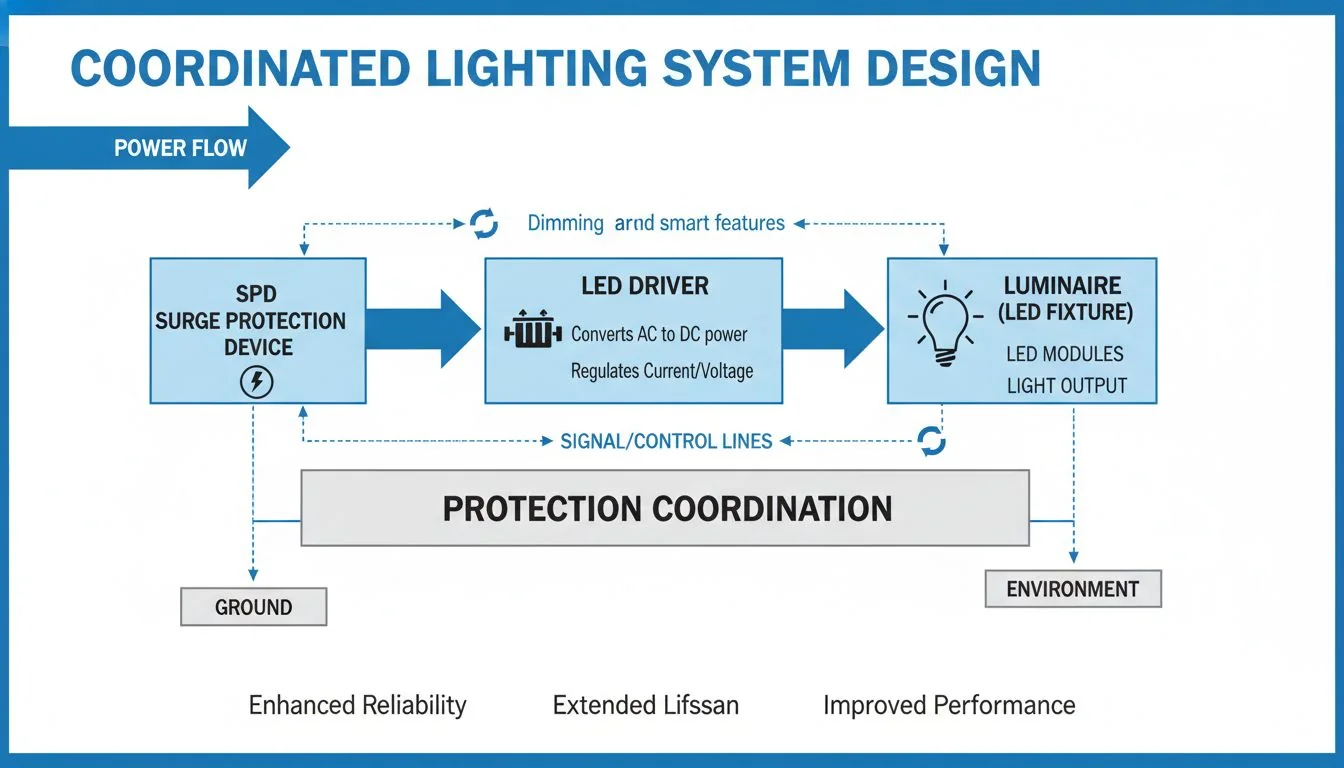
This is where everything comes together. A chain is only as strong as its weakest link. You can have a 20kV/10kA SPD, but if your luminaire has IP20 gaskets, the first rainstorm will kill it. You can have an IP67-rated fixture, but if the driver isn't protected from surges, a grid transient will take it out. From my field practice, the most robust installations use a systems approach. For a large-scale project, like a new warehouse for a client in Central Asia, we don't just sell lights. We design a solution. This means specifying thermally protected 20kV/10kA SPD modules with replacement indicators, pairing them with IP66-rated luminaires to handle dust and high-pressure water, and ensuring the driver is perfectly matched. This coordination is what maximizes mean time between failures (MTBF) and gives our clients the lowest total cost of ownership. It's not about one part; it's about the whole system's resilience.
System Coordination Checklist
| Component | Specification | Why It Matters |
|---|---|---|
| SPD | Match ANSI C136.2 level (e.g., 20kV/10kA) | Protects the entire system from grid transients. |
| Luminaire | Match IP rating to environment (e.g., IP66) | Prevents physical damage from water and dust. |
| Driver | Match current, voltage, and protections | Ensures efficient, stable power and prevents overload. |
As long as the luminaire is IP67 rated, you don't need a high-level SPD.False
This is false. The IP rating protects against water and dust ingress, while the SPD protects against electrical surges. They protect against completely different types of threats and are both necessary.
Coordinating the SPD, driver, and luminaire specifications significantly improves the Mean Time Between Failures (MTBF).True
Absolutely. A systems approach where all components are specified to handle the same environmental and electrical stresses creates a more resilient and reliable lighting system with a longer operational life.
Have More Questions? Here Are Some Quick Answers?
You still have some lingering questions about specifications and failures. Getting clear, direct answers is crucial before you make your next big purchasing decision for a project.
Is IP65 enough? Usually, yes for rain. What surge level? 10kV/5kA is good, 20kV/10kA is best for critical sites. Is my driver bad? Check for flicker or no output. Do SPDs need replacement? Yes, they are sacrificial. Why do LEDs fail after storms? Usually a power surge.
I get these questions all the time from clients, whether they're developers in Thailand like Somchai or contractors in the US. Let's tackle them one by one.
Is IP65 enough for outdoor street lights?
For most applications, yes. IP65 protects against low-pressure water jets from any direction, which is sufficient for rain and general cleaning. However, for coastal areas with salt spray or regions with high-pressure cleaning or wind-driven rain, upgrading to IP66 is a smart investment.
What surge level do street lights need?
It depends on the location. ANSI C136.2 recommends 10kV/5kA ("Enhanced") as a good baseline. But for critical infrastructure like airports, major highways, and stadiums, I always push for 20kV/10kA ("Extreme") protection. It costs a little more upfront but prevents costly failures.
How do I know an LED driver is bad?
The most obvious signs are flickering, dimming when it shouldn't, or the light not turning on at all. A quick test with a multimeter on the driver's output terminals will confirm if it's dead.
Do SPDs need replacement?
Yes, absolutely. They are designed to sacrifice themselves to protect the more expensive driver and LEDs. Many modern SPDs, like the ones we use at Besenled, have an indicator to tell you when they've done their job and need to be replaced.
Why do LEDs fail after storms?
The number one reason is a massive voltage surge caused by a nearby lightning strike. Even if the strike is not direct, it can induce powerful transients on the power grid that destroy unprotected electronics. This is why a properly rated SPD is not optional; it's essential.
LEDs fail after storms because the rain gets inside.False
While water ingress can be a problem, the most common cause of mass failure after a storm is electrical surges from lightning, not water. A proper SPD is the primary defense.
An LED driver can fail from thermal stress even without a power surge or water damage.True
True. If a luminaire is installed in a hot climate or has poor ventilation, the driver can consistently overheat, leading to a shortened lifespan and eventual failure on its own.
Conclusion
By checking for surge, water, and driver issues in that order, you can quickly solve most LED failures. A coordinated system is key to long-term lighting reliability.
References
-
Preventing water ingress is essential for maintaining the functionality and lifespan of outdoor lighting systems. ↩
-
ANSI C136.2 provides guidelines for surge protection levels, crucial for ensuring the safety of lighting systems. ↩
-
Understanding IP ratings helps in selecting the right lighting fixtures for different environmental conditions. ↩
-
Effective thermal management is vital for preventing LED driver failures and ensuring optimal performance. ↩