How Can You Win Tenders Without Being the Lowest Price?

Tired of losing bids to low-ball offers? It feels like your quality and service don't matter. The solution is to shift the focus from price to proven, quantifiable value1.
To win tenders without the lowest price, you must focus on the Most Economically Advantageous Tender (MEAT) criteria. Build a powerful evidence pack2 that proves your value in quality, delivery, and risk reduction. Align your proposal directly with the buyer's scoring matrix to maximize non-price points.
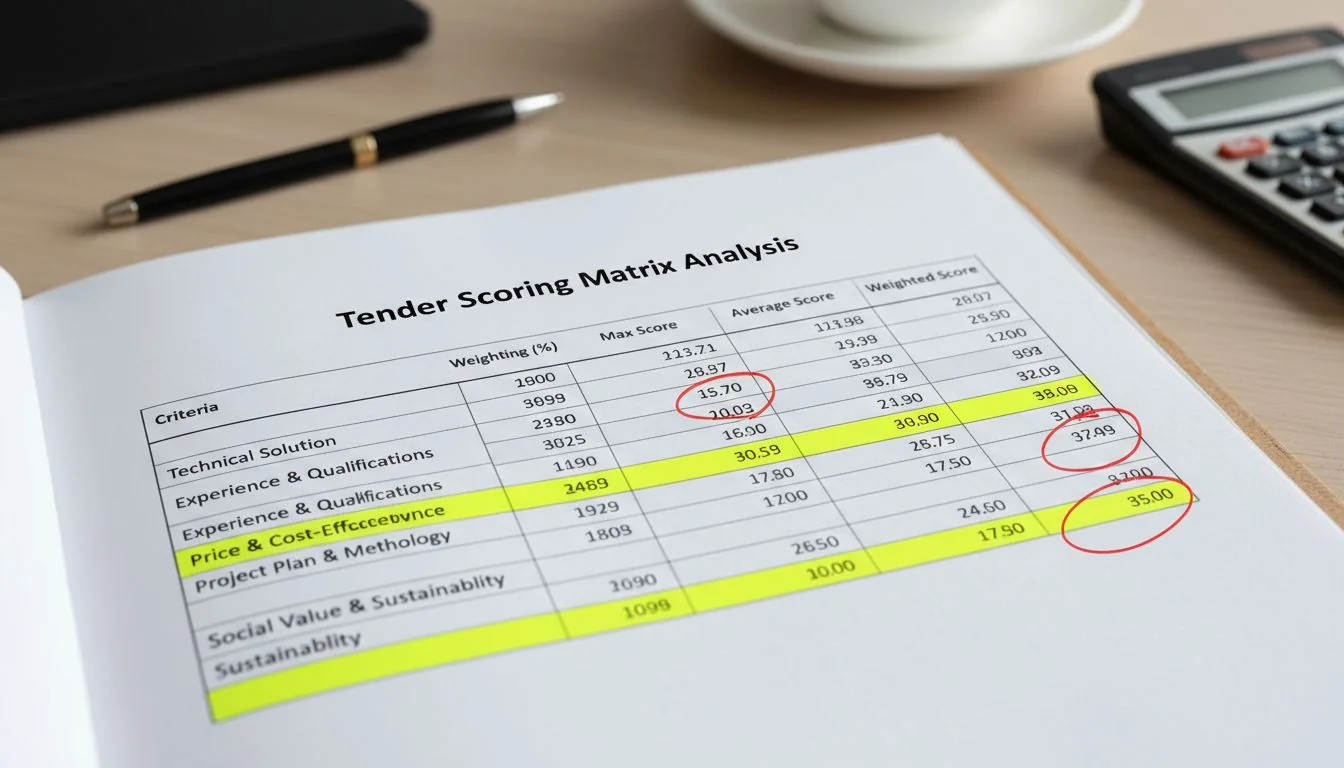
I've seen too many good companies lose out because they thought the game was only about price. It's not. Public and large corporate buyers are moving away from the "cheapest wins" model. They have to justify their decisions, and that means looking at the total cost of ownership3, risk, and long-term performance. They are scored on it. This is a huge opportunity if you know how to play the game. It means you need a playbook to demonstrate your value in a way they can measure and score. Let's break down how you can build that playbook and start winning the projects you deserve, even with a higher price tag.
All public sector tenders are awarded based on the lowest price.False
Many public tenders, especially in the EU and UK, use the Most Economically Advantageous Tender (MEAT) model, which balances price with quality, technical merit, and other value criteria.
A 1-week faster delivery time can be a quantifiable value lever in a tender.True
For projects with tight deadlines, like a retail store opening, faster delivery reduces the client's risk and holding costs, which can be translated into a monetary value that justifies a higher price.
How Do You Turn Proof Into Points With an Evidence Pack That Scores?
Struggling to make your quality claims believable to evaluators? Your words aren't enough. You need to build an evidence pack that turns your proof into points on their scoresheet.
An evidence pack is a structured collection of documents that substantiates every claim you make. Instead of just saying you have "high quality," you provide the test reports, certifications, and case studies that prove it. This makes it easy for evaluators to award you maximum points.

I learned this lesson the hard way on an early bid for a large warehouse project. We said our high bay lights were "superior," but a competitor who was 10% cheaper won. When I asked for feedback, the procurement manager told me, "Your competitor provided photometric files, LM-80 test data, and a case study from a similar facility showing 65% energy savings. You just gave us a spec sheet." That's when it clicked. Buyers don't buy your adjectives; they score your evidence.
Your evidence pack must be directly mapped to the tender's evaluation criteria.
Map Your Evidence to Their Criteria
Before you write a single word of your proposal, create a table. On one side, list every single scoring criterion from the tender. On the other side, list the specific piece of evidence you will provide to prove it.
| Tender Criterion | Your Evidence | Besenled Example |
|---|---|---|
| Energy Efficiency | IES files, LM-80 reports, Energy Star/DLC certificate | Provide DLC certificate showing our Pole Lights achieve 140 lm/W. |
| Product Reliability | 5-year warranty document, MTBF data, accelerated life test reports | Offer our standard 3-year warranty and show test data proving a 50,000-hour lifespan. |
| Delivery Speed | Logistics partner agreement, past project delivery records | Show tracking records from 5 recent projects to North America delivered in under 2 weeks. |
| Compliance | CE, UL, TISI, SASO certificates | Provide the client's required TISI certificate for a project in Thailand. |
This approach forces you to be disciplined. If you can't find a piece of hard evidence for a claim, don't make it. This simple exercise transforms your bid from a collection of marketing statements into an auditable, point-scoring machine.
A product specification sheet is sufficient evidence of quality for most tenders.False
Evaluators look for third-party, objective proof. Spec sheets are created by the manufacturer, while certifications (UL, CE), independent lab tests (LM-80), and client testimonials are more convincing.
Including a project plan with clear timelines can score points under 'Risk Management'.True
A detailed plan shows you've thought through the execution, understand the client's needs, and have a process to mitigate delays, which directly addresses the buyer's risk concerns.
How Can You Reverse-Engineer the Matrix to Write for the Buyer's Descriptors?
Are your proposals getting good but not great scores? You might be describing your solution instead of writing to the specific descriptors the evaluators use to assign points.
You win by dissecting the scoring matrix4 and using the buyer's own language. Find the evaluation guide in the tender pack. It will define what "poor," "good," and "excellent" mean for each question. Write your answer to hit every single point in the "excellent" descriptor.
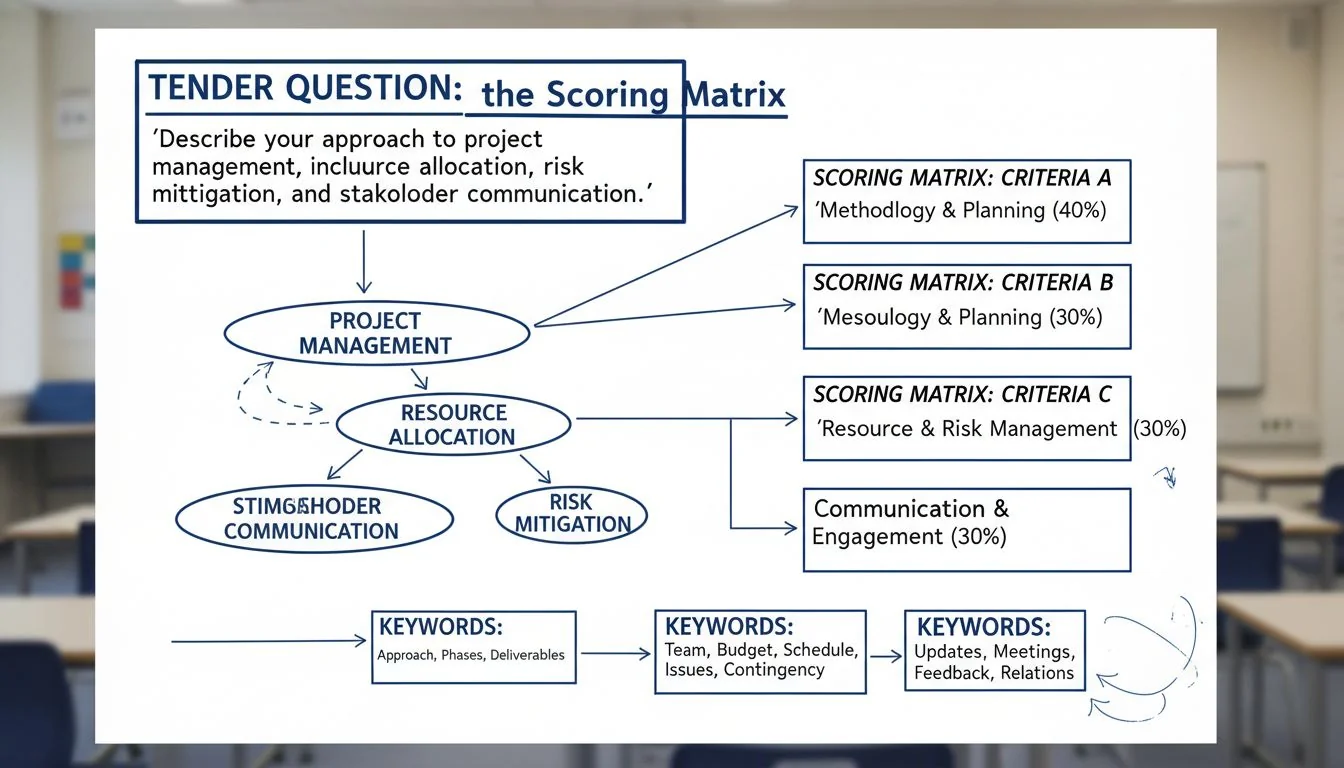
Think of it like a test where the teacher gives you the answer key beforehand. The scoring matrix is the answer key. For a client like Somchai, the procurement director in Thailand, the matrix might specify that an "excellent" score for technical solution requires "full DALI compatibility," "TISI certification," and a "customization plan for branding." Your proposal shouldn't just mention your smart lighting; it should have a section titled "Full DALI Compatibility and TISI-Certified Customization Plan" that uses those exact words.
Write to the "Excellent" Column
Break down the scoring descriptors and use them as your writing guide. Structure your answers with subheadings that mirror the buyer's language. This makes the evaluator's job easy. They can literally tick off their checklist as they read your response.
| Scoring Level | Typical Descriptor | How to Write for It |
|---|---|---|
| 0 - Unacceptable | Fails to meet requirement. | N/A |
| 2 - Poor | Partially meets requirement, significant gaps. | You mention you have smart controls. |
| 4 - Good | Fully meets requirement. | You state your system is DALI compatible. |
| 5 - Excellent | Exceeds requirement, adds significant value. | You state: "Our DALI-2 certified system integrates with your existing BMS, and we provide a TISI-certified technician for on-site commissioning, eliminating integration risk." |
Notice how the "Excellent" response doesn't just meet the need; it anticipates and solves a related problem (integration risk). It adds value beyond the basic requirement. By using their language and exceeding their definition of a good answer, you make it simple for them to give you the top score.
Using the exact keywords from the scoring matrix is seen as unoriginal by evaluators.False
Evaluators are often on tight deadlines. Using their keywords makes it easier for them to find the information they need to award points, which they appreciate.
A score of 'Good' is usually enough to win a tender.True
In a competitive tender, multiple bidders will likely achieve 'Good' scores. Winning often requires achieving 'Excellent' scores on heavily weighted criteria to differentiate your bid.
What Are the Street-Lighting Value Levers That Win Points Without Cutting Price?
Feel stuck when the only way to seem more attractive is to lower your price? You need to find value levers5—non-price benefits that solve a buyer's hidden costs and risks.
Value levers are specific, quantifiable benefits that justify your price. Instead of a 5% discount, offer a 2-week faster delivery, a 5-year warranty instead of 3, or guaranteed compatibility with their existing systems. These solve real business problems for the buyer.
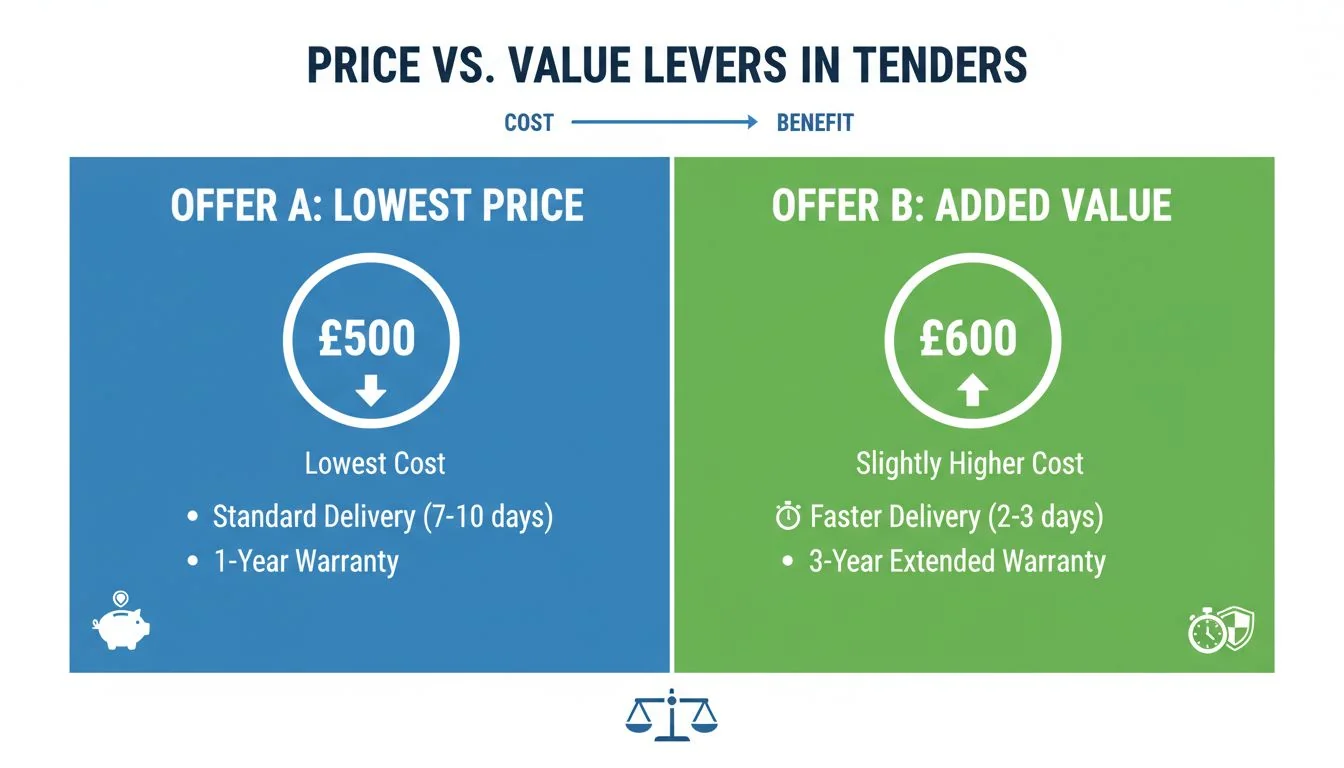
I once worked with a developer on a multi-unit residential project. Our price was higher than a local competitor's. During discovery, I learned their biggest fear was construction delays, which incurred huge penalty fees. So, in our bid, we didn't cut our price. Instead, we leveraged our 1-2 week international delivery capability. We guaranteed delivery of all LED panels and retrofits within 10 days of order, while the competition offered 4-6 weeks. We framed this as "Project Timeline Insurance." We won the bid because the value of avoiding a single week of delays was far greater than the 15% price difference.
Identify and Quantify Your Levers
Think about your customer's entire experience, not just the product. Where can you save them time, reduce their risk, or lower their long-term operational costs?
- Speed: Can you deliver faster? Our 1-2 week delivery is a major advantage over the 3-4 week industry average. For a retail chain refit, this means stores open sooner.
- risk reduction6: Do you offer better warranties or certifications? Our 3-year warranty and full compliance with standards like UL, TISI, and SASO give buyers peace of mind and reduce their compliance risk.
- Ease of Use: Can you make their life easier? We provide free lighting design (DIALux simulations) and technical support for integrating our smart DALI systems. This saves the client from hiring an expensive consultant.
- Sustainability: Is your product greener? We use recyclable materials and our LEDs save up to 80% on energy, which helps clients meet their ESG (Environmental, Social, and Governance) targets.
For each lever, quantify the benefit. Don't just say "fast delivery." Say "Delivery in 2 weeks, 3 weeks faster than the industry average, enabling your project to finish on schedule and avoid late-completion penalties."
Offering a longer warranty doesn't add real value.False
A longer warranty is a direct measure of the manufacturer's confidence in their product's reliability. It lowers the buyer's total cost of ownership by reducing future maintenance and replacement costs.
Buyers only care about the initial purchase price.True
Sophisticated buyers, especially in B2B and public sectors, evaluate the Total Cost of Ownership (TCO), which includes purchase price, energy consumption, maintenance costs, and expected lifespan.
What Is a Price-to-Value Strategy to Trade Margin for Top Scores?
Think you have to choose between protecting your margin and winning the bid? A smart price-to-value strategy lets you strategically "trade" a small amount of margin for maximum points on critical criteria.
This isn't about across-the-board discounting. It's about identifying the one or two things the buyer values most and offering a specific, high-impact concession on them. This shows you understand their priorities and makes your proposal stand out.
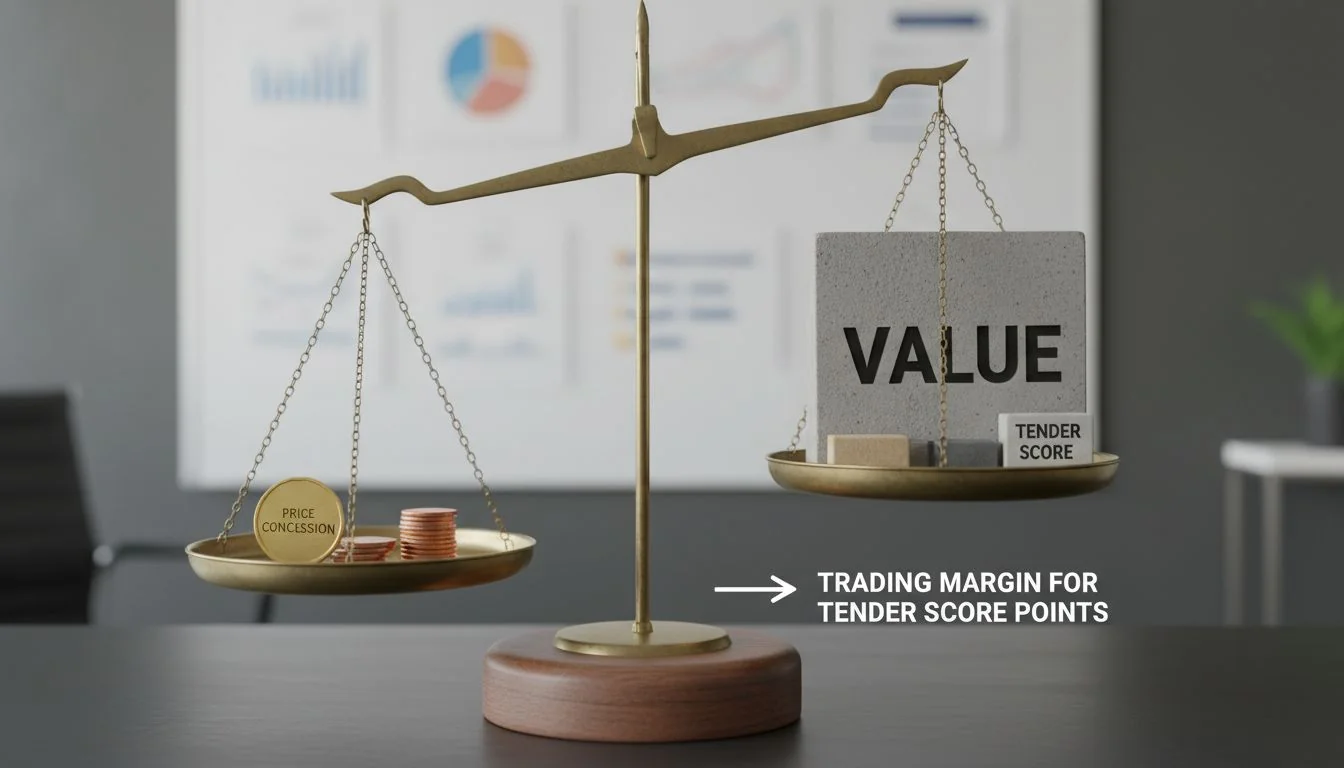
We were bidding on a smart lighting system for a new corporate headquarters in North America. The tender's quality score was 60% of the total, and half of that was for "System Integration and Support." We knew the client's IT team was stretched thin. Our competitors offered standard email support. We kept our product price firm but included a line item: "On-site Integration Support - 20 hours from a certified DALI engineer - Value: $3,000, Price: $0." We traded a small margin for a huge perceived value. In their scoring, this moved us from "meets requirements" to "exceeds requirements," securing the top score on the most important criterion and winning us the multi-million dollar contract.
Find the Buyer's "Golden" Criterion
Look at the scoring weights. Is there a criterion that accounts for 20%, 30%, or even 40% of the quality score? That's where you should focus your trade.
- Identify the Heavily Weighted Criterion: Find the section of the scoring matrix with the most points. Often, it's related to risk, innovation, or a specific pain point.
- Develop a High-Value Offer: Brainstorm a service or feature that directly addresses that criterion and goes beyond the standard expectation.
- Present it as a Value-Add: In your pricing table, list the item with its real-world value, then show it as "Included" or "$0." This quantifies the value you're providing for free.
| Standard Offer | strategic price-to-value7 Offer |
|---|---|
| LED High Bays: $150/unit | LED High Bays: $150/unit |
| 3-Year Warranty | 5-Year Extended Warranty (Value: $15/unit, Price: $0) |
| Technical Support: Email | On-Site Commissioning Support (Value: $2,000, Price: $0) |
This strategy shifts the conversation from "Why are you more expensive?" to "Look at the extra value they're giving us." You're not just cutting price; you're investing in winning.
Giving away services for free always destroys your profit margin.False
Strategically offering a high-value, low-cost service (like expert consultation) can secure a large, profitable contract that you would have otherwise lost, resulting in a net gain.
All tender criteria should be treated with equal importance.True
Tender documents explicitly assign different weights to price, quality, and sub-criteria. Focusing your efforts on the most heavily weighted criteria is the most efficient way to maximize your score.
What Are the Most Common Questions About Value-Based Bidding?
Still have questions about moving beyond price? Many people do. It's a different way of thinking about sales. Here are the answers to the most common questions I get.
This is about understanding the rules of the game. Buyers want the best value, not just the lowest price. Your job is to make it easy for them to see that value.
When you master these concepts, you stop being a commodity supplier and become a strategic partner. You're no longer just selling lights; you're selling guaranteed project timelines, lower operating costs, and peace of mind. That is something a buyer will always pay a premium for. Let's tackle the key questions.
What is MEAT in tenders?
MEAT stands for Most Economically Advantageous Tender. It’s a scoring method used widely in public procurement to evaluate bids on more than just price. It forces buyers to consider a balanced view, weighing the initial price against factors like quality, technical support, delivery timelines, risk, sustainability, and social value. For a supplier like us, winning under MEAT means you must maximize your non-price points. You do this by providing quantified, auditable evidence for every value claim you make.
How do I score higher on quality criteria?
You score higher by being specific and providing proof. Don't just claim "high-quality." Instead, submit the evidence:
- Certifications: Provide copies of UL, CE, DLC, or other relevant certificates.
- Test Reports: Include IES, LM-79, or LM-80 reports.
- Case Studies: Show data from past projects, like "Client X saved $15,000 annually on energy."
- Warranties: A longer warranty is tangible proof of your confidence in the product's lifespan.
Can I beat a lower price with better value?
Absolutely. This is the entire point of the MEAT framework. If price is 40% of the score and quality is 60%, you can easily win with a higher price if your quality score is superior. For example, if your bid is 10% more expensive but you prove you can deliver 4 weeks faster, preventing costly project delays for the client, your "value" is much higher. The key is to quantify that value in terms the buyer understands (e.g., "Our faster delivery saves you an estimated $50,000 in potential delay penalties").
What evidence convinces evaluators?
Evaluators are convinced by objective, third-party, and quantifiable proof. They are skeptical of marketing claims. The best evidence includes:
- Third-Party Certifications: UL, CE, FCC, TISI, SASO.
- Independent Lab Reports: Photometric data, life-test results.
- Client Testimonials & Case Studies: Especially those with hard numbers.
- Financial Stability Reports: Shows you are a low-risk partner.
- Detailed Project Plans & Timelines: Proves you are organized and reliable.
How do I present social value and sustainability?
Link your features directly to the buyer's goals. Don't just say "we are green." Say:
- "Our LED lights reduce energy consumption by 75%, directly contributing to your corporate CO2 reduction targets."
- "Our products are manufactured using 90% recyclable aluminum, helping you meet the sustainability requirements outlined in section 4.2 of this tender."
- "We use a closed-loop manufacturing process that minimizes waste, aligning with circular economy principles."
Conclusion
Stop competing on price. Win tenders by proving your superior value with structured evidence, strategic scoring, and a focus on the buyer's total cost of ownership and key priorities.
References
-
Quantifiable value makes your proposal more persuasive by demonstrating clear benefits to the buyer. ↩
-
An evidence pack substantiates your claims, making your proposal more credible and competitive. ↩
-
Understanding TCO helps you frame your proposal in terms of long-term value, not just initial price. ↩
-
A scoring matrix helps you align your proposal with buyer expectations, maximizing your score. ↩
-
Identifying value levers allows you to present non-price benefits that can justify a higher bid. ↩
-
Highlighting risk reduction strategies can make your proposal more attractive to cautious buyers. ↩
-
This approach helps you balance pricing with value, making your bid more competitive. ↩