How Can You Stop Streetlight Glare and Light Trespass with a 3-Step Playbook?
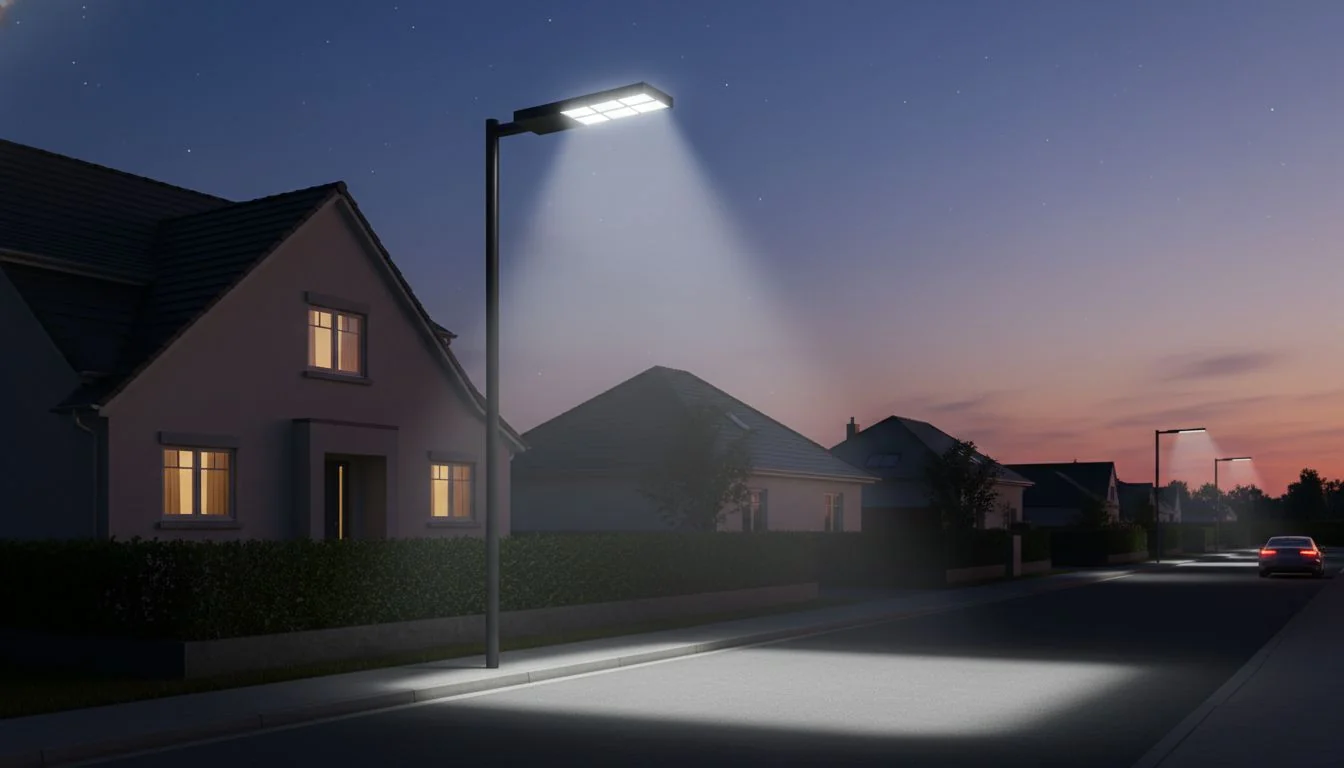
Your streetlights are causing blinding glare and spilling into homes. This leads to angry resident complaints, potential safety hazards, and wasted energy, complicating your large-scale development projects.
The most effective solution is a three-part playbook. Combine a warm Correlated Color Temperature (CCT), specify full-cutoff optics1 with shields, and implement a smart dimming schedule. This approach systematically eliminates glare and light trespass while meeting international standards.
Over my 13 years in the LED lighting industry, I've seen countless contractors and developers struggle with this. They often think the only solution is to reduce brightness, which can compromise safety. But the real problem isn't brightness; it's a lack of control. Glare and light trespass are design and operations issues. By getting the specifications right from the start, you can prevent these problems before they even happen. This playbook is the exact method we use at Besenled to help our partners deliver compliant, community-friendly projects2 every time. Let's walk through each step.
Reducing streetlight brightness is the only way to stop glare.False
Glare is primarily caused by high-angle light and excessive blue light content (high CCT), not just brightness. Proper optics and warmer CCTs can reduce glare even at the same light level.
Light trespass from streetlights can disrupt human sleep cycles and harm local wildlife.True
The American Medical Association and the International Dark-Sky Association have both issued guidance noting that stray artificial light at night, especially blue-rich light, can negatively impact circadian rhythms in humans and animals.
Why Should You Select a CCT Between 2200–3000K for Comfort and Weather?
Harsh, blue-white streetlights are creating blinding glare for drivers. They also perform poorly in fog and rain, making roads less safe and leaving your project open to liability.
Choosing a warmer Correlated Color Temperature (CCT) solves both issues. Warmer CCTs in the 2200K to 3000K range have significantly less blue light. This reduces the scattering effect that causes glare and improves visibility in bad weather, creating a safer and more comfortable environment.
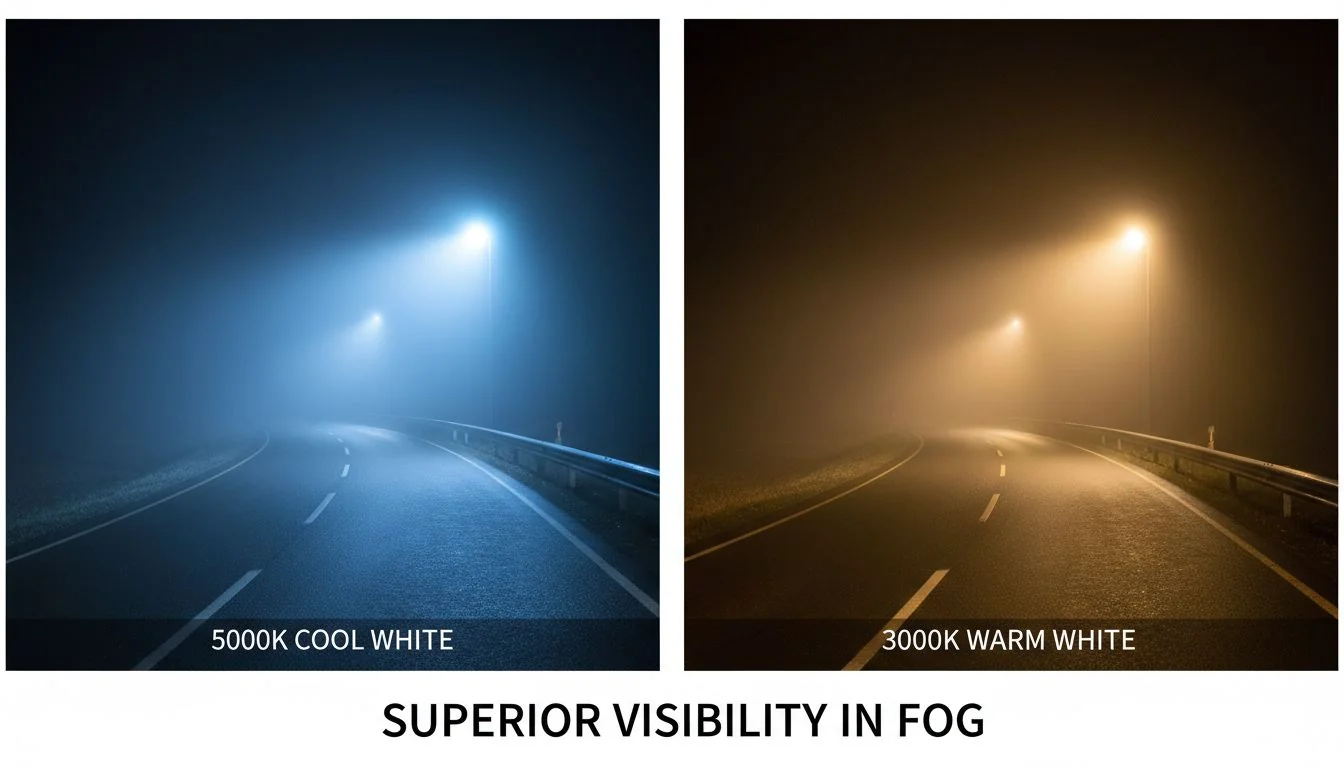
When I work with developers on large residential projects, CCT is one of the first things we discuss. The choice seems small, but it has a huge impact on resident satisfaction. High CCT light (4000K and above) contains a lot of blue-wavelength light. This type of light scatters easily in the Earth's atmosphere and within the human eye, a phenomenon known as Rayleigh scattering. This scattering is what creates the painful "halo" or "disability glare" effect that makes it hard to see. In contrast, warmer light (2200K-3000K) has longer wavelengths that scatter far less, resulting in crisp, comfortable visibility.
CCT Selection Guide
Choosing the right CCT depends on the application. It's not a one-size-fits-all decision. For a procurement director like Somchai in Thailand, matching the CCT to the project's environment is key for both compliance and public acceptance.
| CCT Range | Common Name | Best Application | Why It Works |
|---|---|---|---|
| 2200K | Amber | Environmentally sensitive areas, coastal zones, parks. | Maximum glare reduction. Minimal impact on nocturnal wildlife and meets the strictest DarkSky guidelines. |
| 3000K | Warm White | Residential streets, commercial campuses, parking lots. | The best all-around choice. Provides excellent visual comfort and good color rendering without excessive glare. |
| 4000K+ | Cool White | Major highways, industrial yards, high-security zones. | Use with extreme caution. Only for areas where maximum visual acuity is critical and no residential properties are nearby. |
A client of ours in a coastal South American city was facing constant complaints about their new 5000K streetlights. We helped them switch to 3000K fixtures. The complaints stopped almost overnight, and drivers reported feeling safer.
LEDs with a CCT of 3000K or lower are often called 'amber' lights.False
3000K is typically called 'warm white.' True amber LEDs are usually 2200K or lower and have a distinctly yellow-orange color.
The International Dark-Sky Association (IDA) recommends using luminaires with a CCT of 3000K or less.True
The IDA's Fixture Seal of Approval program requires CCTs of 3000K or below to minimize blue light emission, which contributes to skyglow and ecological disruption.
How Can You Engineer Optics to Stop Spill Light Completely?
Your new streetlights are lighting up bedroom windows and backyards, not just the road. This light trespass wastes energy, angers residents, and can even violate local lighting ordinances.
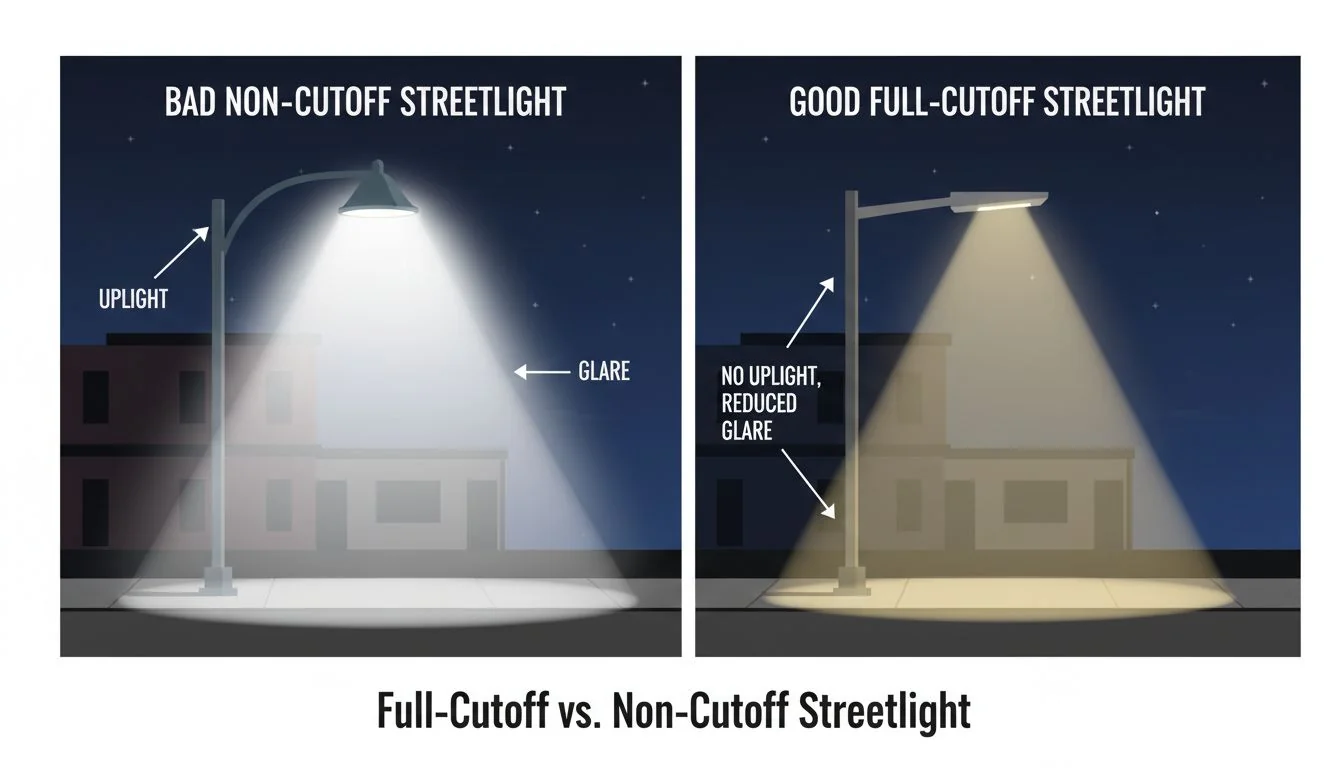
The solution is to use precisely engineered optics. Specify full-cutoff fixtures that direct 100% of their light downward. Then, use BUG ratings3 and house-side shields to shape the light distribution and physically block it from spilling onto private property.
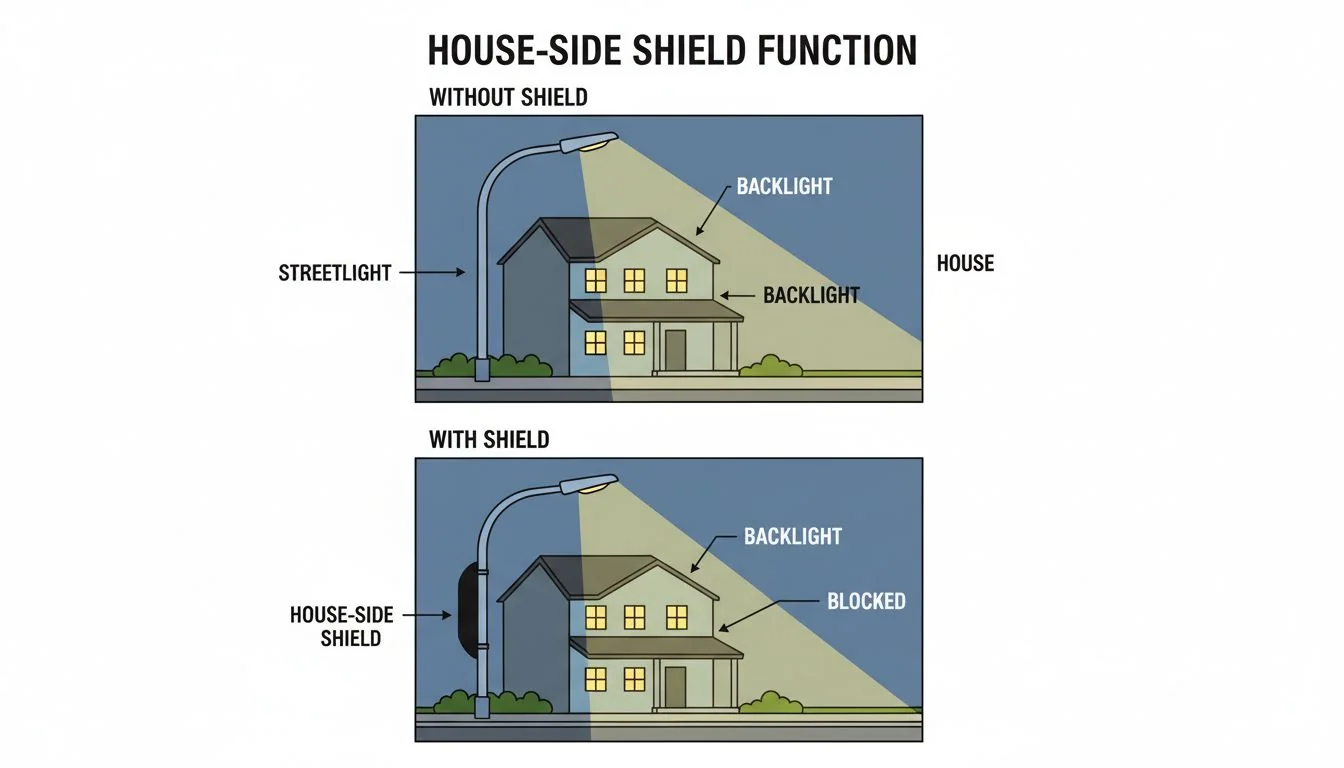
This is where the technical details really matter for a procurement manager. Simply choosing a "streetlight" isn't enough. You have to control where the lumens go. At Besenled, we provide detailed IES files for every fixture, so our partners can model the light distribution before a single pole is installed. This proactive approach prevents costly mistakes. The two most important tools for this are BUG ratings and shields.
Mastering BUG Ratings and Shields
The Illuminating Engineering Society (IES) created the BUG rating system to classify how much light a fixture emits in undesirable directions.
- B (Backlight): Light projected behind the pole. This is a primary cause of light trespass onto adjacent properties.
- U (Uplight): Light projected above the horizontal plane of the fixture. This is the worst offender for skyglow and is pure wasted energy.
- G (Glare): High-angle forward light that causes discomfort for drivers and pedestrians.
For any project near residential or natural areas, your goal should be a U0 rating, meaning zero uplight. For backlight, a B1 or B2 rating is usually acceptable, but you can eliminate it almost entirely with a shield.
| Optical Control Tool | What It Does | When to Specify It |
|---|---|---|
| Full-Cutoff Design | Ensures no light is emitted above 90 degrees. | Always. This is non-negotiable for responsible outdoor lighting. Look for a U0 rating. |
| house-side shield4 | A physical barrier that blocks the "Backlight" portion of the distribution. | When streetlights are located near homes, apartments, or hotel windows. It's a simple, low-cost fix. |
| Distribution Type (e.g., Type II, III) | Shapes the forward throw of light to match the road width. | Select the type that illuminates the target area without spilling onto sidewalks or landscaping. |
For a recent project with a developer in North America, we specified a pole light with a Type III distribution, a B1-U0-G1 rating, and a field-installable house-side shield. This combination perfectly lit the two-lane road while keeping the adjacent homes in complete darkness, meeting strict local codes.
All LED streetlights are full-cutoff.False
Many decorative or older-style 'acorn' LED fixtures are not full-cutoff and produce significant uplight. It is a specific design feature that must be verified in the product specifications (U0 rating).
A house-side shield can reduce backlight by over 90%.True
A properly designed internal or external house-side shield is a physical barrier that effectively blocks the light distribution zone behind the luminaire, preventing it from becoming light trespass.
How Do You Dim Lights by Zone and Time Without Sacrificing Safety?
Running streetlights at 100% brightness all night is a massive waste of energy and money. It's also a major source of light trespass during late-night hours when traffic is low.
Implement smart dimming schedules using controls like DALI or 0-10V systems. By aligning dimming levels to IES Lighting Zones (LZ) and time of night, you can cut energy use and light pollution by 30-50% without ever compromising public safety.
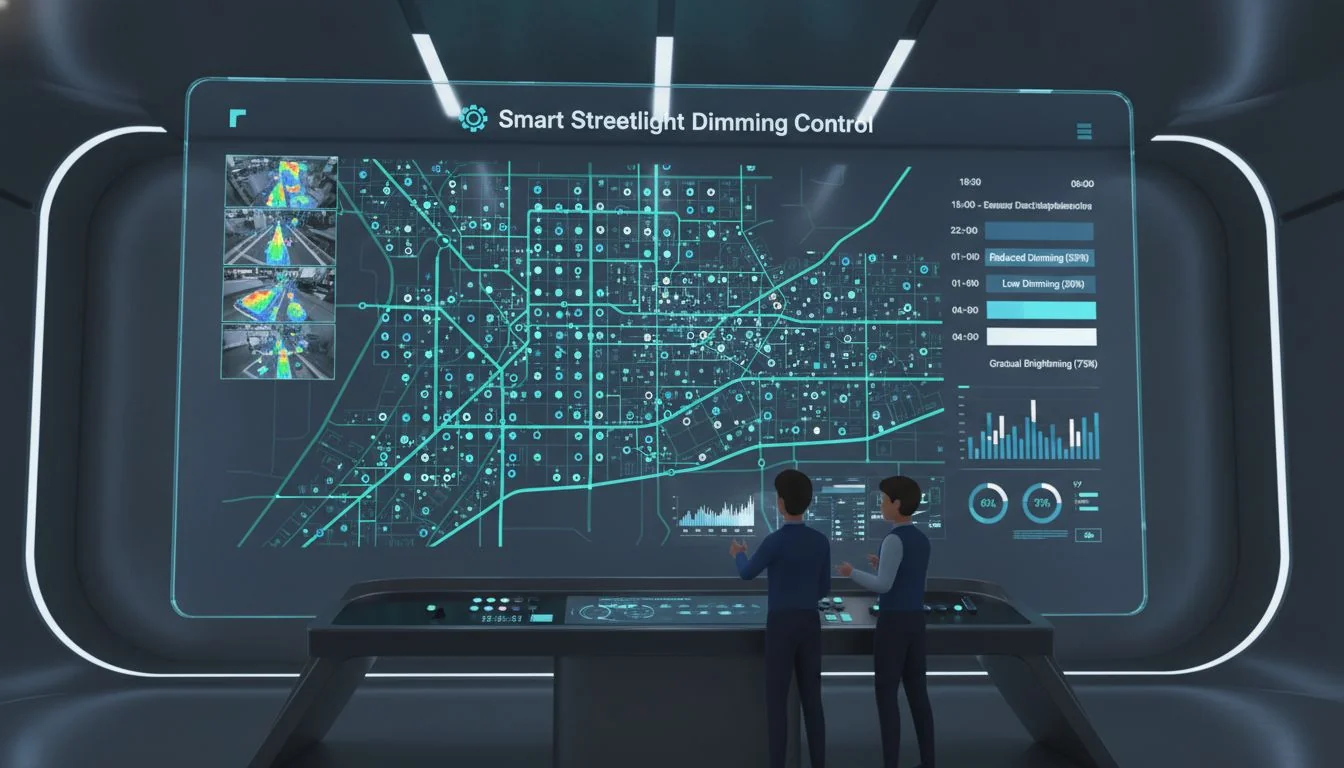
This is the operational part of the playbook. For large-scale buyers, integrating smart controls is a huge value-add that delivers long-term operational savings. It transforms a static liability into a dynamic, manageable asset. Our Besenled fixtures come standard with 0-10V dimming and can be equipped with DALI or Wi-Fi controllers compatible with major building management systems (BMS). This makes it easy to implement sophisticated control strategies across entire cities or commercial campuses.
Implementing a Zonal Dimming Strategy
The IES defines Lighting Zones to help planners match light levels to the surrounding environment. Using these zones as a guide for your dimming schedule ensures you provide enough light for safety, but no more.
- LZ1: Low Ambient Lighting. (Rural, undeveloped areas)
- LZ2: Moderate Ambient Lighting. (Suburban neighborhoods, residential areas)
- LZ3: Moderately High Ambient Lighting. (Urban commercial districts, main roads)
- LZ4: High Ambient Lighting. (Dense urban cores, entertainment districts)
A typical strategy involves setting a "curfew" time, often midnight, when light levels can be safely reduced.
| Lighting Zone | Example Area | Pre-Curfew Level (until 12 AM) | Post-Curfew Level (after 12 AM) |
|---|---|---|---|
| LZ1 | Rural Road | 50% | 30% (or motion-activated) |
| LZ2 | Residential Street | 70% | 50% |
| LZ3 | Commercial Corridor | 100% | 70% |
| LZ4 | City Center | 100% | 100% (or 80%) |
We worked with a municipality in South Asia on a smart city project. By programming their new pole lights to dim from 100% to 60% after 1 AM, they achieved a 40% reduction in energy consumption5 and extended the life of the fixtures, all while maintaining IES-recommended light levels for safety.
Dimming streetlights by 50% cuts visibility in half.False
The human eye perceives brightness logarithmically, not linearly. A 50% reduction in power and lumen output results in only a ~30% perceived reduction in brightness, which is often unnoticeable to the casual observer.
Smart lighting controls can reduce outdoor lighting energy consumption by up to 50%.True
Studies by the Department of Energy and various municipalities have shown that combining LED conversions with adaptive controls like dimming schedules and motion sensors can yield energy savings of 40-60% compared to non-controlled HID or LED systems.
How Do You Verify and Document Compliance with Lighting Standards?
You've designed a perfect lighting plan on paper, but how do you prove it works in the real world? Without verification, you can't satisfy the client, the public, or regulatory bodies.
The key is to document everything upfront and verify it in the field. Create detailed procurement specifications, then after installation, use light meters to conduct field measurements. Check vertical illuminance6 at property lines to prove you've stopped trespass and document compliance.
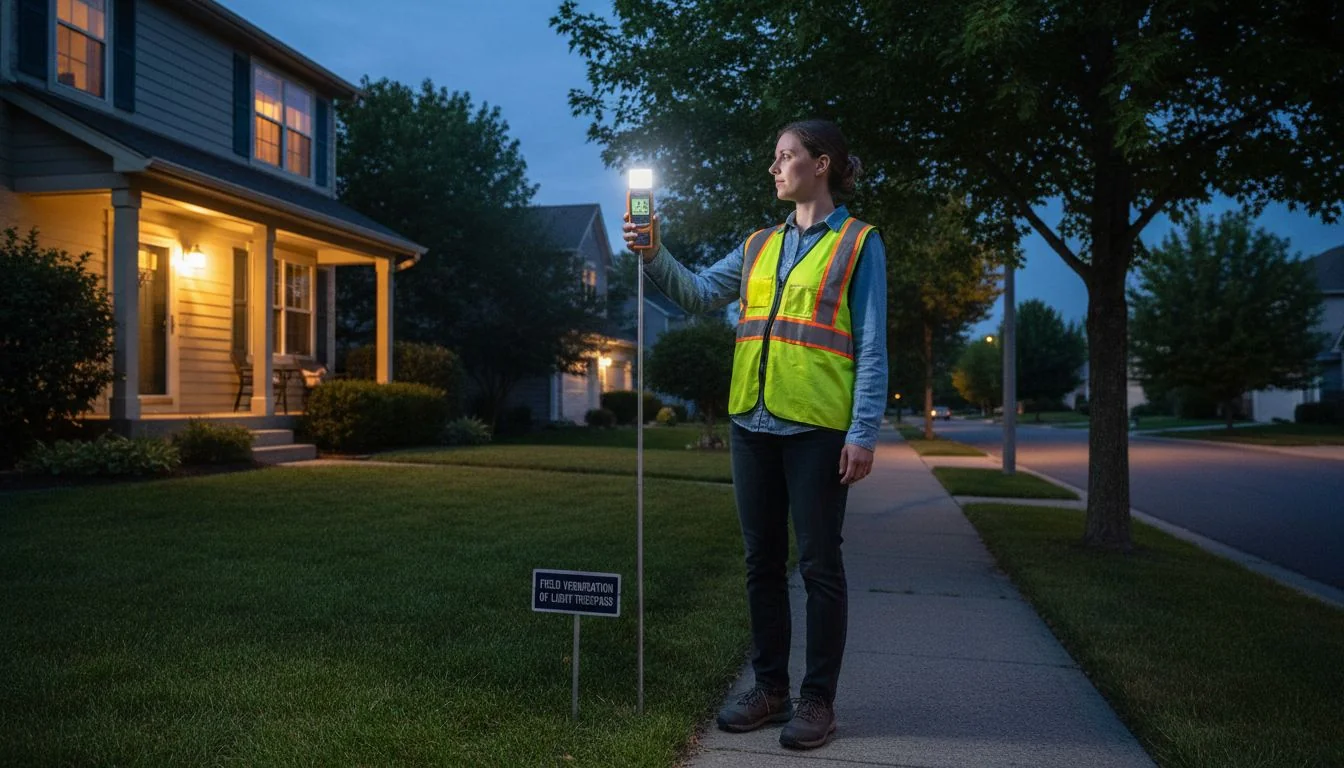
For a procurement director managing multi-million dollar projects, documentation is not optional—it's your protection. It's how you prove you delivered what was promised. At Besenled, we support our partners by providing a full suite of documentation for every product, including IES files, LM-79/LM-80 reports, and certifications like UL, DLC, and CE. This makes the submittal process seamless.
Building a Bulletproof Spec and Verification Plan
Your procurement specification is your first line of defense. Be explicit.
- Bad Spec:
150W LED Streetlight - Good Spec:
LED Streetlight, 150W max, 3000K CCT, CRI >80, Type III distribution, B1-U0-G1 BUG rating, 0-10V dimming, 7-pin NEMA receptacle, with optional house-side shield. Must be UL and DLC Premium listed.
After installation, your verification plan should include:
- Horizontal Illuminance Check: Measure the light levels (in lux or footcandles) on the street and sidewalk to ensure they meet IES minimums for safety.
- Vertical Illuminance Check: This is crucial for trespass. Measure the vertical light level at the windows of the nearest homes. Your target should be less than 1 lux.
- Visual Inspection: Walk the site at night. Look for harsh shadows, glare spots, or light spill. Confirm that shields are installed correctly and dimming schedules are active.
By following this process, you create a transparent, defensible record that shows your project meets all technical and community requirements. It's the final step in a professional, repeatable playbook.
A simple smartphone app can accurately measure light levels for compliance.False
Smartphone light sensors are not calibrated and are not spectrally corrected, leading to highly inaccurate readings. Professional-grade, calibrated photometers are required for reliable compliance verification.
IES RP-8-18 recommends a maximum of 3 lux of vertical illuminance on a residential window at night.True
The Illuminating Engineering Society's Recommended Practice for Roadway Lighting suggests limiting vertical illuminance at the property line to prevent light trespass, with specific values depending on the Lighting Zone.
Have More Questions About Glare and Light Trespass? We Have Answers.
You've learned the CCT-Optics-Dimming playbook, but you might still have specific questions. Let's tackle the most common ones I hear from clients and partners around the world.
Here are quick, direct answers to your most pressing questions about CCT, light trespass, BUG ratings, visibility with warm LEDs, and the value of shields. This will clear up any final doubts.
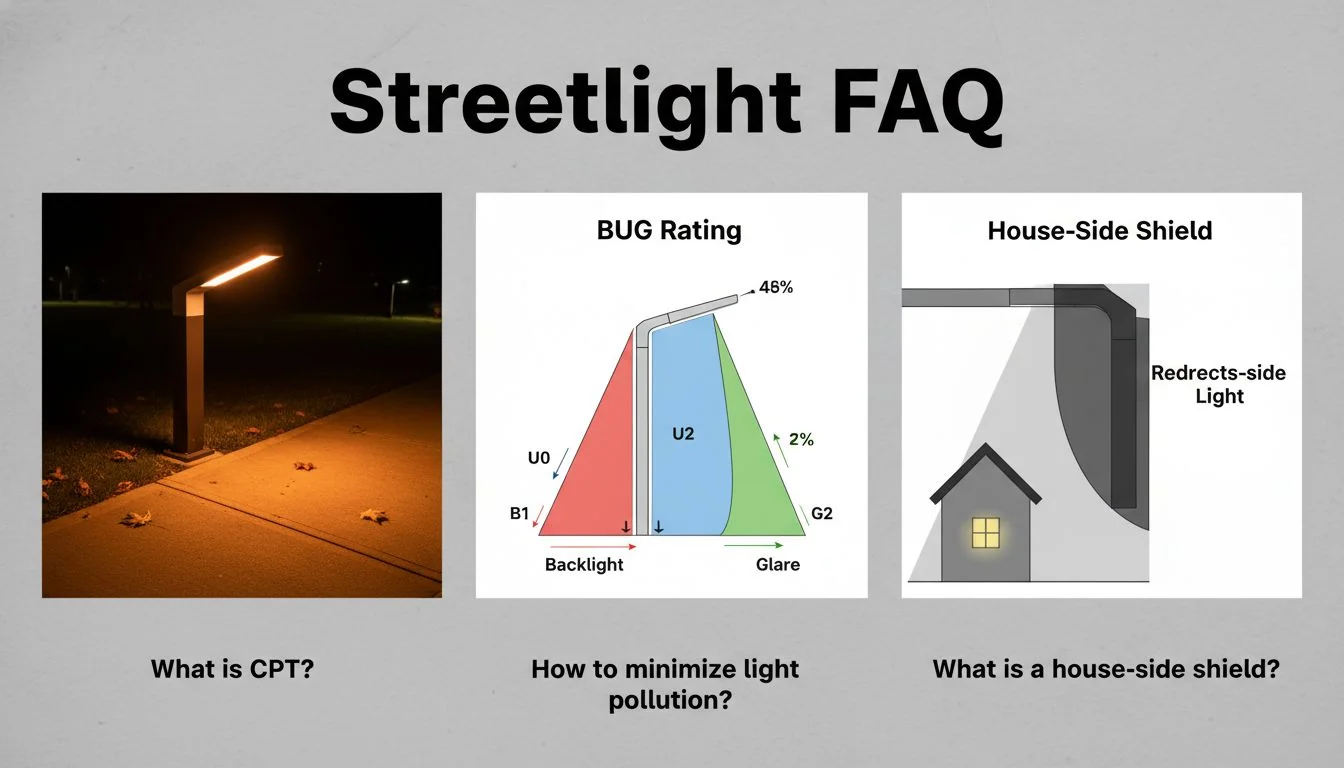
These are the questions that come up in project meetings every day. As a supplier, my job is not just to sell a fixture, but to provide the expertise that ensures my partners succeed. Here are the straightforward answers you need.
What CCT reduces streetlight glare most?
The lowest CCT practical for the application will reduce glare most. For most areas, 3000K (warm white) is the ideal balance of comfort and visibility. For maximum glare reduction in environmentally sensitive areas, 2200K (amber) is the best choice. The key is minimizing high-frequency blue light.
How do I stop light trespass into homes?
The most effective method is a two-part solution. First, use a full-cutoff fixture (U0 rating) to ensure no light goes up. Second, add a house-side shield. This physical barrier is specifically designed to block the backlight that would otherwise spill onto a property.
What is BUG and how do I choose ratings?
BUG stands for Backlight, Uplight, and Glare. It's a rating system that quantifies stray light. When choosing a rating for a residential or mixed-use area, always aim for U0 (zero uplight). For Backlight and Glare, B1 and G1 are very good targets, as they represent very low levels of potentially disruptive light.
Do warmer LEDs hurt visibility?
No, this is a persistent myth. While cool, blue-rich light can feel brighter due to a phenomenon called scotopic stimulation, it doesn't necessarily improve visual acuity. A well-designed 3000K lighting system provides excellent color rendering and visibility for identifying obstacles, faces, and colors, all without the disabling glare of high-CCT light. Safety is about the quality and distribution of light, not just its color.
Are shields worth it?
Absolutely. In any area where streetlights are near homes, a house-side shield is one of the highest-return investments you can make. It is a low-cost accessory, often under $20, that can completely eliminate light trespass complaints. For a developer or contractor, this small cost saves thousands in potential remediation and builds immense goodwill with the community.
Warmer CCT LEDs (3000K) have a lower Color Rendering Index (CRI) than cooler CCTs.False
CRI is independent of CCT. High-quality LEDs are available with CRIs of 80, 90, or even 95+ at both warm (3000K) and cool (5000K) color temperatures. It is a matter of specification, not a limitation of the CCT itself.
Conclusion
Solving glare and light trespass is about smart control, not just brightness. By following the CCT-Optics-Dimming playbook, you can deliver safer, more efficient, and community-friendly lighting projects every time.
References
-
Full-cutoff optics are essential for preventing light trespass and ensuring compliance with lighting standards. ↩
-
Community-friendly projects foster goodwill and reduce complaints, enhancing public safety and satisfaction. ↩
-
BUG ratings help assess light distribution and minimize unwanted light spill, enhancing community satisfaction. ↩
-
House-side shields are effective tools for blocking backlight and preventing light from spilling into homes. ↩
-
Reducing energy consumption in street lighting is vital for sustainability and cost savings. ↩
-
Measuring vertical illuminance is key to ensuring compliance and preventing light trespass. ↩