Your street light tender is vague, using terms like "durable" or "dark-sky friendly1." This ambiguity invites low-quality bids, leading to disputes, project delays, and lost utility rebates.
A strong Request for Quotation (RFQ) translates project needs into specific, verifiable standards. It must define light control with BUG ratings2, electrical resilience with ANSI surge classes, durability with IK/IP ratings, and safety with UL/DLC certifications, backed by lab reports.
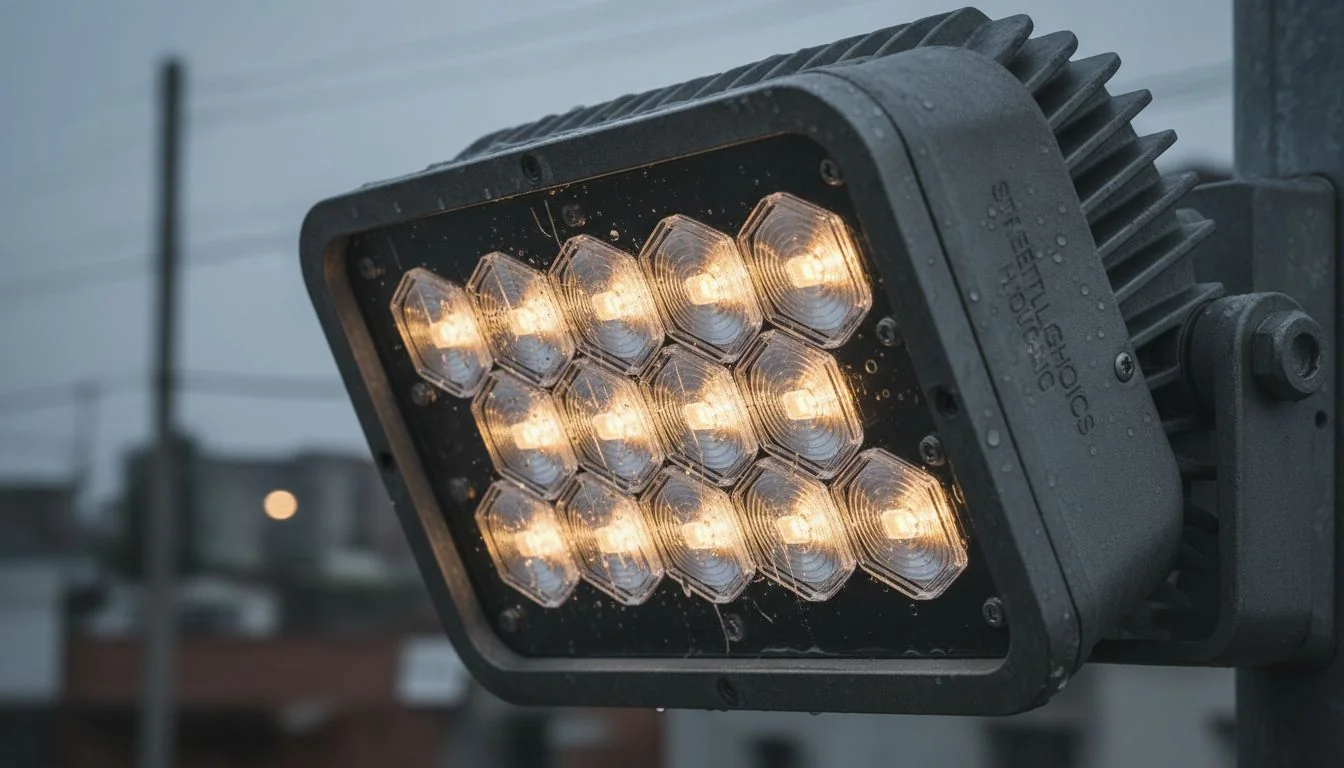
I've been in the LED lighting business for over 13 years, and I've seen countless public tenders fall short. They describe what they want but fail to specify how to prove it. This is where projects go wrong. A well-written RFQ isn't just a request for a price; it's a technical contract that protects your investment. It removes ambiguity and ensures every bidder is competing on the same level playing field. Getting these details right from the start is the single most important step you can take to ensure your street lighting project is a long-term success. Let's break down the four critical areas your RFQ must cover.
Vague RFQs are the leading cause of disputes and project failures in public lighting tenders.True
When specifications are not precise and testable, it leads to misinterpretation by suppliers, resulting in products that don't meet the client's actual needs and causing conflicts over performance and quality.
Any manufacturer can claim their product is 'durable' without providing test data.True
Terms like 'durable' or 'robust' are marketing language. Without specific IK and IP ratings from accredited labs, these claims are meaningless and unenforceable.
How Do You Specify BUG and Uplight (U0) for Your Location and Ordinances?
Light pollution is a major issue, and local ordinances are getting stricter. If you specify the wrong optics, you could face complaints, fines, and wasted energy lighting up the night sky.
To comply with local rules and prevent skyglow, you must specify a precise BUG (Backlight, Uplight, Glare) rating based on your IES Lighting Zone (LZ). For any dark-sky sensitive area, a U0 (zero uplight) rating is non-negotiable.
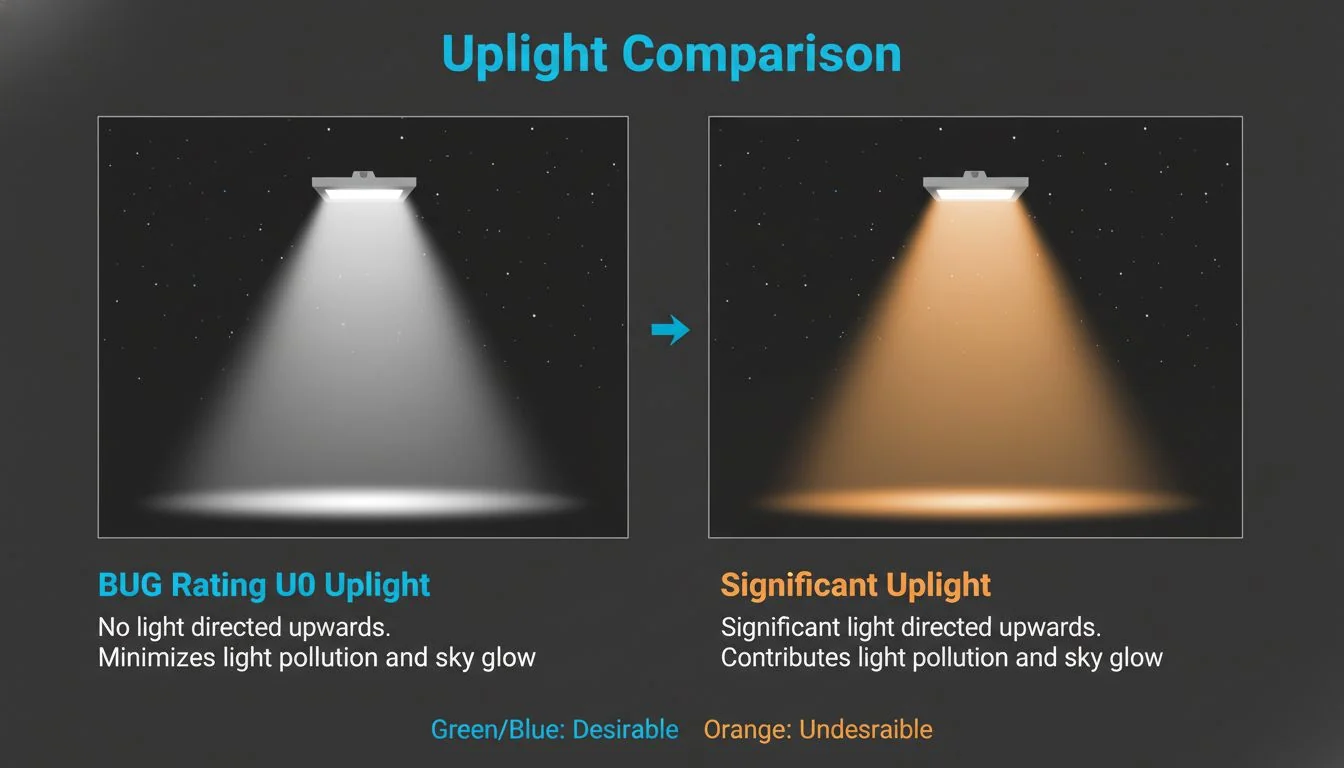
The BUG rating system, developed by the Illuminating Engineering Society (IES), is your best tool for controlling where light goes. Just saying "dark-sky friendly" is not enough. I once worked with a municipality that made this mistake. They ended up with fixtures that spilled light everywhere, and they had to spend a fortune on shields after the fact. Your RFQ must demand a specific BUG rating and require a full photometric report3 from an accredited lab to prove it. This report contains the IES file that models the light distribution, so you can see exactly how it will perform before you buy.
Matching BUG Ratings to Lighting Zones
The key is to match the BUG rating to the official Lighting Zone (LZ) of your project area.
| Lighting Zone | Description | Recommended Max BUG Rating |
|---|---|---|
| LZ0 | No ambient light (Nature reserves) | B0-U0-G0 |
| LZ1 | Low ambient light (Rural areas) | B1-U0-G1 |
| LZ2 | Moderate ambient light (Suburban) | B2-U1-G2 |
| LZ3 | Moderately high ambient light (Urban) | B3-U2-G3 |
| LZ4 | High ambient light (Dense urban centers) | B3-U3-G4 |
For any project focused on reducing light pollution, especially in LZ0, LZ1, or near residential areas in LZ2, you must specify U0. This ensures no light is wasted by being thrown directly into the sky.
A U0 rating means a fixture emits 0% of its light upwards.True
The 'U' in BUG stands for Uplight. A U0 rating is the strictest category, indicating that no direct light is emitted at or above the horizontal plane of the luminaire, which is essential for dark-sky compliance.
All street lights can be made dark-sky compliant with a simple shield.False
While shields can help, true compliance comes from the fixture's optical design. A poorly designed optic will still create glare and spill light. Specifying a U0 rating from the start is far more effective and economical.
How Do You Choose the Right Surge Protection (SPD) for Your Grid?
Power surges can instantly destroy your new LED street lights. A single grid fluctuation or nearby lightning strike can cause mass failures, leaving streets dark and forcing you to bear huge, unplanned replacement costs.
Select the ANSI C136.2 Surge Exposure Class that matches your grid's risk level. While 20kV/10kA is for high-risk areas, 10kV/5kA is a robust standard for most applications. Choosing the right level balances cost and protection effectively.
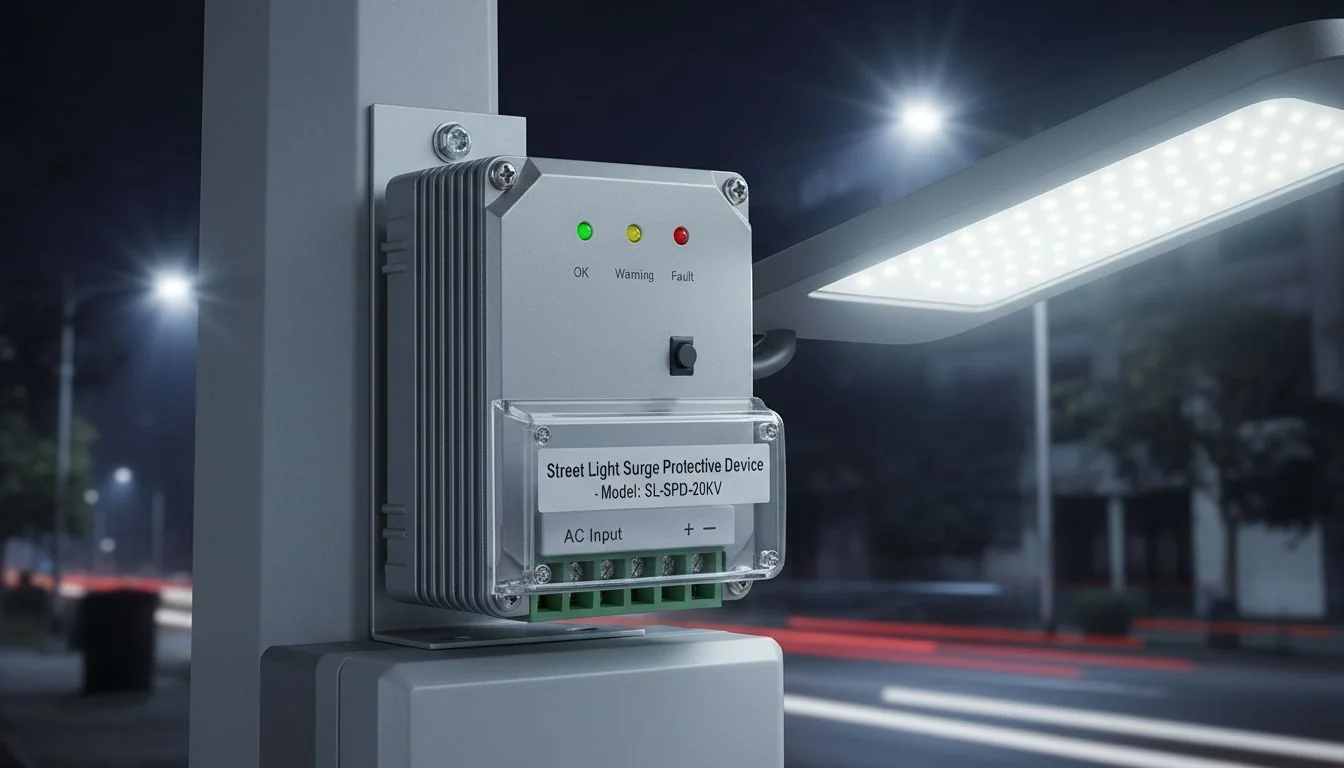
A Surge Protective Device (SPD) is like a bodyguard for your luminaire's electronics. It diverts excess voltage and current from sensitive components during a surge event. I had a client in a coastal region who tried to save a few dollars per fixture by opting for a lower 6kV SPD. The first major storm of the season wiped out nearly a third of their new lights. The cost of replacement and labor was ten times their initial savings. Don't make the same mistake. Your RFQ must specify not only the voltage (kV) but also the current (kA) rating for the SPD.
Understanding ANSI Surge Exposure Classes
The ANSI C136.2 standard provides a clear framework for this.
| ANSI Class | Surge Rating | Typical Application |
|---|---|---|
| Low Exposure | 6kV / 3kA | Areas with stable underground grids and low lightning activity. |
| Medium Exposure (B) | 10kV / 5kA | The most common specification. Good for most urban and suburban areas with overhead lines. |
| High Exposure (C) | 20kV / 10kA | High lightning areas, long overhead line runs, mountainous regions, or critical infrastructure. |
Specifying "20kV/10kA" for every project is overkill and adds unnecessary cost. Assess your location's real-world risk. If you're in an urban core with an underground grid, 10kV/5kA is likely more than enough. If you're in a rural area in Florida or along a mountain pass, 20kV/10kA is a wise investment.
A 10kV/5kA SPD can withstand a nearby lightning strike.True
While a direct strike is catastrophic, a 10kV/5kA SPD is designed to handle the induced surges from nearby lightning strikes, which are a far more common cause of failure for street lights.
All LED drivers have built-in surge protection.False
Most drivers have some basic, low-level protection (e.g., 4kV), but this is insufficient for outdoor luminaires. A separate, higher-rated SPD module is required to meet ANSI standards and provide adequate protection.
How Do You Set IK and IP Ratings for Vandalism and Weather?
Your street lights are exposed to everything: driving rain, dust storms, and even vandalism. A weak housing will fail, allowing water or dust to destroy the electronics and turning your investment into a maintenance headache.
For robust weather protection, specify a minimum of IP65, which is dust-tight and protects against water jets. For impact resistance, IK08 is a good baseline, but in areas prone to vandalism, you must require IK09 or IK10.
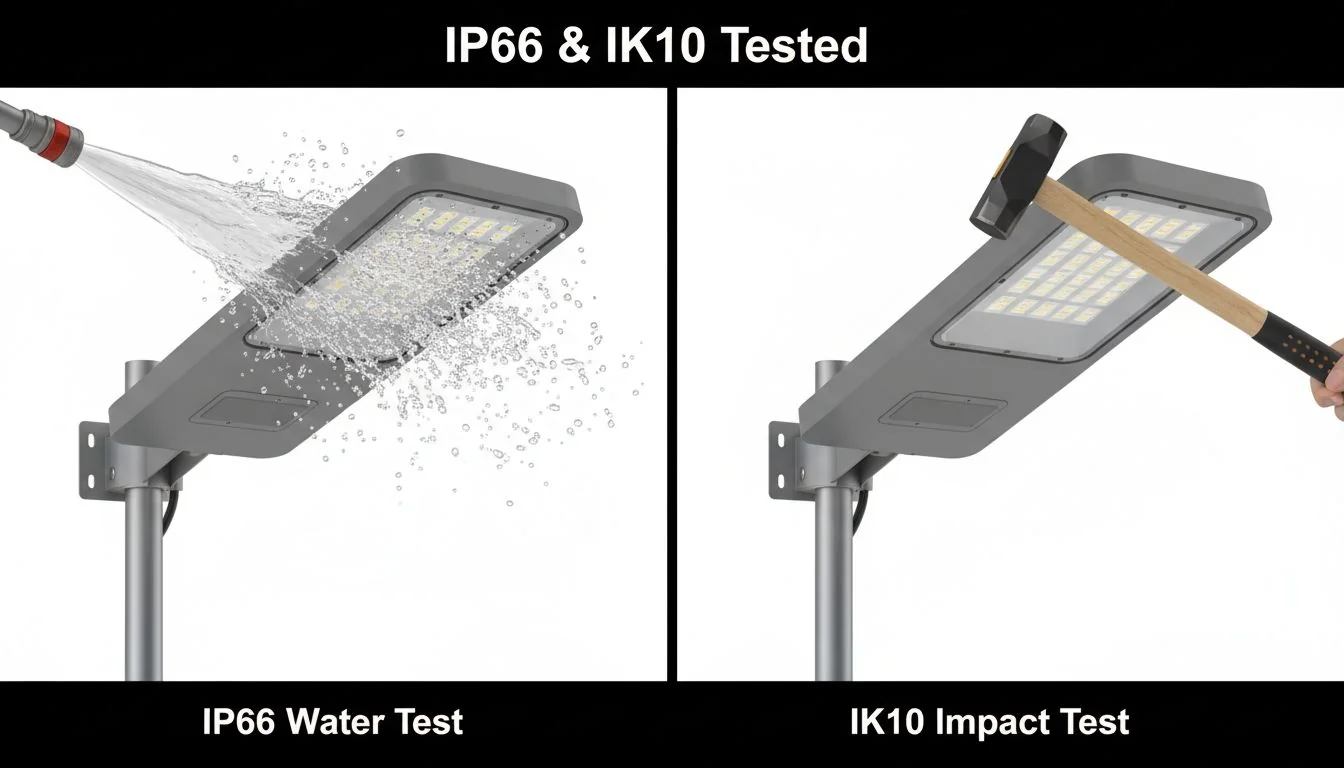
These two ratings, Ingress Protection (IP) and Impact Protection (IK), are the language of durability. They are defined by international standards (IEC 60529 and EN 62262). As a manufacturer, we test our products to these exact standards. When you specify them in your RFQ, you are setting a clear, measurable requirement for physical toughness. Don't accept vague terms like "weatherproof" or "vandal-resistant." Demand the numbers and the test reports to back them up.
Decoding IP and IK Ratings
Let's break down what these ratings mean for a street light.
IP (Ingress Protection) Ratings:
| IP Rating | Solids Protection | Liquids Protection | Best For |
|---|---|---|---|
| IP65 | Dust Tight | Protected against water jets | Standard for most outdoor applications. |
| IP66 | Dust Tight | Protected against powerful water jets | Areas with heavy rain, pressure washing. |
| IP67 | Dust Tight | Protected against temporary immersion | Locations prone to flooding. |
IK (Impact Protection) Ratings:
| IK Rating | Impact Energy (Joules) | Equivalent Impact |
|---|---|---|
| IK08 | 5 Joules | A 1.7 kg mass dropped from 300 mm. |
| IK09 | 10 Joules | A 5 kg mass dropped from 200 mm. |
| IK10 | 20 Joules | A 5 kg mass dropped from 400 mm. |
For most street and parking lot applications, IP66 and IK08 is a solid combination. However, if the lights are in a public park, an underpass, or a low-mounted application where they can be easily reached, specifying IK10 is critical to prevent damage from rocks, bats, or other impacts.
An IK10 rating means the luminaire is 'vandal-proof'.False
IK10 is the highest standard rating for impact energy resistance (20 Joules), making it highly vandal-resistant. However, no luminaire is truly 'vandal-proof' against extreme, determined force, but IK10 offers the best practical protection.
IP65 is sufficient for all outdoor lighting.False
While IP65 is a common minimum, IP66 provides better protection against high-pressure water, such as from cleaning crews or severe, wind-driven rain. The correct IP rating depends on the specific environmental conditions.
Why Must You Require Both UL Listing and DLC Qualification?
You need your lights to be safe, and you want to get money back from the utility company. Choosing an uncertified product is a major risk that can void your insurance and make you ineligible for thousands of dollars in rebates.
Require UL 1598 Listing to ensure the luminaire is safe from fire and electrical shock. At the same time, require DLC SSL or LUNA qualification to guarantee energy performance4 and unlock utility rebates, which are almost always tied to the DLC list.
This is one of the most common points of confusion I see with buyers. They think UL and DLC are interchangeable, or that one implies the other. They are completely different, and you need both. UL is about safety. DLC is about performance and efficiency. A fixture can be perfectly safe (UL Listed) but have terrible energy efficiency, meaning it won't qualify for rebates. I've seen clients lose out on a 30% project rebate because the lights they bought were UL Listed but not on the DLC Qualified Products List (QPL).
The Two Pillars of Certification: Safety and Performance
Think of them as two separate quality gates that a product must pass.
1. UL (Underwriters Laboratories) for Safety:
- What it is: A global safety certification company.
- The Standard: For luminaires, you must specify UL 1598.
- What it means: The product has been tested by an accredited lab and found to be free from foreseeable risk of fire, electric shock, and related hazards. This is critical for insurance, liability, and electrical code compliance.
2. DLC (DesignLights Consortium) for Performance & Rebates:
- What it is: A non-profit that promotes quality, high-efficiency commercial lighting.
- The Standard: Specify DLC Standard or DLC Premium for higher efficacy. For dark-sky projects, specify DLC LUNA qualification.
- What it means: The product's performance claims (lumens, wattage, color, lifespan) have been verified by an accredited lab. Being on the DLC QPL is the key to unlocking utility rebates, which can significantly lower your project's total cost.
Your RFQ must state: "Product must be UL 1598 Listed and appear on the current DLC SSL Qualified Products List. Certified test reports from an NVLAP or equivalent accredited laboratory must be submitted with the bid."
UL Listing and DLC Qualification are the same thing.False
UL Listing certifies a product's safety against fire and electrical shock. DLC Qualification verifies its energy efficiency and lighting performance claims. They are separate, independent qualifications, and both are necessary.
DLC LUNA is the new standard for all outdoor lighting.False
DLC LUNA (Light Usage for Night Applications) is a specific qualification for luminaires that meet dark-sky requirements by controlling uplight and spectral content. It is essential for dark-sky projects but not required for all outdoor applications.
FAQ
-
What is a good BUG rating for dark-sky areas?
For any dark-sky area, the most critical part of the BUG rating is U0, meaning zero uplight. A full rating like B1-U0-G1 is excellent for rural areas. -
Do all street lights need 20kV surge protection?
No. This is overkill for many locations. A 10kV/5kA SPD is a robust standard for most urban and suburban grids. 20kV/10kA is reserved for high-risk areas. -
Is IK10 enough for vandal resistance?
Yes. IK10 is the highest level in the standard EN 62262 scale, representing protection against 20 Joules of impact energy. It is considered highly vandal-resistant for practical purposes. -
Which IP rating is standard for street lights?
IP65 is the minimum standard, ensuring the fixture is dust-tight and can withstand water jets. IP66 is becoming more common as it offers superior protection against powerful jets and harsh weather. -
Why specify DLC and UL together?
You need both for a successful project. UL ensures the product is safe and meets electrical codes. DLC ensures it is energy-efficient and qualifies you for utility rebates.
Conclusion
A detailed RFQ with precise BUG, SPD, IK/IP, and certification requirements is your best tool to ensure project success, secure rebates, and prevent costly disputes down the road.
References
-
Understanding dark-sky friendly lighting is essential for reducing light pollution and enhancing night skies. ↩
-
Learn about BUG ratings to effectively manage light pollution and ensure compliance with local ordinances. ↩
-
A photometric report provides essential data on light distribution, crucial for effective lighting design. ↩
-
Explore how energy performance metrics impact efficiency and cost savings in lighting projects. ↩