How do heatsink & LED package impact life?

Your LED fixtures are failing too soon, costing you money and damaging your reputation. You need a solution that ensures long-term reliability for your commercial and industrial projects.
A high-quality heatsink and robust LED package are critical for a long L70 lifetime. They work together to pull heat away from the LED chip. If they fail, the chip overheats, causing rapid light loss, color shift, and premature failure of the entire fixture.
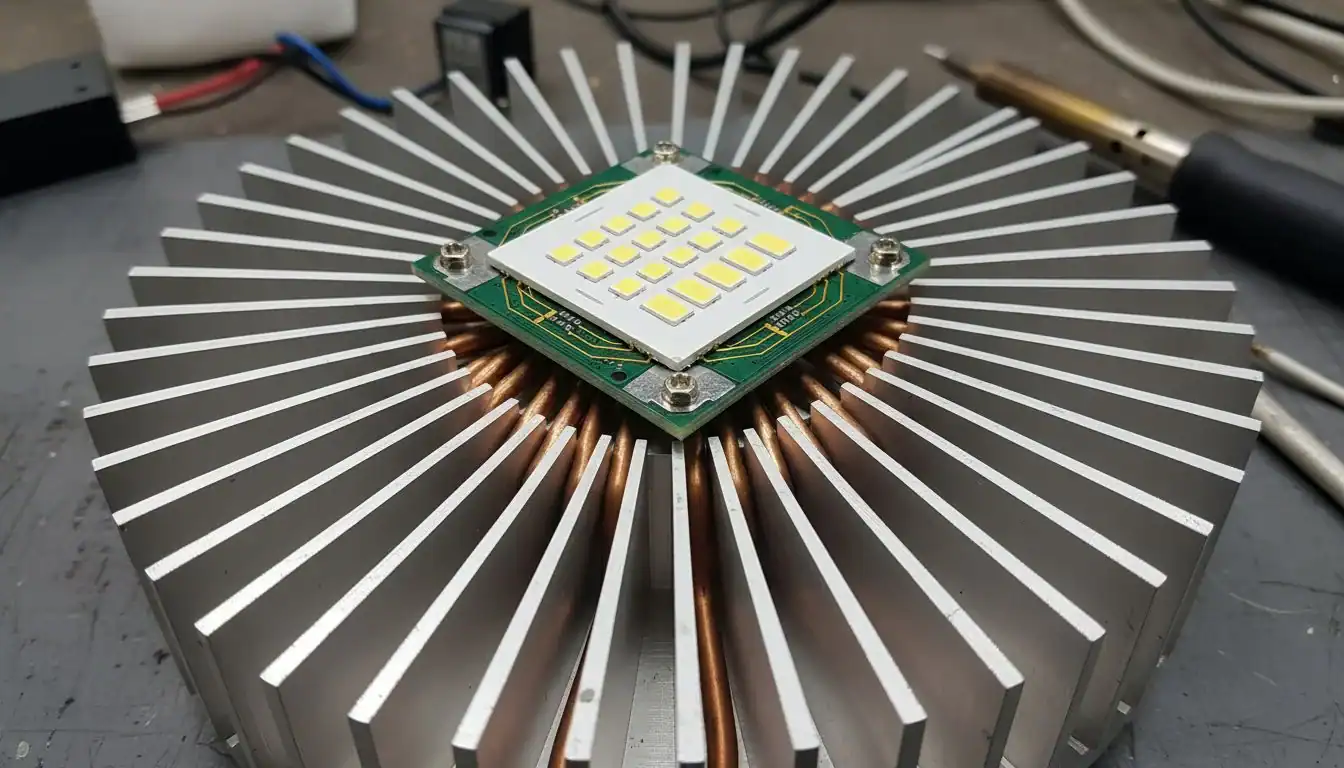
I've been in the LED lighting business for over 13 years, and I've seen countless projects succeed or fail based on one thing: thermal management1. It’s not just about buying a fixture with a big heatsink. The real story is in the details of how heat travels from the tiny LED chip out into the world. Understanding this journey is the first step to sourcing products that last, protecting your investment and satisfying your clients. Let's break down exactly how heat becomes the number one enemy of LED life and what you can do about it.
Keeping an LED's junction temperature below 85°C can double its L70 lifetime compared to running it at 105°C.True
According to studies by the Department of Energy and LED manufacturers, the rate of lumen depreciation is exponentially related to junction temperature. A 20°C drop can significantly slow this degradation process.
All LED power is converted into light.False
Modern LEDs are efficient, but not perfect. Typically, 60-95% of the electrical energy input is converted directly into heat, not visible light. This waste heat must be managed.
From junction to ambient: the thermal path that sets LED life?
leading paragraph:
Confused by technical terms like "junction temperature2" and "thermal resistance"? This jargon makes it hard to choose reliable fixtures. Let's make it simple and clear.
snippet paragraph:
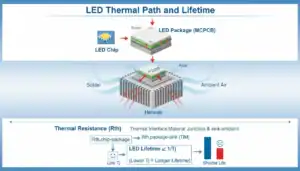
The thermal path is the route heat must travel from the LED chip (the junction) to the outside air (the ambient). Every layer in this path, like the circuit board and heatsink, adds resistance. High resistance traps heat, raising the junction temperature and shortening the LED's life.

Dive deeper Paragraph:
In my experience, the most reliable projects are built on a solid understanding of this thermal path. It’s a chain, and it's only as strong as its weakest link. Think of it as a highway for heat. If there's a traffic jam anywhere along the route, everything backs up.
The Critical Temperatures: Tj and Ta
- Tj (Junction Temperature): This is the temperature right at the LED chip itself. It's the single most important factor for LED lifetime. We always aim to keep Tj at or below 85°C for our clients' projects to ensure a long L70 life.
- Ta (ambient temperature3): This is the temperature of the air surrounding the fixture. A high-bay in a hot warehouse in South Asia will have a much higher Ta than a pole light in a Canadian winter.
The Path Heat Must Travel
Heat flows from hot to cold, moving from the Tj to the Ta through several layers. Each layer has a thermal resistance4 (Rth), which measures how much it resists heat flow.
| Layer | Material Example | Role in Heat Transfer |
|---|---|---|
| LED Junction | Semiconductor Chip | The source of all the heat. |
| Solder/Die Attach | SAC305 Solder | Connects the chip to the circuit board. A poor solder joint creates a major bottleneck. |
| MCPCB | Metal Core PCB | Spreads heat from the small chip over a larger area. |
| TIM | Thermal Grease/Pad | Fills microscopic air gaps between the PCB and the heatsink. Air is a terrible conductor. |
| Heatsink | Aluminum ADC12 | Dissipates the heat into the surrounding air. |
A low total thermal resistance is the goal. When we design custom solutions for clients, we analyze every one of these layers to guarantee the heat has a smooth, easy path out.
Thermal Interface Material (TIM) is optional for good performance.False
Even perfectly flat metal surfaces have microscopic air gaps. Since air is a thermal insulator, TIM is essential to fill these gaps and ensure efficient heat transfer from the PCB to the heatsink.
The LED chip itself is the hottest part of the entire fixture.True
The semiconductor junction is where the energy conversion (and heat generation) happens. All other thermal management components are designed to cool this specific point.
Package materials that fail first: silicone, phosphor, lenses, and moisture?
leading paragraph:
You might think the LED chip is the weak link. But often, it's the materials around the chip that degrade first, causing failures you never saw coming.
snippet paragraph:
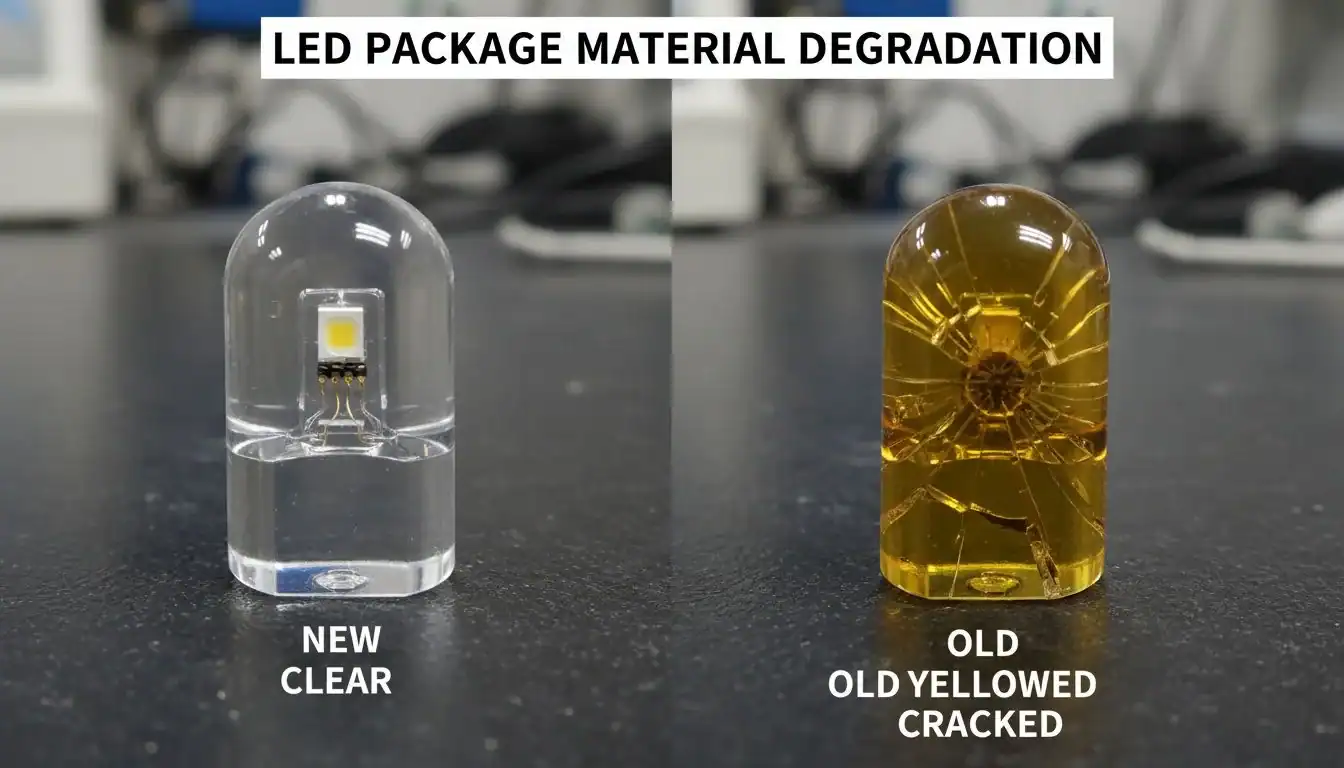
Yes, the LED package materials5 are frequently the first point of failure. High heat and humidity cause silicone encapsulants and phosphor layers to crack, yellow, or delaminate. This results in major light loss, color shifts, and failure long before the LED chip itself dies.
Dive deeper Paragraph:
The LED chip itself is incredibly durable. I've seen chips that could theoretically last for 200,000 hours. But the fixture fails at 40,000 hours. Why? The problem is almost always the packaging that protects the chip. These materials are the unsung heroes, but also the first victims of heat and environmental stress.
Silicone and Phosphor Degradation
Most white LEDs use a blue chip coated with a yellow phosphor mixed into a silicone base. This silicone is a polymer. At high temperatures (above 85°C), the long polymer chains in the silicone start to break down. The material becomes brittle, cracks, and turns yellow.
- Yellowing: A yellowed encapsulant absorbs blue light, which shifts the color of the light to a warmer, dimmer yellow and reduces overall lumen output.
- Cracking: Cracks can expose the chip and its delicate wire bonds to moisture and contaminants, leading to a sudden, catastrophic failure.
Lens and Optic Failures
The lenses that shape the light are also vulnerable. While glass is very stable, most commercial fixtures use polymers like polycarbonate (PC) or acrylic (PMMA) for cost and weight. High heat and UV exposure from the sun (for outdoor lights) or even from the LED chip itself can cause these lenses to yellow and become hazy, trapping light and ruining the beam distribution.
Moisture: The Silent Killer
For my clients with projects in humid regions like Southeast Asia or Latin America, moisture is a huge concern. Water vapor can slowly work its way through tiny gaps in the fixture's seals. Once inside, it can condense on the electronics, causing corrosion, or be absorbed by the package materials, accelerating their breakdown. This is why an IP65 or higher rating is non-negotiable for outdoor and industrial applications.
LEDs do not produce any UV light.False
While the primary output is visible light, some high-power blue-pump LEDs can emit a small amount of near-UV radiation, which can contribute to the degradation of less-stable polymer optics and encapsulants over time.
The phosphor layer in a white LED converts blue light into yellow light.True
White LEDs are typically blue LEDs coated with a phosphor. The phosphor absorbs some of the blue light and re-emits it as yellow light. Our eyes perceive the mix of blue and yellow light as white.
Heatsink sizing that actually works: materials, fins, surface area, and finish?
leading paragraph:
Is a bigger heatsink always the answer? Not always. Choosing the wrong material or a poor design is an expensive mistake that might not even solve your heat problem.
snippet paragraph:
An effective heatsink is a balance of the right material, maximum surface area, smart fin design, and a proper finish. Aluminum is standard, but the grade matters. More fins create more surface area for cooling. A dark, matte finish radiates heat far better than a shiny one.

Dive deeper Paragraph:
The heatsink is the final and most visible part of the thermal path. Its job is to take all the concentrated heat from the PCB and release it into the air. As a supplier, this is where we can add huge value through smart design and material selection. A well-designed heatsink can lower Tj by 10-20°C, which can double the fixture's useful life.
Material: Not All Aluminum is Equal
- Die-Cast Aluminum (e.g., ADC12): Great for complex shapes and very cost-effective for high-volume production. It's the workhorse for many of our wall packs and floodlights. However, its thermal conductivity is good, but not the best.
- Extruded Aluminum (e.g., 6063-T5): This has superior thermal conductivity compared to die-cast. It's perfect for linear shapes like high bays and pole lights. The extrusion process allows for complex fin designs optimized for airflow.
Surface Area is King
The single most important factor for a heatsink is surface area. The more surface area in contact with the air, the faster the heat can escape. We increase surface area by adding fins. However, there's a balance. If fins are too close together, they trap air and prevent convection, making the heatsink less effective. For a large warehouse project, we designed a custom extruded heatsink that was 15% lighter but had 30% more effective surface area than the off-the-shelf option, all while meeting the project's budget.
Finish Matters More Than You Think
A black, matte surface is a much better radiator of thermal energy than a bare, shiny one. This property is called emissivity. A powder-coated or anodized black finish can improve a heatsink's performance by 5-10% just by radiating heat more effectively.
A shiny, polished aluminum heatsink is best because it reflects heat away.False
This is a common misconception. A heatsink needs to radiate (emit) heat, not reflect it. A dark, matte surface has high emissivity and radiates heat much more effectively than a shiny, low-emissivity surface.
Heatsinks cool primarily through conduction.False
A heatsink uses conduction to move heat through its own body, but it dissipates that heat into the environment primarily through convection (transfer to moving air) and radiation (emission of thermal energy).
Predicting lifetime the right way: using LM-80 data + TM-21 extrapolation?
leading paragraph:
Are you tired of vague "50,000-hour lifetime" claims on spec sheets? These numbers are often meaningless without context. There is a standardized way to get real, reliable predictions.
snippet paragraph:
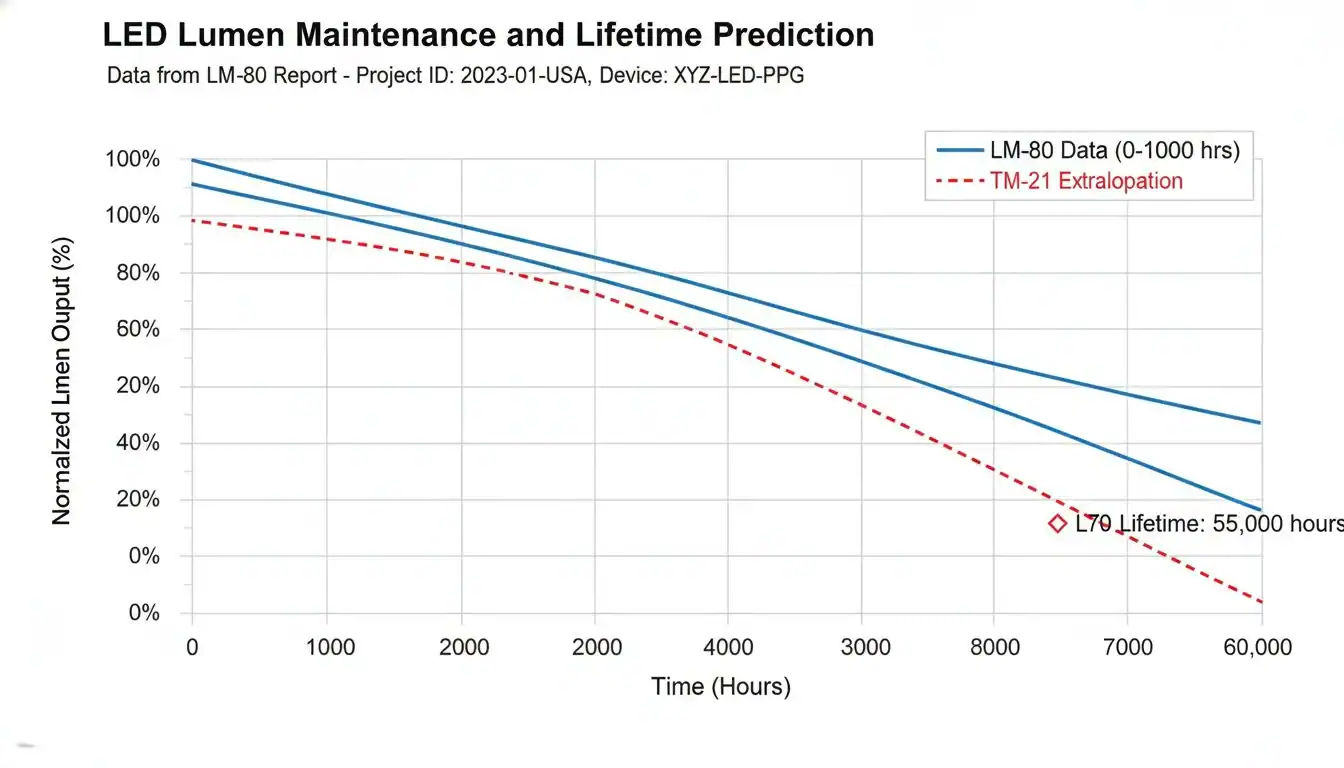
To predict lifetime accurately, you must use LM-806 test reports. These reports provide real-world lumen maintenance data for an LED over thousands of hours at specific temperatures. You then use the TM-21 calculation method to extrapolate this data and predict the true L70 lifetime.
Dive deeper Paragraph:
As a procurement director or developer, you need to be able to trust the lifetime ratings you're given. Vague promises don't help when a project's reputation is on the line. That's why my team at Besenled always provides transparent data based on industry standards. The two most important standards are LM-80 and TM-217.
What is LM-80?
LM-80 is a standard from the Illuminating Engineering Society (IES) that dictates how to test the lumen depreciation8 of an LED package. A certified lab runs the LEDs for at least 6,000 hours (often 10,000 hours) at three different case temperatures (e.g., 55°C, 85°C, and a third, higher temperature). They measure the light output at regular intervals. The result is an LM-80 report, which is a set of real data, not a marketing claim. It shows you exactly how that specific LED performs under heat.
What is TM-21?
No one can wait 50,000 hours to test a product. So, we use the TM-21 method to make a projection. This is a mathematical formula, also from the IES, that takes the real data from the first 6,000-10,000 hours of an LM-80 test and extrapolates it into the future. Crucially, TM-21 has a rule: you can only project a maximum of 6 times the LM-80 test duration. So, a 10,000-hour test allows for a 60,000-hour projection. This prevents unrealistic claims of 100,000+ hours from short-term tests.
When you ask a supplier for lifetime data, don't just accept a number. Ask for the LM-80 report for the LEDs used and the TM-21 calculation based on the fixture's actual operating temperature. This is the only way to make a true, apples-to-apples comparison.
A 50,000-hour L70 rating is a guarantee the product will work for 50,000 hours.False
L70 only refers to lumen depreciation. It does not cover catastrophic failure of the driver or other components. The actual service life of the fixture can be shorter if other parts fail before the LEDs dim to 70%.
TM-21 can be used to predict the lifetime of any LED, even without an LM-80 report.False
The TM-21 calculation method is entirely dependent on having valid test data from an LM-80 report. Without the initial data points from a standardized test, any projection is just a guess.
Frequently Asked Questions about LED Lifetime?
leading paragraph:
Still have some questions about LED lifetime? You're not the only one. Misinformation is everywhere. Let's clear up the most common points of confusion for good.
snippet paragraph:
This FAQ section directly answers your key questions. We cover what L70 means, how heatsinks impact life, why LEDs fail, how much power becomes heat, the role of package materials, and the standards for reporting lifetime, giving you clear and actionable information.
Dive deeper Paragraph:
Over my years in this industry, I get asked the same questions again and again by clients. These are important questions that show a deep concern for quality and long-term value. Here are the straight answers to the most common ones.
What is L70 and how is it calculated?
L70 is the point in time when an LED is projected to produce 70% of its initial light output. It is considered the end of its "useful life" for most commercial applications. It is calculated by taking lumen maintenance data from a standardized LM-80 test and using the TM-21 mathematical model to project that data into the future.
Does the heatsink really change LED lifetime?
Yes, absolutely. It is one of the most critical factors. A poor heatsink fails to remove heat effectively, causing the LED's junction temperature (Tj) to rise. Higher Tj directly accelerates lumen depreciation, meaning the L70 lifetime will be much shorter. A good heatsink is a direct investment in longevity.
Why do LEDs still fail if chips last “forever”?
The semiconductor chip is extremely robust. However, the complete "LED" is a system. Failure is almost always caused by the components around the chip: the driver electronics can fail, the silicone package can yellow and crack, the phosphor can degrade, or the solder joints can break from thermal stress.
How much of LED power becomes heat?
A surprising amount. Even a highly efficient LED only converts about 30-40% of electrical power into visible light. The remaining 60-70% is lost directly as heat. For less efficient LEDs, this number can be as high as 95%. All of this heat must be managed.
Do package materials limit lifetime?
Yes, they are often the primary limiting factor. The silicone encapsulants, phosphor coatings, and plastic lenses are far more sensitive to heat and humidity than the LED chip itself. Their degradation is a leading cause of light loss, color shift, and premature failure.
Are there standards for reporting LED life?
Yes. The Illuminating Engineering Society (IES) provides the key standards. LM-80 is the standard for testing lumen maintenance of LED components. TM-21 is the standard for projecting that test data to calculate L70 lifetime. Reputable manufacturers like Besenled always use these standards to report lifetime.
L90 means an LED has lost 90% of its light.False
The number in 'Lxx' refers to the percentage of remaining lumens. L90 means the LED still produces 90% of its initial light output. L70 means it produces 70%.
The LED driver's lifetime is just as important as the LED's L70 rating.True
The driver is a complex electronic power supply and often has its own lifetime rating based on the lifespan of its components, like electrolytic capacitors. If the driver fails, the entire fixture goes dark, regardless of how much life the LEDs have left.
Conclusion
Managing heat is everything for LED longevity. A well-designed thermal path, from the package to the heatsink, is the key to achieving long, reliable performance and protecting your project's value.
References
-
Understanding thermal management is crucial for ensuring LED longevity and performance. ↩
-
Junction temperature is a key factor in LED performance; learn how to manage it effectively. ↩
-
Ambient temperature plays a significant role in LED efficiency; learn how to manage it. ↩
-
Thermal resistance impacts heat flow; knowing this helps in selecting better LED fixtures. ↩
-
The choice of LED package materials affects durability; learn about the best options available. ↩
-
The LM-80 standard provides essential data for predicting LED lifespan; it's vital for informed decisions. ↩
-
TM-21 is crucial for understanding LED longevity predictions; explore its methodology. ↩
-
Understanding lumen depreciation helps in selecting long-lasting LED products; find out more. ↩