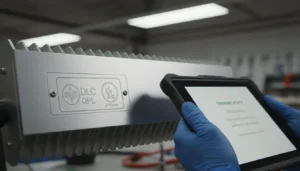
Your project is specified, the luminaires are certified, and rebates are approved. But a simple firmware update could void your certifications, causing costly delays and jeopardizing the entire project.
**Yes, [firmware updates](https://infinity-ex.com/firmware-updates-without-losing-certifications/ "infinity-ex.com")[^1] can absolutely affect your DLC listing or UL mark. You must treat firmware like a hardware change. Any update that alters performance—like light output, color, or energy use—requires re-evaluation and potentially new testing to maintain your certification and ensure utility rebates remain valid.**

I remember a project we supplied for a large warehouse in North America. The client was thrilled with the initial installation. A few months later, their team pushed a driver firmware update designed to improve dimming performance. They didn't realize it slightly increased the minimum power draw. When the utility company did a random audit, the fixtures failed the approved power consumption specs, and a six-figure rebate was suddenly at risk. It was a stressful lesson in why documentation and process matter. Navigating the web of certifications, from DLC and UL to DALI and Zhaga, isn't just about ticking boxes; it's about protecting your investment and reputation. Let's break down these critical details so you can avoid these pitfalls.
Any firmware update on a DLC-listed product automatically voids its certification.False
Not all updates void certification. Only those that affect photometrics, electrical performance, or other critical parameters require re-evaluation. Minor bug fixes may not, but they must still be documented.
Treating firmware changes with the same rigor as hardware changes is a best practice for maintaining certifications.True
Certification bodies like DLC and UL consider firmware integral to a product's performance and safety. A formal change-control process is essential for compliance.
## Will firmware updates affect my DLC listing or UL mark?
You've just received a notification for a critical firmware patch for your installed luminaires. Pushing the update seems like a simple fix, but doing so could invalidate your product's UL safety mark or DLC performance listing, putting your entire project's compliance and rebates in jeopardy.
Yes, firmware updates can impact both DLC and UL certifications. You must treat firmware as a critical component, just like a hardware change. Document every update, assess its impact on safety (UL) and performance (DLC), and be prepared to re-certify if key parameters like power consumption or light output change.

When I work with clients like Somchai, a developer in Thailand who manages massive commercial projects, this is a topic I emphasize. For him, a product's certification is non-negotiable. A lost certification means a failed government inspection or a lost tenant. That's why we at Besenled have a strict protocol. Think of firmware not as abstract code, but as the brain that controls the luminaire's physical behavior.
### The "Hardware" Mindset for Software
Firmware directly controls the electrical and photometric performance of a luminaire. A change in the code can alter the drive current, which affects lumen output and efficacy. It can change the dimming curve, power factor, or even the spectral power distribution (SPD). From a certification standpoint, if the performance changes, the product is no longer the same one that was tested. That's why you must lock firmware versions at the time of shipment and tag that specific version on your DLC Qualified Products List (QPL) submission.
### Your Safety Net: A Change-Control SOP
A standard operating procedure (SOP) for change control is your best defense. It ensures nothing slips through the cracks. Here’s a simple process:
1. **Log the Change:** Document the new firmware version and the reason for the update.
2. **Assess the Impact:** Determine if the change affects any certified parameter.
3. **Test and Verify:** If performance is affected, you must get new test evidence.
4. **Update Certifications:** Submit the new test data (e.g., LM-79 report) to the DLC or notify UL.
Here’s a quick guide on when to re-test:
| Firmware Change Type | Potential Impact | Action Required |
| :--- | :--- | :--- |
| Minor bug fix (e.g., communication glitch) | None on performance | Document internally; notify cert body if required. |
| Adjusts dimming curve or timing | Power consumption, flicker | Assess impact, may require new testing. |
| Alters output, spectrum, or efficacy | Lumen output, CCT, power | **Mandatory:** Re-run LM-79, update DLC tables. |
| Adds a new control feature | Functionality, power draw | Assess impact, notify cert body. |
UL certification is only concerned with electrical safety and not firmware.False
UL evaluates any component, including firmware, that can affect the safety of the product. A firmware change that could lead to overheating or electrical instability would require a re-evaluation by UL.
You must maintain a change-control log mapping each firmware delta to its certification impact.True
This is a core requirement for maintaining compliance. It provides a clear audit trail for you, your clients, and certification bodies, proving due diligence.
## How do I read DLC status: Standard vs Premium and LUNA?
You're looking at the DLC Qualified Products List (QPL), but the different status levels are confusing. Choosing a "Standard" product when "Premium" was needed could mean losing out on thousands in utility rebates, while ignoring "[LUNA](https://designlights.org/our-work/luna/technical-requirements/luna-v1-0/ "designlights.org")[^2]" could violate local lighting ordinances.
DLC Standard is the baseline for certified energy efficiency. Premium demands higher efficacy and better control capabilities (like dimming) for maximum rebates. LUNA (Lighting for the Night and Environment) is a special designation for outdoor fixtures designed to minimize light pollution and protect nocturnal ecosystems.

Understanding these tiers is crucial for maximizing project value. For a budget-conscious warehouse project, DLC Standard might be enough. But for a high-profile corporate campus in North America aiming for LEED certification and the highest possible energy savings, DLC Premium is the only way to go. Then there's LUNA, which is becoming a mandatory requirement in many environmentally conscious communities.
### Decoding the DLC Tiers
The DLC's tiered system helps specifiers quickly identify products that meet their project's specific needs for efficiency, quality, and controllability.
* **DLC Standard:** This is the entry-level certification. Products must meet a baseline efficacy (lumens per watt), have a minimum warranty, and provide basic performance data. It guarantees a good level of energy efficiency over non-listed products.
* **DLC Premium:** This is the top tier for performance and energy savings. Products must achieve a significantly higher efficacy, offer dimming capabilities, and meet stricter lumen maintenance requirements. Specifying Premium often unlocks the highest utility rebates.
### What is LUNA?
LUNA is not a separate tier but a technical requirement focused on "dark sky" compliance. To qualify, an outdoor luminaire must:
* Have a Correlated Color Temperature (CCT) of 3000K or less.
* Minimize uplight and light trespass.
* Be dimmable and controllable.
This helps reduce sky glow and is critical for projects near residential areas, parks, or natural habitats.
| DLC Tier / Spec | Key Requirement | Best For |
| :--- | :--- | :--- |
| **Standard** | Baseline efficacy (e.g., ≥120 lm/W) | Projects needing basic certified performance and standard rebates. |
| **Premium** | Higher efficacy (e.g., ≥140 lm/W), dimmable | Maximizing utility rebates and achieving top-tier energy savings. |
| **LUNA** | CCT ≤ 3000K, specific light distribution | Environmentally sensitive areas, municipalities with dark-sky ordinances. |
A common question I get is, "Does LUNA reduce allowable efficacy?" The answer is nuanced. The LUNA requirements themselves don't lower the efficacy bar, but achieving high efficacy with a lower CCT (like 3000K) is technically more challenging than with a cooler CCT (like 5000K). So, a LUNA-compliant product might have a slightly lower efficacy than the highest-performing Premium product, but it still meets a rigorous standard while providing significant environmental benefits.
LUNA is a separate certification from DLC Standard or Premium.False
LUNA is a set of technical requirements that can be applied to products listed under DLC Standard or Premium. It is a designation for dark-sky-friendly performance, not a standalone tier.
DLC Premium products always provide a better return on investment than DLC Standard products.True
While the initial cost may be slightly higher, the combination of increased energy savings over the product's lifetime and larger upfront utility rebates typically results in a faster payback and higher overall ROI for Premium products.
## DALI‑2, D4i, and Zhaga Book 18: what should I specify?
You're trying to specify a smart lighting system, but the jargon is overwhelming. Choosing the wrong combination of DALI, [D4i](https://www.dali-alliance.org/news/504/d4i-explained-in-new-video-from-the-dali-alliance "dali-alliance.org")[^3], and Zhaga can lead to incompatible components, extra wiring on-site, and a system that fails to deliver the promised smart functionality.
For maximum value, specify [DALI-2](https://www.dali-alliance.org/data/downloadables/3/2/7/diia-pwgtw020a_benefits-of-dali-for-lighting.pdf "dali-alliance.org")[^4] for interoperable control, ensure the driver is D4i-certified for standardized power and data, and choose the right socket: Zhaga Book 18 for compact nodes in urban settings or NEMA for traditional highway applications.

This is the core of future-proofing your lighting assets. When I advise developers on smart city projects, I tell them to think in layers. DALI-2 is the language, D4i is the data pipeline, and Zhaga is the physical connection. Getting them right means you can swap out a control node from one brand with another ten years from now without having to replace the entire luminaire.
### The Foundation: DALI-2 and D4i
* **DALI-2:** This is the latest version of the DALI lighting control protocol. Its key benefit is **certified interoperability**. If you have a DALI-2 certified controller and a DALI-2 certified driver, they are guaranteed to work together. This eliminates the risk of vendor lock-in.
* **D4i:** This is an extension of DALI-2 specifically for intra-luminaire communication. A D4i-certified driver provides standardized data and power. This includes:
* **Energy Data (Part 252):** Real-time power and energy consumption.
* **Diagnostics Data (Part 253):** Driver temperature, operating hours, start counters.
* **Auxiliary Power (24V):** A standardized power supply for control nodes, eliminating the need for external power supplies.
### Choosing the Right Socket: Zhaga vs. NEMA
The socket is the physical interface for your control node.
* **[Zhaga Book 18](https://chi-swear.com/what-is-the-zhaga-book-18-standard-and-how-is-it-used-in-smart-city-sensors/ "chi-swear.com")[^5]:** A compact, standardized socket ideal for modern, low-profile luminaires in urban and commercial areas. It's designed from the ground up to work with D4i, creating a true plug-and-play ecosystem.
* **NEMA C136.41:** The traditional 7-pin twist-lock receptacle. It's larger and more robust, often preferred for highway lighting where higher-power photocells or legacy systems are still in use.
A common question is whether a Zhaga-D4i luminaire is certified as a whole. Yes, and that's its biggest advantage. The Zhaga-D4i certification program verifies that the luminaire, D4i driver, and Zhaga socket all work together seamlessly, creating an interoperable platform.
D4i is a replacement for DALI-2.False
D4i is a certification program and an extension of the DALI-2 standard. It builds on DALI-2 by adding specifications for power and data within the luminaire, but it requires DALI-2 as its foundation.
Specifying a luminaire with a D4i driver and a Zhaga Book 18 socket future-proofs the installation.True
This combination creates a standardized, plug-and-play ecosystem. It allows for easy upgrades and replacement of control nodes in the future, regardless of the manufacturer, protecting the long-term value of the lighting infrastructure.
## Are standards bodies converging for smart street lighting?
The landscape of lighting standards is fragmented, with different bodies governing different parts of the system. This creates confusion for specifiers and integration risks for contractors, slowing down the adoption of smart city technologies and increasing project complexity.
Yes, key standards bodies are actively converging to simplify smart lighting. The partnership between the DALI Alliance (D4i) and the Zhaga Consortium (Book 18) is the leading example, creating a unified, certified ecosystem for smart outdoor luminaires that makes specification and deployment easier than ever.

This collaboration is a huge step forward for the industry. For years, we had to piece together solutions, hoping a driver from one company would talk to a controller from another. Now, when I see the Zhaga-D4i logo on a luminaire, I can tell my clients with confidence that the components are guaranteed to be interoperable. It removes the guesswork and significantly de-risks the project.
### The Zhaga-D4i Partnership: A Game Changer
This joint certification program is the backbone of the new plug-and-play standard for smart outdoor lighting.
* **Zhaga** defines the physical fit: the standardized Book 18 socket that ensures any certified node will connect to any certified luminaire.
* **D4i** defines the electrical and data interface: it ensures the driver can power the node and that they can communicate using a common language to share diagnostics and energy data.
For a procurement director like Somchai, this means he can source Zhaga-D4i luminaires from Besenled and control nodes from a local specialist in Thailand, knowing they will work together perfectly.
### The Role of Firmware Updates in a DALI System
This convergence also simplifies maintenance. A frequently asked question is, "Can a DALI-2 controller update other devices’ firmware?" The answer is yes, provided the controller and the device (like a driver) support the **IEC 62386-105** standard for Firmware File Transfer. This allows a central management system (CMS) to securely deploy patches and feature upgrades to thousands of luminaires remotely, a critical feature for managing large-scale smart city infrastructure. We ensure our DALI-2 compatible systems support this to offer maximum long-term flexibility.
This trend is about creating an open, competitive, and innovative market, which benefits everyone from manufacturers like us to the end-users managing the infrastructure.
The Zhaga-D4i certification is only for outdoor lighting.True
Currently, the joint Zhaga-D4i certification program is focused on outdoor and industrial applications, using the Zhaga Book 18 and Book 20 receptacles for connecting sensors and communication nodes to luminaires.
Convergence of standards leads to higher costs for consumers due to licensing fees.False
On the contrary, convergence fosters competition by creating an open market. It reduces R&D costs for manufacturers, simplifies integration, and drives down prices for consumers by preventing vendor lock-in.
## Conclusion
Mastering certifications is key to project success. Treat firmware like hardware, understand DLC tiers to maximize rebates, and specify Zhaga-D4i to build future-proof, interoperable smart lighting systems.
---
## References
[^1]: Understanding the impact of firmware updates is crucial for maintaining certifications and avoiding costly project delays.
[^2]: LUNA focuses on minimizing light pollution; understanding it is crucial for environmentally conscious projects.
[^3]: D4i provides standardized data and power, improving the efficiency and functionality of lighting systems.
[^4]: DALI-2 ensures interoperability in smart lighting, making it easier to manage and upgrade systems over time.
[^5]: Zhaga Book 18 standardizes connections, ensuring compatibility and future-proofing lighting installations.